Business of Medicine | When Care Breaks Down: A Case Study

Malpractice claims often involve multiple failures. In the following case study, failure to follow evidence-based guidelines and lapses in communication and documentation led to permanent and debilitating patient injury.
The Patient
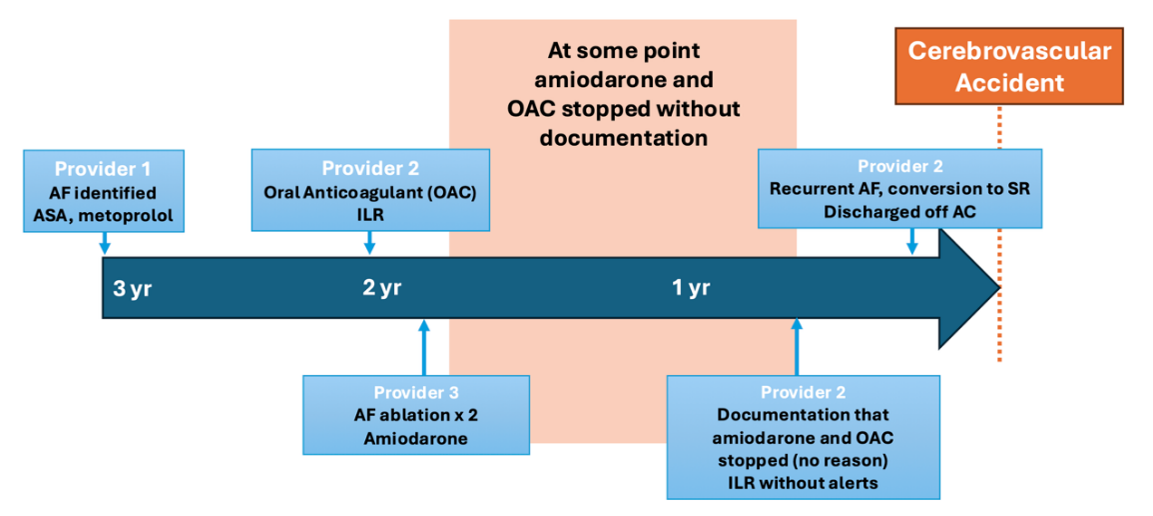
The patient, with type 2 diabetes, hyperlipidemia, hypertensive heart disease and obesity, presented with a middle cerebral artery cerebrovascular accident (CVA) (Figure 1). Three years earlier, the patient developed atrial fibrillation (AFib) and was treated with metoprolol and aspirin. The next year, a new cardiologist initiated an oral anticoagulant (OAC) and inserted an implantable loop recorder (ILR); a third physician later performed an AFib ablation.
After recurrent AFib developed within a month, the cardiologist started amiodarone and the patient underwent repeat ablation. One year later, the patient was off OAC and amiodarone with no ILR alerts, but the rationale for that strategy was not documented.
The patient subsequently returned with recurrent AFib, converted to sinus rhythm after intravenous amiodarone and was discharged without OAC therapy.
Several days later, the patient presented to the emergency department with a CVA.
Figure 1: Time Course of Patient Care
Case Discussion
The plaintiff alleged the cardiologist was negligent by discontinuing anticoagulation in a patient with AFib, resulting in a stroke and permanent neurological injuries. Defense experts did not support the cardiologist's care. The cardiologist stated in an interview with legal counsel the patient was informed of the stroke risks when stopping anticoagulants, but this was not documented. The case settled on behalf of the cardiologist for a high dollar amount.
Risk Management Strategies
- Follow guideline recommendations. Recent studies such as OCEAN AF1 and ALONE AF2 suggest anticoagulation discontinuation and using aspirin may be feasible after a successful ablation in selected patients. However, the ACC/AHA/HRS guideline3 recommends anticoagulation regardless of AFib burden or prior therapy. A higher risk for stroke is likely clustered around AFib episodes. In a claims database study of nearly 500,000 patients with AFib episodes >5.5 hours, stroke risk was fivefold higher in the first five days after return to sinus rhythm in patients not on anticoagulation.4
In this case, recurrent AFib that converted to sinus rhythm was followed by discharge without anticoagulation and then catastrophic embolic stroke.
- Document patient care. Discontinuation of anticoagulation is associated with increased mortality and risk of stroke, pulmonary embolus and myocardial infarction. However, it is common in real-world settings, ranging from 20-40%, with nonadherence rates as high as 16%.5-8 If, through shared decision-making, a choice is made that deviates from usual accepted practice, it is important to document this deviation and any other clinically relevant discussion and ensure key clinical points are captured accurately. The patient should be fully informed about potential risks. In this case, although the cardiologist stated this discussion occurred, absence of documentation was critical in the outcome.
- Improve communication among treating practitioners. The patient received care from several cardiologists; however, there was no documentation of discussion among them about the long-term strategy for arrhythmia management. In a cardiology closed claims study,9 poor communication among practitioners (12%) and with patients/caregivers (16%) were common contributing nonclinical factors, and practitioner communication was the factor most often linked to indemnity (29%).
Resources
- Cassavar DK. Strong Working Relationships With Patients Protect Healthcare Practitioners. The Doctor's Advocate.
- Cardiology Claims: February Malpractice Risk Review. The Doctors Company.
- Effective Patient Communication: Strategies for Challenging Situations. The Doctors Company.
- Ritzman J. Litigation Prevention Checklist for Healthcare Practitioners. The Doctors Company.
References
- Verma A, Birnie DH, Jiang C, et al, for the OCEAN Investigators. Antithrombotic therapy after successful catheter ablation for atrial fibrillation. N Engl J Med. 2026;394:323-332.
- Kim D, Shim J, Choi EK. Long-term anticoagulation discontinuation after catheter ablation for atrial fibrillation: The ALONE-AF randomized clinical trial. JAMA. 2025;334;(14):1246-1254.
- 2023 ACC/AHA/ACCP/HRS guideline for the diagnosis and management of atrial fibrillation. JACC. 2024;83(1):109-279.
- Singer DE, Ziegler PD, Koehler JL, et al. Temporal association between episodes of atrial fibrillation and risk of ischemic stroke. JAMA Cardiol. 2021;6(12):1364-1369.
- Banerjee A, Benedetto V, Gichuru P, et al. Adherence and persistence to direct oral anticoagulants in atrial fibrillation: a population-based study. Heart. 2020;106(2):119-126.
- Tarn DM, Shih K, Tseng C, et al. Reasons for nonadherence to the direct oral anticoagulant apixaban: A cross-sectional survey of atrial fibrillation patients. JACC Adv. 2023;2(1).
- Tarn D, Shih K, Schwartz J. Understanding reasons for nonadherence to the direct oral anticoagulant (DOAC) apixaban for atrial fibrillation. Ann Fam Med. 2022;20(suppl 1):2725.
- Brízido C, Ferreira AM, Lopes P, et al. Medication adherence to direct anticoagulants in patients with non-valvular atrial fibrillation - A real world analysis. Rev Port Cardiol (Engl Ed). 2021;40(9):669-675.
- Kusumoto F, Dudzinski DM, Ross J, et al. Analysis of closed claims in cardiovascular medicine: Importance of nonclinical factors. JACC Adv. 2026;5(1):102467.
Keywords: Cardiology Magazine, ACC Publications, CM-Oct-2026, Malpractice
