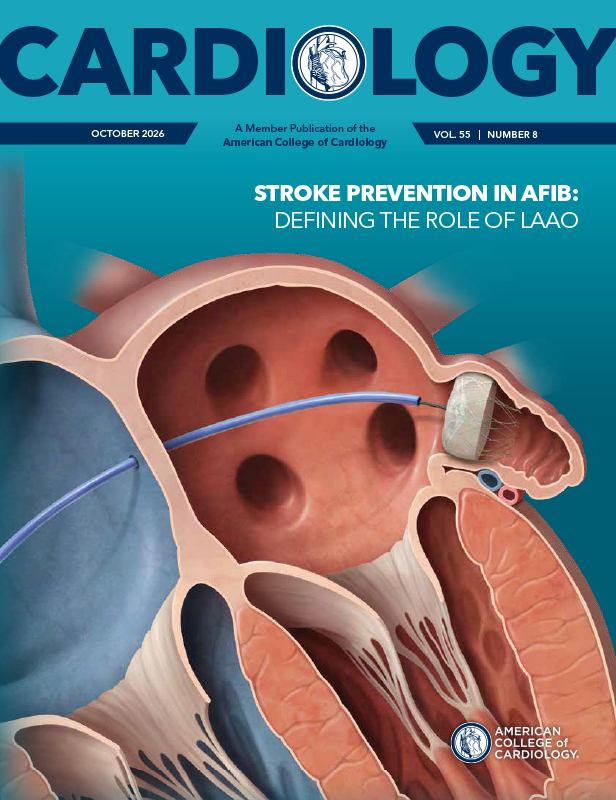
Online Exclusive | NCDR: Driving Discovery. Improving CV Care
ACC's NCDR suite of registries turns real-world clinical data into actionable insights that help hospitals, practices and clinicians advance the quality of cardiovascular care. From informing research to identifying opportunities for improvement, NCDR continues to play a critical role in improving outcomes for patients across the cardiovascular care continuum.
Recent NCDR research offers insights into how BMI and age influence TAVR outcomes; the relationship between reduced LVEF and post-LAAO outcomes; racial and sex disparities after M-TEER; and procedural strategies for AFib ablation.
Read on and then share your thoughts about the findings on social media using #NCDR and #CardiologyMag or join in discussions on the ACC's LinkedIn page.
BMI, Age and TAVR Outcomes
Older adults with lower BMI faced higher one-year risks after TAVR, including all-cause mortality and major adverse cardiovascular and cerebrovascular events (MACCE), while BMI was not associated with outcomes in patients younger than 65, according to a study published in JACC: Advances.
Using STS/ACC TVT Registry data, Sant Kumar, MD, and colleagues analyzed 6,639 TAVR patients (mean age, 77 years; mean BMI, 29.7 kg/m2) treated from January 2021 to February 2023, stratifying them by age (<65 or ≥65 years) and BMI (<25 or ≥25 kg/m2).
At one year, all-cause mortality occurred in 6.4% of patients. Among older adults, lower BMI was associated with higher risk of all-cause mortality (adjusted hazard ratio [aHR], 1.29; p=0.013) and MACCE (aHR, 1.20; p=0.001), compared with higher BMI.
The mortality benefit associated with a higher BMI was significant in patients aged 75 to 84 years (aHR, 0.60) and ≥85 years (aHR, 0.36), strengthening with age.
The authors conclude that the "TAVR obesity paradox" appears largely age dependent, noting that lower BMI in elderly TAVR patients may signal reduced physiologic reserve rather than higher BMI being uniformly protective.
Reduced LVEF Raises Mortality, Not Stroke, After LAAO
Patients with reduced LVEF undergoing transcatheter left atrial appendage occlusion (LAAO) had similar procedural success, major in-hospital complications and one-year stroke rates compared with those with preserved LVEF, but had higher one-year mortality, according to a recent study published in JACC: Clinical Electrophysiology.
The analysis included 186,085 patients (2.8% with LVEF <30%) in ACC's LAAO Registry from December 2015 to December 2023. Angela Y. Higgins, MD, et al., compared outcomes through one year after LAAO stratified by LVEF.
Procedural success was similar across groups (98.0% for LVEF <30% vs. 98.1% for LVEF ≥50%; p=0.12), as was in-hospital mortality (adjusted odds ratio, 1.39).
At one year, there was no significant difference in stroke (adjusted hazard ratio [aHR], 1.10) or ischemic stroke/arterial thromboembolism (aHR, 1.26). The authors write that patients with severely reduced LVEF had a similarly low stroke risk after LAAO despite higher baseline thromboembolic risk.
All-cause mortality at one year increased with every 10% reduction in LVEF, with the highest risk among patients with LVEF <30% (adjusted HR, 1.93). Heart failure was the most common cause of death in patients with severely reduced LVEF.
Racial and Sex Disparities in M-TEER Outcomes
Black patients undergoing mitral transcatheter edge-to-edge repair (M-TEER) for functional mitral regurgitation (FMR) were more likely to present with advanced disease, had lower procedural success and experienced higher heart failure (HF) readmission rates compared with White patients, according to a recent study published in Structural Heart. Women had lower rates of procedural success than men.
Using STS/ACC TVT Registry data, Kyeeun Park, MD, et al., evaluated 9,441 patients undergoing M-TEER for FMR. Among them, 58% were men, 80% White, 16% Black and 3% Asian. Investigators compared 30-day and 12-month all-cause and HF hospitalizations and mortality by race and sex.
Black patients had lower LVEF and larger left ventricular dimensions than White patients, with lower 30-day procedural success (49% vs. 57%; p<0.001) and greater adjusted odds of HF hospitalization at 12 months (adjusted hazard ratio, 1.35; p=0.006). Outcomes for Asian patients were comparable with White patients.
By sex, women had lower 30-day procedural success than men (48% vs. 61%; p<0.001) but adjusted one-year outcomes did not differ. The authors note that higher 30-day all-cause and HF readmissions among women were unadjusted and based on a small incidence difference, limiting clinical interpretation.
Park and colleagues say the findings underscore the need for patient-specific management and efforts to address structural inequities to improve outcomes for all patients with FMR.
AFib Ablation Outcomes Similar With Single, Double TSP
Among patients undergoing atrial fibrillation (AFib) ablation, single and double transeptal puncture (TSP) were associated with similar procedural safety and likelihood of discharge in sinus rhythm, according to a recent study published in the Journal of Interventional Cardiac Electrophysiology.
Using data from 212,345 patients in the ACC's AFib Ablation Registry from 2016 to 2024, Alejandro Velasco, MD, FACC, et al., compared in-hospital outcomes after catheter ablation via single vs. double TSP.
Single TSP was associated with comparable but slightly lower procedural complication rates than double TSP in both paroxysmal AFib (1.47% vs. 1.73%; odds ratio, 0.91) and nonparoxysmal AFib (2.09% vs. 2.58%; odds ratio, 0.77).
Rates of discharge in sinus rhythm were also similar but slightly higher with single TSP, and no difference in stroke was observed between groups.
"Overall, our registry was able to show that both TSP techniques are comparable with a difference in procedural complication rates between groups below 1%," the authors write, adding that operator preference and patient characteristics should guide the optimal TSP strategy.
NCDR: Data Powering Performance
More than 2,000 facilities worldwide participate in one or more ACC's registries, forming a comprehensive network of cardiovascular care providers committed to ensuring evidence-based cardiovascular care, improving patient outcomes and lowering health care costs.
Learn more about all the NCDR registries and become a participant.
Visit ACC.org/RegistryNews and bookmark the news page to keep up with the clinical insights from NCDR research.
Clinical Topics: Arrhythmias and Clinical EP, Cardiac Surgery, Invasive Cardiovascular Angiography and Intervention, Atrial Fibrillation/Supraventricular Arrhythmias, Cardiac Surgery and Arrhythmias
Keywords: Cardiology Magazine, ACC Publications, CM-Oct-2026, Transcatheter Aortic Valve Replacement, Atrial Appendage, Atrial Function, Left, Body Mass Index, Atrial Fibrillation, National Cardiovascular Data Registries, Registries, Coronary Occlusion
