Statins For the Prevention of Anthracycline-Induced Cardiotoxicity: Contextualizing Guideline Recommendations For Clinical Practice
Quick Takes
- As cancer survivorship continues to improve, preventing cancer therapy–related cardiac dysfunction is crucial to reducing cardiovascular (CV) morbidity in survivors of cancer.
- Meta-analyses of contemporary trials demonstrate that statins provide the greatest benefit for patients at the highest risk of anthracycline-induced cardiotoxicity based on cumulative anthracycline dose and/or pre-existing CV risk factors.
- Evolving practice guideline recommendations reflect a growing emphasis on personalized cardio-oncology risk assessment within the context of shared decision-making for patients with active cancer and borderline or higher ASCVD risk.
Anthracycline-induced cardiotoxicity is a major contributor to long-term cardiovascular (CV) outcomes in survivors of cancer. Up to 20% of patients exposed to anthracyclines develop irreversible cardiomyopathy through mechanisms leading to cardiomyocyte death. Dose-dependent cancer therapy–related cardiac dysfunction (CTRCD) may significantly limit successful treatment due to risks of myocardial cell damage that can lead to reduced left ventricular (LV) systolic function and ultimately irreversible cardiomyopathy if not promptly addressed.
Statins have emerged as a potential cardioprotective strategy because of their pleiotropic effects on oxidative stress, inflammation, and endothelial dysfunction. Although RCTs have shown promising results, uncertainty remains regarding their routine use for primary prevention of anthracycline-induced cardiotoxicity.
Although differing in recommendation strength, contemporary practice guidelines are largely aligned in supporting selective statin therapy for patients at high risk of CTRCD. The 2022 European Society of Cardiology (ESC) Guidelines on Cardio-Oncology provide a Class 2a recommendation that statins should be considered for primary prevention in adult patients with cancer at high and very high CV toxicity risk.1 Most recently, the 2026 ACC/AHA/Multisociety Guideline on the Management of Dyslipidemia gave a Class 2b recommendation that statins may be considered in patients with active cancer and borderline or higher predicted CV risk to prevent anthracycline-induced cardiotoxicity.2 Understanding this discrepancy requires an examination of the evolving evidence base informing each recommendation (Figure 1).
Figure 1: Case-Based Presentation of a Personalized, Risk-Based Approach to Statin Therapy for the Prevention of Anthracycline-Induced Cardiotoxicity
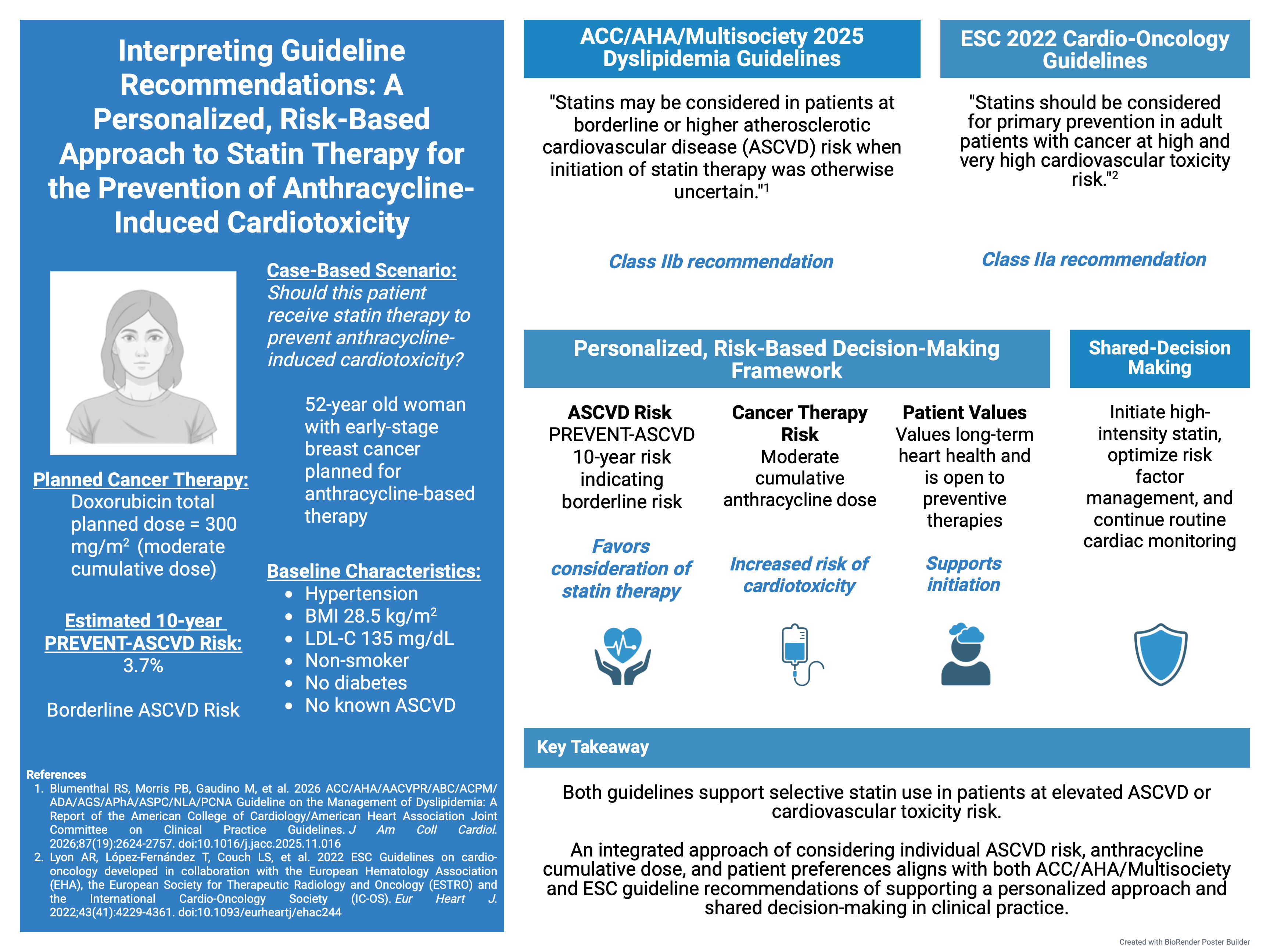
Created in BioRender. Baggett, K. (2026) https://BioRender.com/s3jxpql
Note: PREVENT-ASCVD is a trademark of the AHA.
ESC = European Society of Cardiology; PREVENT-ASCVD = Predicting Risk of Cardiovascular Disease EVENTs–Atherosclerotic Cardiovascular Disease.
Promise Found Through Early Clinical Evidence: Observational Studies
Early evidence supporting statin therapy in patients exposed to anthracyclines originated from observational cohort studies demonstrating an association between baseline statin therapy and lower risk of incident heart failure (HF). Findings from an early observational study by Seicean et al. demonstrated that uninterrupted statin therapy initiated prior to anthracycline exposure reduced the risk of incident HF, in addition to lower rates of cancer-related death in young women with breast cancer.3 This beneficial effect remained after adjustment for CV risk factors and baseline ejection fraction.
Contemporary observational studies similarly provided positive signals, with a population-based retrospective cohort study by Abdel-Qadir et al. finding that statin-exposed women had a lower risk of clinically significant HF requiring hospital admission.3 Although findings from cohort studies consistently suggested a cardioprotective benefit of statins in this population, they were subject to residual confounding due to their nonrandomized design and, thus, could not establish causality.
Mounting Evidence: Randomized Controlled Trials and Meta-Analyses
The positive results in these early observational studies formed the basis for subsequent randomized controlled trials (RCTs) that further elucidated the cardioprotective effects of statins within this population at high risk. The earliest prospective randomized trial was performed by Acar et al. and suggested that atorvastatin 40 mg QD was associated with a reduced risk of impaired LV systolic function following anthracycline exposure.3
The STOP-CA (Statins to Prevent the Cardiotoxicity of Anthracyclines) trial findings demonstrated that prophylactic atorvastatin significantly reduced the incidence of anthracycline-associated LV systolic dysfunction in patients with lymphoma, supporting statin therapy as a potential cardioprotective strategy for individuals at elevated risk of HF during anthracycline treatment.4
Subsequent meta-analyses of RCTs were conducted with larger sample sizes and a greater emphasis on CV outcomes. An initial meta-analysis performed by Obasi et al. demonstrated a significantly lower incidence of CTRCD among patients randomly assigned to statin therapy.5
The 2025 Focused Update of the 2019 ESC/European Atherosclerosis Society (EAS) Guidelines for the Management of Dyslipidemias reinforced the ESC's class IIa recommendation with meta-analyses by D'Amario et al. and Felix et al., and continued to recommend statin use in patients at high or very high risk of anthracycline-induced cardiotoxicity, noting the excellent safety profile of statin therapies.6-8
The most influential evidence cited by the 2026 ACC/AHA/multisociety guideline on dyslipidemia was a 2024 meta-analysis by Felix et al. of seven RCTs that encompassed 887 patients receiving anthracycline-based chemotherapy.2 Statin therapy was associated with a 54% relative risk reduction in the incidence of anthracycline-induced cardiotoxicity.8 On the basis of this emerging evidence, the writing committee issued a Class 2b recommendation that statins may protect against CTRCD and may be considered for patients at borderline or higher risk of cardiovascular disease (CVD).
Interpreting the Guideline Recommendations
The Class 2b recommendation in the 2026 ACC/AHA/multisociety guideline on dyslipidemia reflects a broader shift toward a personalized approach to CVD risk assessment. Neither guideline advocates routine statin therapy for all patients receiving anthracyclines; rather, both support selective use among patients with elevated CV or anthracycline dose–related risk, with an increased emphasis on individualized treatment decisions within the context of shared decision-making. Clinicians should consider both baseline ASCVD risk and HF risk when evaluating patients for preventive statin therapy. The recently developed PREVENT (Predicting Risk of Cardiovascular Disease EVENTs) risk equations (AHA), which estimate both ASCVD and HF risk, provide a practical framework for comprehensive risk assessment.2
Radiation-Associated CVD
Although this review has focused on anthracycline-related cardiotoxicity, many patients with CTRCD also receive radiation therapy. Radiation-associated CVD encompasses accelerated coronary artery disease, valvular disease, pericardial disease, arrhythmias, and HF, with risk increasing decades after exposure. Consequently, CV risk assessment in survivors of cancer should extend beyond anthracycline-related cardiomyopathy to consider the cumulative effects of systemic therapy, cardiac radiation exposure, and baseline CV risk (Figure 2).9
Figure 2: The Intersection of Cardio-Oncology and CV Risk Assessment
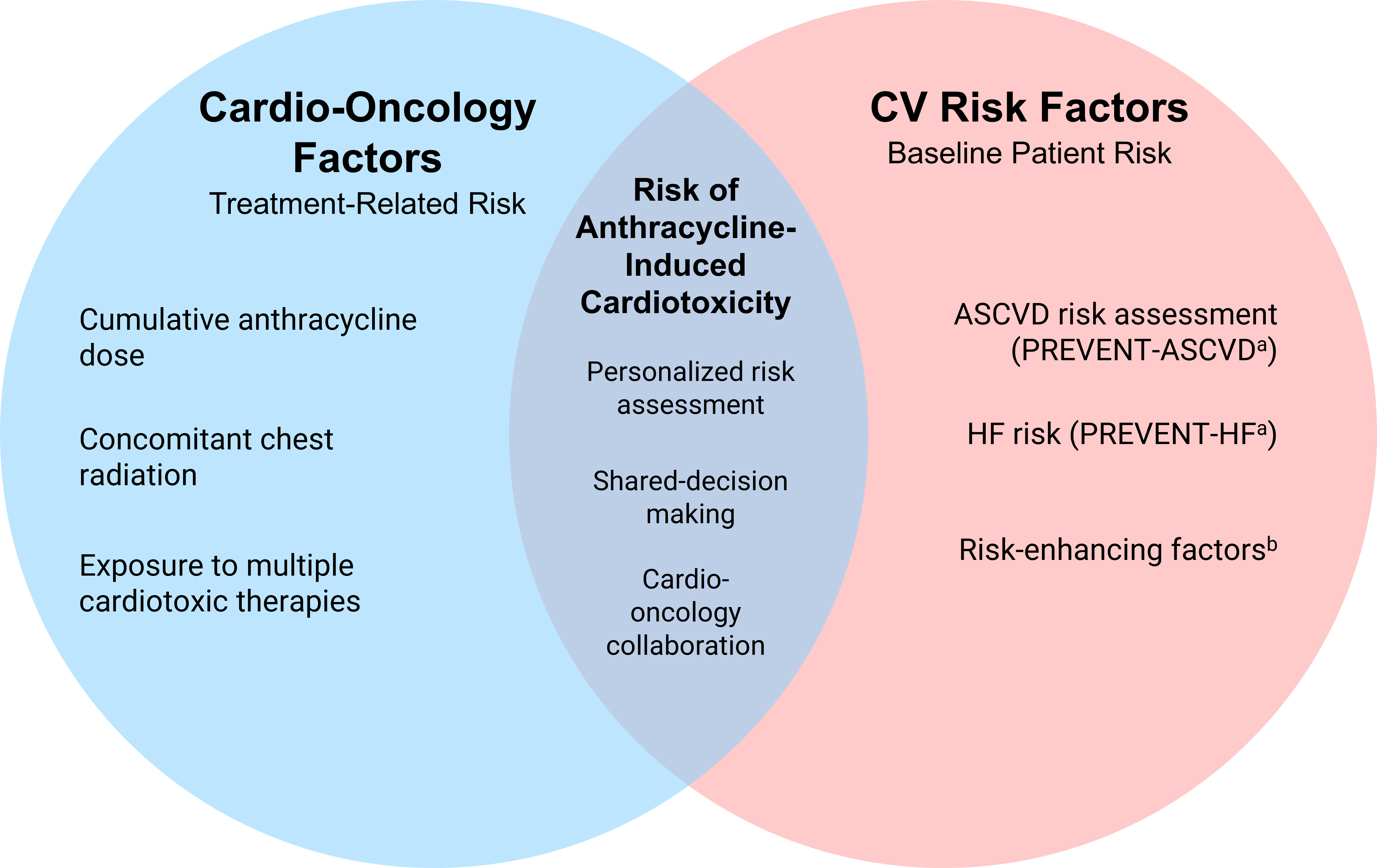
a Trademark of the AHA
b Such as chronic inflammatory diseases, CKM syndrome, and reproductive risk markers
CKM = cardiovascular-kidney-metabolic; CV = cardiovascular; HF = heart failure; PREVENT-ASCVD = Predicting Risk of Cardiovascular Disease EVENTs–Atherosclerotic Cardiovascular Disease; PREVENT-HF = Predicting Risk of Cardiovascular Disease EVENTs–Heart Failure.
Clinical Implications and Future Directions
Statin therapy is most likely to benefit patients at highest risk of anthracycline cardiotoxicity, including those receiving higher cumulative anthracycline doses or concomitant chest radiation and those with pre-existing CV risk factors. Multidisciplinary cardio-oncology care should incorporate baseline HF and ASCVD risk assessment to identify patients most likely to benefit from statin therapy. Future research should focus on refining risk stratification and identifying biomarkers to determine which patients derive the greatest benefit from statin therapy.
As advances in oncology continue to improve cancer survival, minimizing long-term CV toxicity has become an increasingly important component of cardio-oncology care. Current evidence supports consideration of statin therapy for carefully selected patients at elevated risk of anthracycline-related cardiotoxicity rather than routine treatment of all patients receiving anthracycline-based chemotherapy. The updated ESC and ACC/AHA guideline recommendations reinforce a patient-centered, multidisciplinary approach and highlight the need for continued investigation into cardioprotective strategies.
References
- Lyon AR, López-Fernández T, Couch LS, et al. 2022 ESC guidelines on cardio-oncology developed in collaboration with the European Hematology Association (EHA), the European Society for Therapeutic Radiology and Oncology (ESTRO) and the International Cardio-Oncology Society (IC-OS). Eur Heart J. 2022;43(41):4229-4361. doi:10.1093/eurheartj/ehac244
- Blumenthal RS, Morris PB, Gaudino M, et al. 2026 ACC/AHA/AACVPR/ABC/ACPM/ADA/AGS/APhA/ASPC/NLA/PCNA guideline on the management of dyslipidemia: a report of the American College of Cardiology/American Heart Association Joint Committee on Clinical Practice Guidelines. J Am Coll Cardiol. Published online March 13, 2026. doi:10.1016/j.jacc.2025.11.016
- Bhasin V, Vakilpour A, Scherrer-Crosbie M. Statins for the primary prevention of anthracycline cardiotoxicity: a comprehensive review. Curr Oncol Rep. 2024;26(10):1197-1204. doi:10.1007/s11912-024-01579-6
- Neilan TG, Quinaglia T, Onoue T, et al. Atorvastatin for anthracycline-associated cardiac dysfunction: the STOP-CA randomized clinical trial. JAMA. 2023;330(6):528-536. doi:10.1001/jama.2023.11887
- Obasi M, Abovich A, Vo JB, et al. Statins to mitigate cardiotoxicity in cancer patients treated with anthracyclines and/or trastuzumab: a systematic review and meta-analysis. Cancer Causes Control. 2021;32(12):1395-1405. doi:10.1007/s10552-021-01487-1
- Mach F, Koskinas KC, Roeters van Lennep JE, et al. 2025 focused update of the 2019 ESC/EAS guidelines for the management of dyslipidaemias. Atherosclerosis. 2025;409:120479. doi:10.1016/j.atherosclerosis.2025.120479
- D'Amario D, Laborante R, Bianchini E, et al. Statins as preventive therapy for anthracycline cardiotoxicity: a meta-analysis of randomized controlled trials. Int J Cardiol. 2023;391:131219. doi:10.1016/j.ijcard.2023.131219
- Felix N, Nogueira PC, Silva IM, et al. Cardio-protective effects of statins in patients undergoing anthracycline-based chemotherapy: An updated meta-analysis of randomized controlled trials. Eur J Intern Med. 2024;126:43-48. doi:10.1016/j.ejim.2024.04.007
- Atkins KM, Walls G, Nikolova AP, et al. Heart substructure radiation dose and cardiac outcomes: contemporary evidence and actionable opportunities: JACC CardioOncology state-of-the-art review. JACC CardioOncol. 2026;8(3):211-230. doi:10.1016/j.jaccao.2026.04.009
Clinical Topics: Cardio-Oncology, Prevention, Dyslipidemia, Noninvasive Imaging
Keywords: Primary Prevention, Cardio-oncology, Cardiotoxicity, Anthracyclines, Practice Guidelines as Topic, Risk Assessment, Statins, Plaque, Atherosclerotic, Cardiovascular Diseases