Editors' Corner | Mother Nature Does Not Offer a Free Lunch!
It takes longer than we'd like to gain confidence in new percutaneous technology. Twenty years after Andreas Grüntzig's first coronary PTCA, we were still debating whether stents were good or bad. Now we're wondering about a return to balloons alone – albeit drug-coated. So it has been with left atrial appendage occlusion (LAAO).
In 1949, New York surgeon John Madden reported on two patients with mitral stenosis and recurrent systemic emboli, showing that resected atrial appendages contained mural thrombi. In patients with cardiac mural thrombi, 90% were in the left atrial appendage. Fast forward to the Watchman trials 20 years ago – and to today – and we're still not entirely sure which patients to select for percutaneous LAAO.
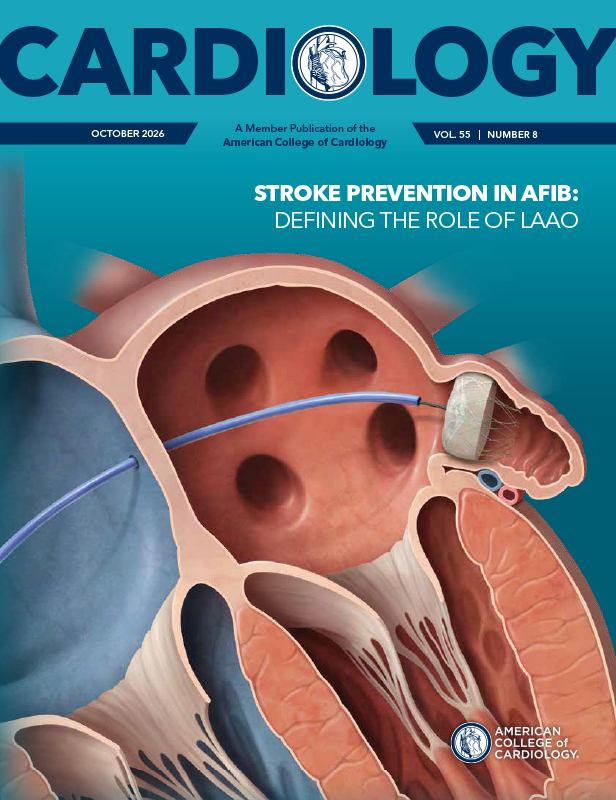
Mother Nature reminds us there are upsides and downsides to both percutaneous and medical therapies. This month's cover story underscores that tension by summarizing recent trial outcomes of LAAO vs. novel oral anticoagulants (NOACs) in patients with atrial fibrillation (AFib). It's complicated!
The recent CHAMPION-AF trial, with high NOAC adherence, showed LAAO with Watchman FLX was noninferior to NOACs. But bleeding risk still matters, even when lower with Watchman FLX, and some patients have embolic recurrence. There's no free lunch! Critics note that noninferiority should have been more robust in CHAMPION-AF and that last year's CLOSURE-AF trial failed to show noninferiority in similar patients. Overall, patients with AFib still need individualized assessment of LAAO vs. NOAC risks and benefits.
Two patient groups stand out as strong candidates for LAAO: those with previous intracranial hemorrhage (ICH) and those with "breakthrough" stroke on adequate NOACs. A 2025 meta-analysis of patients with AFib and prior ICH in the NCDR LAAO Registry found that, during follow-up and against risk-score predictions, LAAO significantly reduced ischemic stroke and bleeding events.
For "breakthrough" ischemic stroke, the 2024 STR-OAC LAAO analysis examined patients with recurrent ischemic stroke despite adequate oral anticoagulation. Recurrence was higher than expected with continued anticoagulation. Adding LAAO reduced the annualized ischemic stroke rate to 2.8% per patient-year vs. 8.9% in controls. As a bonus, 67% of LAAO patients discontinued anticoagulation entirely, while 33% continued it as adjunctive therapy.
Finally, we need to keep looking ahead. What about the combination of AFib ablation and LAAO now gaining traction? John Madden opened the native mitral valve to relieve congestive symptoms and excised the LAA to prevent embolic events. Why not percutaneously ablate the source of AFib and consider LAAO to prevent embolic events if AF recurs? Combination therapy makes sense. Stay tuned!
Clinical Topics: Anticoagulation Management, Arrhythmias and Clinical EP, Anticoagulation Management and Atrial Fibrillation, Atrial Fibrillation/Supraventricular Arrhythmias
Keywords: Cardiology Magazine, ACC Publications, CM-Oct-2026, Atrial Function, Left, Atrial Appendage, Coronary Occlusion, Anticoagulants, Novel Agents, Atrial Fibrillation
