Feature | A New Way Around a TAVR Complication: The First Human VECTOR Procedure
Coronary artery obstruction is one of the deadliest complications in TAVR. Interventionalists have developed workarounds – BASILICA (slicing the leaflet before it can obstruct), UNICORN (radiofrequency undermining), CATHEDRAL (electrosurgical debulking) and "snorkel" stenting. But each of these options depend on being able to reach and manipulate the offending leaflet. In a patient with heavily calcified, immobile leaflets and no safe pathway through them to the coronary ostia, none of those creatively-named options work.
That was the situation facing a 67-year-old man with a severely stenotic aortic valve replacement, an ejection fraction of 20%, end-stage kidney disease on dialysis and severe peripheral artery disease (with a recent leg amputation). He was anatomically ineligible for any existing coronary-protection technique and at prohibitive risk for redo valve surgery. His left main coronary artery sat just 1.7 mm from where a new valve would land, deemed extreme risk for left main coronary artery (LMCA) obstruction.
Rather than protect the coronary artery in place, an Emory University and National Institutes of Health (NIH) team consisting of Vasilis C. Babaliaros, MD; Christopher Bruce, MD; Adam B. Greenbaum, MD, FACC; and Robert J. Lederman, MD, FACC, did something different: they built the artery a new route into the heart, entirely percutaneously.
The technique is called VECTOR (Ventriculo-Coronary transcatheter Outward Navigation and Re-entry), and this recently reported case is its first use in a human.1
How it Works
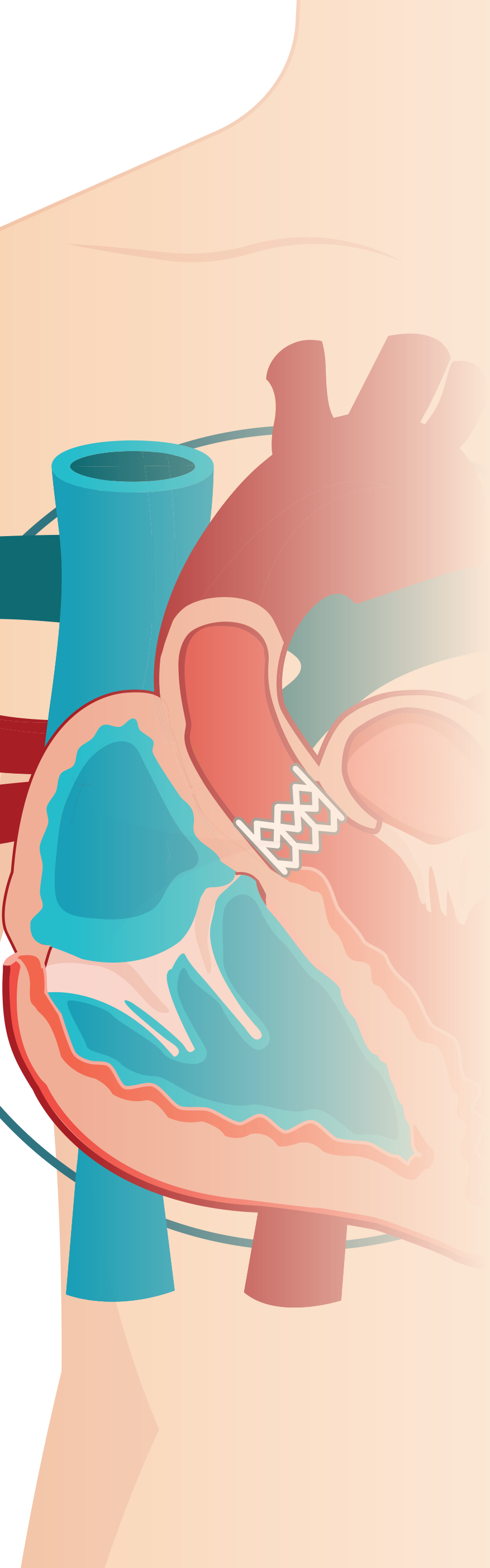
Think of VECTOR as a percutaneous LMCA-ascending aorta-coronary ostial bypass covered-stent graft.
- Establishing a rail. A guidewire is threaded from the coronary circulation, through a small septal perforator branch, and captured in the right ventricle, a maneuver borrowed from chronic total occlusion (CTO) technique.
- Exiting the coronary artery, deliberately. Using that guidewire rail for support, a second retrograde wire is steered out of the LMCA and into the pericardial space. This defines the graft's distal connection point. A stent placed at the exit site facilitates the wire exit.
- Exiting the aorta, deliberately. A separate wire, guided by an electrosurgical ("cutting" electrical current) technique, is used to make a controlled perforation through the aortic wall into the pericardium, which becomes the graft's proximal connection point, positioned safely above where the new aortic valve prosthesis will sit.
- Connecting the two. The two wires are joined inside the pericardial space, creating a single rail running from the aorta to the coronary artery and bypassing the ostium danger zone entirely.
- Building the graft. Covered stents are threaded over this rail to form the new vessel and anchored at each end with additional stents. Circulation is now assured when the original coronary ostium is covered by the incoming valve.
Only after confirming the new route was open did the team proceed with TAVR. As anticipated, the valve did push the old leaflet over the native left main and occlude it, but perfusion continued uninterrupted through the new bypass. The patient was weaned off heart-lung support in the operating room and remained well at six-month follow-up.
The patient passed away seven months post procedure from noncardiac related issues. Until the time of his death, the graft was widely patent with stable left ventricular function.
"We find ourselves being sent patients that other people just can't help. I call them our 'no-option' patients," Greenbaum says. "At one point, Dr. Babaliaros and I were looking at a CT scan and thought that the coronary is just not that far away from the aorta. If only we could move it up and out of the way, we could use this new approach. That's what led us to wonder whether, with the toolset we'd already built for other procedures, it might be feasible to relocate the coronary ostia fully percutaneously."
The procedure took nearly nine hours and was performed with elective veno-arterial ECMO as a safety net.
Durability of the covered-stent conduit is unknown, though the authors note that other extra-anatomic covered-stent conduits tend to resist restenosis over time. Whether VECTOR can be performed reliably, faster and without circulatory support are open questions before it moves beyond compassionate, last-resort use.
Since the first case, Greenbaum and Babaliaros' team has performed VECTOR in a second patient, this time creating bypasses for both the right and left coronary arteries. The feasibility in a second patient supports the concept, rather than just a one-off success.
The reaction to the case has surprised Greenbaum. "This one got way more attention than a case report normally does. I think it's because of the implications outside of TAVR – could this have some role in coronary bypass more broadly, for patients with conventional atherosclerosis who've failed CTO attempts or already have multiple stents? The answer is maybe."
He's quick to temper the enthusiasm, though. "You have to remember, it's hard to beat the traditional LIMA to LAD, which is the magic of coronary bypass surgery," Greenbaum says. "To get cardiologists and cardiac surgeons to agree this could replace the traditional approach is a very large ask."
Still, he notes, the covered stents used in VECTOR carry brisk flow and, lacking a vessel wall of their own, may resist the restenosis that limits other conduits. "I hate to use the word crazy, but a far-reaching idea like this isn't something the field should dismiss right away," he says. "Could I imagine that generations from now, bypass could be done percutaneously? Sure."
For now, VECTOR adds a genuinely new option to the TAVR coronary-obstruction toolkit, offering, well, a bypass around the issue.
This article was authored by Debra L Beck, MSc.
Reference
- Bruce CG, Babaliaros VC, Paone G, et al. Percutaneous aorto-coronary bypass graft to prevent coronary obstruction following TAVR: First human VECTOR procedure. Circ Cardiovasc Interv. 2026;19:e016130.
Clinical Topics: Cardiac Surgery, Invasive Cardiovascular Angiography and Intervention, Atherosclerotic Disease (CAD/PAD), Interventions and Coronary Artery Disease
Keywords: Cardiology Magazine, ACC Publications, CM-Nov-2026, Transcatheter Aortic Valve Replacement, Coronary Artery Stenosis, Coronary Artery Disease