Novel LA Staging Framework Stratifies NOAF Risk in HCM
A novel left atrium (LA) staging framework proposed by Jaehyun Lim, MD, PhD, et al., was independently associated with a significant, stepwise increase in risk of new-onset atrial fibrillation (NOAF) in patients with hypertrophic cardiomyopathy (HCM), providing incremental predictive value beyond established atrial fibrillation (AFib) risk models, and may help tailor AFib surveillance strategies for these patients.
In the multicenter, retrospective study, published Sept. 9 in JACC, Lim and colleagues screened 705 eligible patients (mean age, 58 years; 30% women) with HCM and normal left ventricular systolic function. Mean LVEF was 69%, 18% had an obstructive phenotype, 41% had increased LA pressure and 15% had decreased LA contractile function.
The new framework relied on elevated LA pressure (hemodynamic load) and LA contractile strain (intrinsic LA function) to stratify patients into five categories: stage 1 (normal pressure and function; n=131), stage 2 ("straining LA" characterized by compensatory augmentation of LA contractile function; n=286), stage 3 ("failing LA" marked by loss of this compensatory response despite elevated LA pressure; n=181), stage 4 ("burnt-out LA" characterized by elevated pressure and reduced contractile function; n=77) and isolated LA contractile dysfunction (n=30). Age increased progressively across stages, and women and hypertension were more common in higher stages.
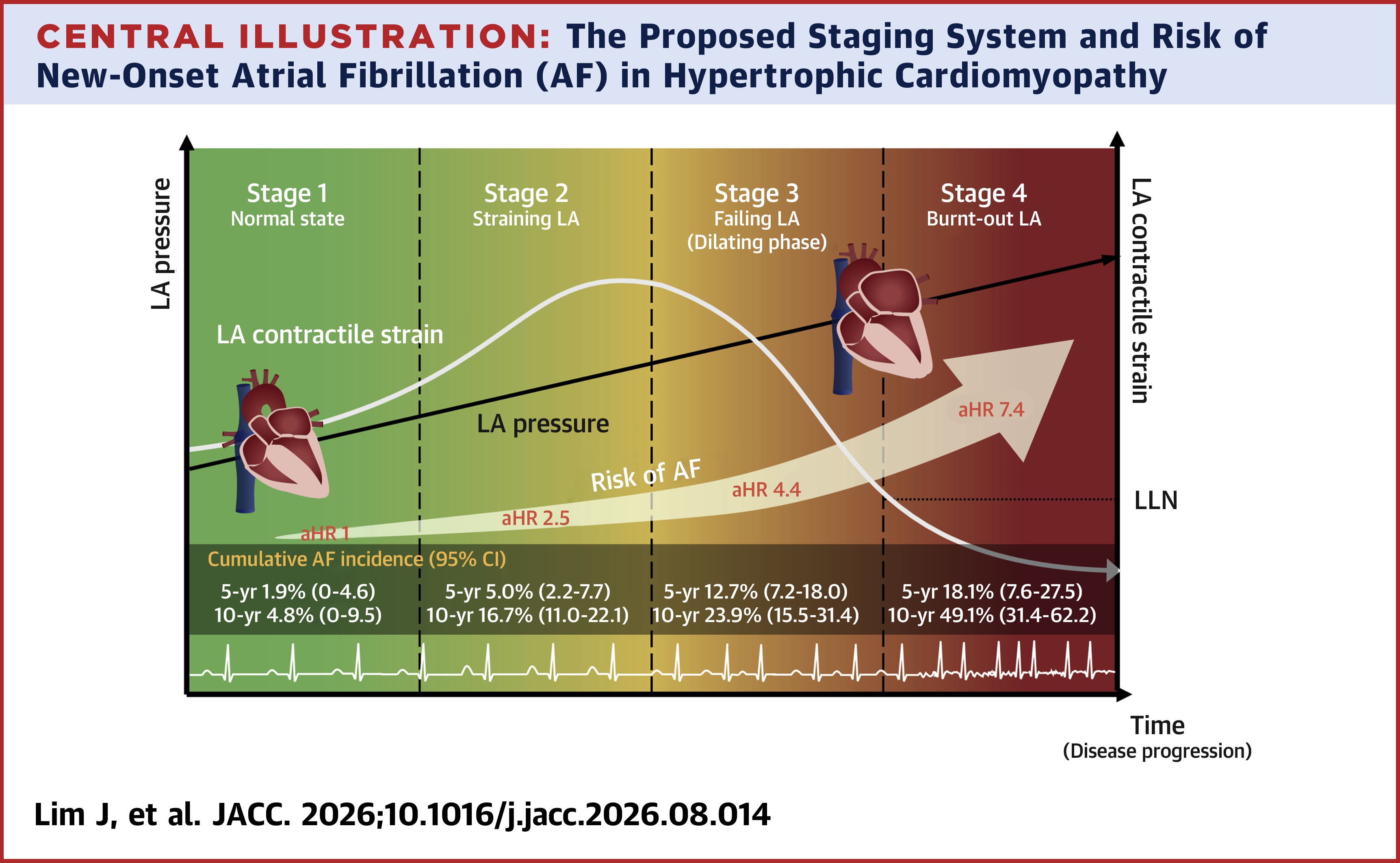
Results showed that during a median follow-up of 7.5 years, NOAF occurred in 101 patients with an estimated cumulative incidence of 8% at five years and 20% at 10 years. The novel staging system was independently associated with a significant, stepwise increase in risk of NOAF at 1.83 per increment (p<0.001), which showed a predictive value beyond the current established risk models, including CHARGE-AF and HCM-AF.
These results remained consistent in one-year landmark and competing-risk analyses, as well as in an external validation cohort of 425 patients (mean age, 60 years). In 217 patients who underwent follow-up echocardiography four to six years after baseline, LA stage remained generally stable (40%) or progressed to a higher stage or AFib (44%), supporting the sequential nature of the proposed staging system.
"This framework provides novel insights into the mechanical cascade of the LA in response to progressive LV diastolic dysfunction," write the authors. "Given that HCM serves as a prototypical model of severe, progressive LV diastolic impairment, the pathophysiologic adaptation of the LA elucidated in the present study may also be relevant to the growing population of patients with [heart failure with preserved ejection fraction.]"
Clinical Topics: Arrhythmias and Clinical EP, Heart Failure and Cardiomyopathies, Valvular Heart Disease, Atrial Fibrillation/Supraventricular Arrhythmias
Keywords: Cardiomyopathy, Hypertrophic, Familial, Ventricular Dysfunction, Left, Heart Atria, Atrial Fibrillation, Cardiomyopathy, Hypertrophic
