Adults ≥75 years of age are disproportionally affected by acute MI. Not only do they make up 30-40% of the adult population hospitalized for acute coronary syndrome (ACS), but they also account for most ACS-related deaths.1 Complex medical decision-making is required in selecting their antiplatelet regimen, as these patients often present with heavy plaque burden, tortuous coronary anatomy, and multivessel disease. In addition, geriatric syndromes such as frailty, multimorbidity, cognitive impairment, polypharmacy, and fall risk substantially influence treatment decisions.
Older adults with coronary artery disease exist at the intersection of heightened ischemic risk and bleeding vulnerability, with age-related changes in vascular biology, thrombogenicity, and comorbidities.2 As a result, clinicians must individualize antithrombotic therapy by weighing the risk of recurrent ischemic events against the risk of major bleeding.
Prasugrel and ticagrelor are the P2Y12 inhibitors of choice for patients with ACS, owing to their more potent antiplatelet effect compared with clopidogrel.3 However, both agents are known to carry a higher risk of bleeding than clopidogrel.4
- In the TRITON-TIMI 38 study (Trial to Assess Improvement in Therapeutic Outcomes by Optimizing Platelet Inhibition With Prasugrel-Thrombolysis In Myocardial Infarction 38), prasugrel significantly reduced rates of ischemic events compared with clopidogrel, but it was associated with a higher incidence of major bleeding, including life-threatening bleeding. Notably, patients ≥75 years of age did not experience a net benefit outcome due to excess bleeding. Consequently, the authors cautioned against the use of prasugrel in this age group because the net clinical benefit may not outweigh harm.4 In this patient scenario, prasugrel would be contraindicated given the patient's age, history of frequent falls, and history of subdural hematoma.
- In the PLATO trial (Platelet Inhibition and Patient Outcomes), ticagrelor demonstrated clinical benefit regarding the composite of cardiovascular death, MI, or stroke, and similar trends in major bleeding events across all age groups, compared with clopidogrel.4 This in turn makes the choice between ticagrelor versus clopidogrel in elderly patients less straightforward.
- In contrast, the SWEDEHEART registry (Swedish Web-System for Enhancement and Development of Evidence-Based Care in Heart Disease Evaluated According to Recommended Therapies), published in 2020, examined the rates of bleeding and thrombosis in 14,005 patients ≥80 years of age. Using inverse probability of treatment weighting to account for the lack of randomization, the study found that although ticagrelor was associated with a lower risk of MI and stroke compared with clopidogrel, the hazard ratio of death as well as hospital readmission for bleeding increased by 17% and 48%, respectively, in the ticagrelor group. As a result, the authors concluded that compared with younger patients, patients ≥80 years of age may carry a different risk-benefit profile when choosing between P2Y12 inhibitors.5
- Similarly, in the POPular AGE trial (Clopidogrel Versus Ticagrelor or Prasugrel in Patients Aged 70 Years or Older With Non-ST-Elevation Acute Coronary Syndrome), clopidogrel was noninferior to ticagrelor regarding cardiovascular death, MI, and stroke, and it was associated with significantly fewer bleeding events.6 Although POPular AGE enrolled patients with non-ST-elevation-ACS rather than STEMI, its findings are clinically relevant because they support clopidogrel as a reasonable alternative in older patients with ACS, particularly when bleeding is of concern.
- Last, a 2021 meta-analysis investigated the effect of potent P2Y12 inhibitors (prasugrel or ticagrelor) versus clopidogrel in patients ≥65 years of age with ACS.7 The study again confirmed that both ticagrelor and prasugrel are associated with increased major bleeding events. However, neither agent was shown to significantly reduce the risk of major adverse cardiovascular outcomes or all-cause mortality compared with clopidogrel.
Landmark trials examining P2Y12 inhibitor use after fibrinolysis for STEMI have commonly excluded patients ≥75 years of age. Limited data exist regarding the optimal agent in this case. As a result, the 2025 ACC/AHA/Multisociety Guideline for the Management of Patients With ACS recommends that in patients >75 years of age receiving fibrinolysis, clopidogrel without a loading dose should be used, based on data from the COMMIT trial (Clopidogrel and Metoprolol in Myocardial Infarction), the only randomized, placebo-controlled study that included patients >75 years of age with suspected STEMI receiving fibrinolytic.3
Bleeding risk assessment tools such as PRECISE-DAPT (Predicting Bleeding Complications in Patients Undergoing Stent Implantation and Subsequent Dual Antiplatelet Therapy), ARC-HBR (Academic Research Consortium for High Bleeding Risk), and the new PRECISE-HBR (age, estimated glomerular filtration rate, hemoglobin, white blood cell count, previous bleeding, oral anticoagulation, and ARC-HBR criteria) scores emphasize factors relevant to this patient, including age, prior bleeding event, and other elements that may predispose patients to bleeding.8
Conversely, ischemic risk assessment tools such as TIMI score, GRACE 2.0 (Global Registry of Acute Coronary Events) score, and the newer ABC-ACS ischemia score (age, biomarkers [growth differentiation factor 15, N-terminal pro–B-type natriuretic peptide], and clinical history [extent of coronary artery disease, prior vascular disease, Killip class, ACS type, P2Y12 inhibitor]) incorporate clinical and biomarker variables to estimate risk of recurrent cardiovascular death or MI after an ACS event.9 In this case, due to the patient's advanced age, recurrent falls, prior intracranial bleeding, and recent fibrinolytic therapy, clopidogrel is likely going to provide a more favorable outcome (Figure 1).
Figure 1: Antiplatelet Decision-Making After Pharmaco-Invasive STEMI Management in an Elderly Patient at High Bleeding Risk
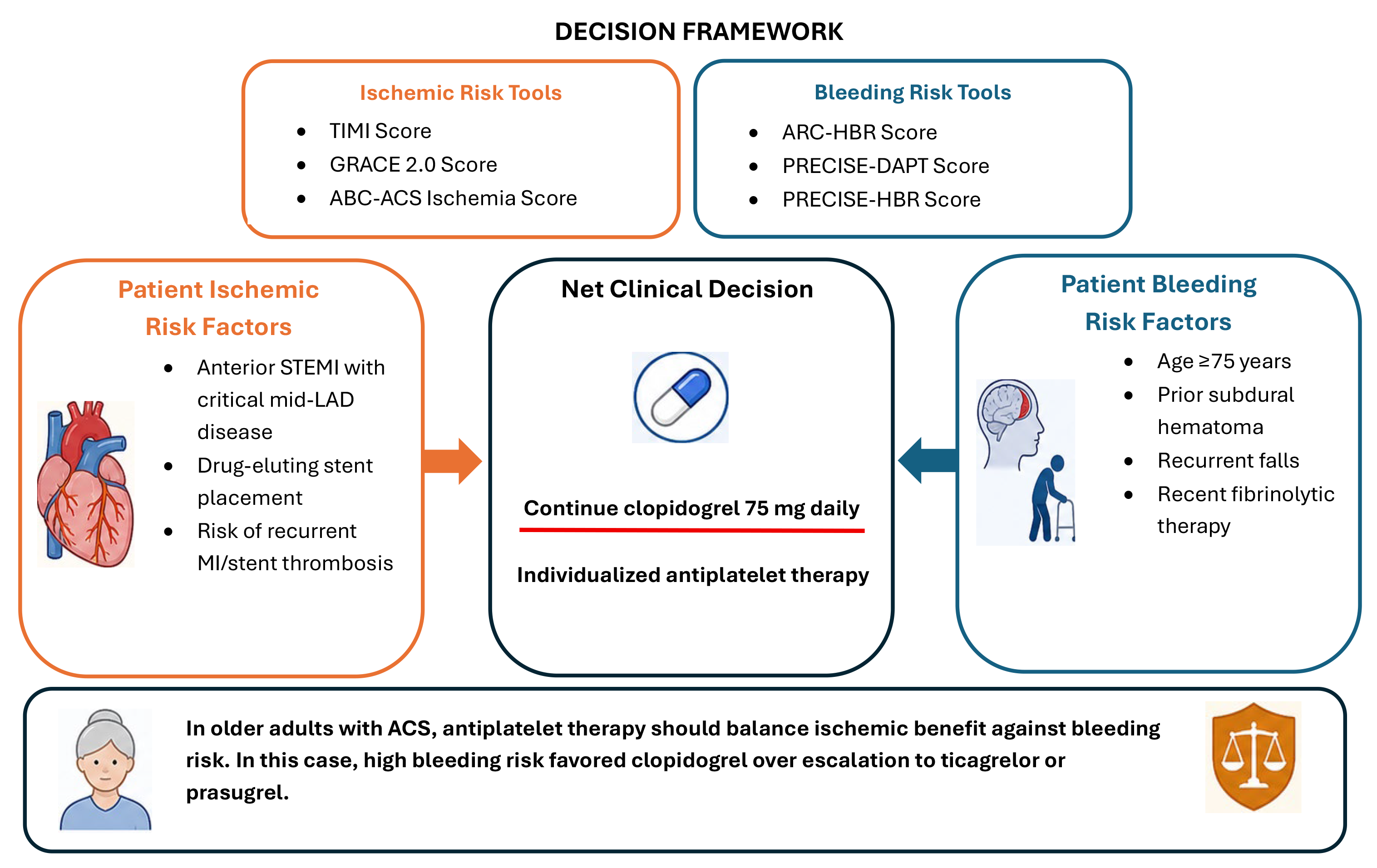
ABC-ACS = age, biomarkers (growth differentiation factor 15, N-terminal pro–B-type natriuretic peptide), and clinical history (extent of coronary artery disease, prior vascular disease, Killip class, ACS type, P2Y12 inhibitor); ACS = acute coronary syndrome; ARC-HBR = Academic Research Consortium for High Bleeding Risk; GRACE 2.0 = Global Registry of Acute Coronary Events; LAD = left anterior descending; MI = myocardial infarction; PRECISE-DAPT = Predicting Bleeding Complications in Patients Undergoing Stent Implantation and Subsequent Dual Antiplatelet Therapy; PRECISE-HBR = age, estimated glomerular filtration rate, hemoglobin, white blood cell count, previous bleeding, oral anticoagulation, and ARC-HBR criteria; STEMI = ST-segment elevation myocardial infarction; TIMI = Thrombolysis in Myocardial Infarction.
The P2Y12 inhibitor of choice in elderly patients represents an ongoing conundrum about finding the balance between major adverse cardiovascular outcome prevention and bleeding. Several strategies have been proposed to mitigate the risks, such as early P2Y12 inhibitor de-escalation, transition to ticagrelor monotherapy after ≥1-month post-PCI, or using platelet inhibitor assays to better guide therapy.3,4 Future research is needed for better risk-benefit stratification in elderly patients with ACS.
References
- Damluji AA, Forman DE, Wang TY, et al. Management of acute coronary syndrome in the older adult population: a scientific statement from the American Heart Association. Circulation. 2023;147(3):e32-e62. doi:10.1161/CIR.0000000000001112
- Capranzano P, Angiolillo DJ. Antithrombotic management of elderly patients with coronary artery disease. JACC Cardiovasc Interv. 2021;14(7):723-738. doi:10.1016/j.jcin.2021.01.040
- Rao SV, O'Donoghue ML, Ruel M, et al. 2025 ACC/AHA/ACEP/NAEMSP/SCAI guideline for the management of patients with acute coronary syndromes: a report of the American College of Cardiology/American Heart Association Joint Committee on Clinical Practice Guidelines. J Am Coll Cardiol. 2025;85(22):2135-2237. doi:10.1016/j.jacc.2024.11.009
- Capranzano P, Angiolillo DJ. Ticagrelor or clopidogrel in elderly patients with myocardial infarction: when the choice makes the difference. Circulation. 2020;142(18):1709-1712. doi:10.1161/CIRCULATIONAHA.120.050845
- Szummer K, Montez-Rath ME, Alfredsson J, et al. Comparison between ticagrelor and clopidogrel in elderly patients with an acute coronary syndrome: insights from the SWEDEHEART registry. Circulation. 2020;142(18):1700-1708. doi:10.1161/CIRCULATIONAHA.120.050645
- Gimbel M, Qaderdan K, Willemsen L, et al. Clopidogrel versus ticagrelor or prasugrel in patients aged 70 years or older with non-ST-elevation acute coronary syndrome (POPular AGE): the randomised, open-label, non-inferiority trial. Lancet. 2020;395(10233):1374-1381. doi:10.1016/S0140-6736(20)30325-1
- Fujisaki T, Kuno T, Ando T, Briasoulis A, Takagi H, Bangalore S. Potent P2Y12 inhibitors versus clopidogrel in elderly patients with acute coronary syndrome: systematic review and meta-analysis. Am Heart J. 2021;237:34-44. doi:10.1016/j.ahj.2021.03.009
- Batra G, Lindbäck J, Becker RC, et al. Biomarker-based prediction of recurrent ischemic events in patients with acute coronary syndromes. J Am Coll Cardiol. 2022;80(18):1735-1747. doi:10.1016/j.jacc.2022.08.767
- Gragnano F, van Klaveren D, Heg D, et al. Derivation and validation of the PRECISE-HBR score to predict bleeding after percutaneous coronary intervention. Circulation. 2025;151(6):343-355. doi:10.1161/CIRCULATIONAHA.124.072009


