PARTNER 3: 7-Year TAVR vs. SAVR Outcomes in Low-Risk Patients
Both TAVR and SAVR were associated with a sustained, substantial improvement in patient-reported health status among patients with severe aortic stenosis (AS) considered at low risk, according to the seven-year outcomes of the PARTNER 3 trial published July 29 in JACC. TAVR was associated with earlier recovery than SAVR.
The PARTNER 3 trial, conducted across 71 international centers, randomized 943 patients (mean age, 74 years; 31% women) with severe AS and low surgical risk (mean STS-PROM, 1.9%) to either TAVR with a balloon-expandable valve (n=494) or SAVR (n=449). Mean baseline KCCQ-OS score was 70.9 among all patients.
Results at seven years showed that 66% of TAVR patients vs. 67% of SAVR patients were alive with favorable outcomes (p=0.695), defined as a KCCQ-OS score ≥60 and no decrease ≥10 points. Additionally, 59% of TAVR patients vs. 62% of SAVR patients were alive with excellent outcomes (p=0.404), defined as a KCCQ-OS score ≥75 and no decrease ≥10 points.
KCCQ-OS scores were substantially higher among TAVR patients at one-month post-procedure, with 93% of TAVR patients reporting a meaningful health status improvement across all KCCQ domains compared with 63% of SAVR patients (mean treatment difference, +16.2 points). While a small but statistically significant health-status advantage for TAVR persisted from six months through two years (mean difference, +1.9 points), there were no significant differences between treatment groups by the third year.
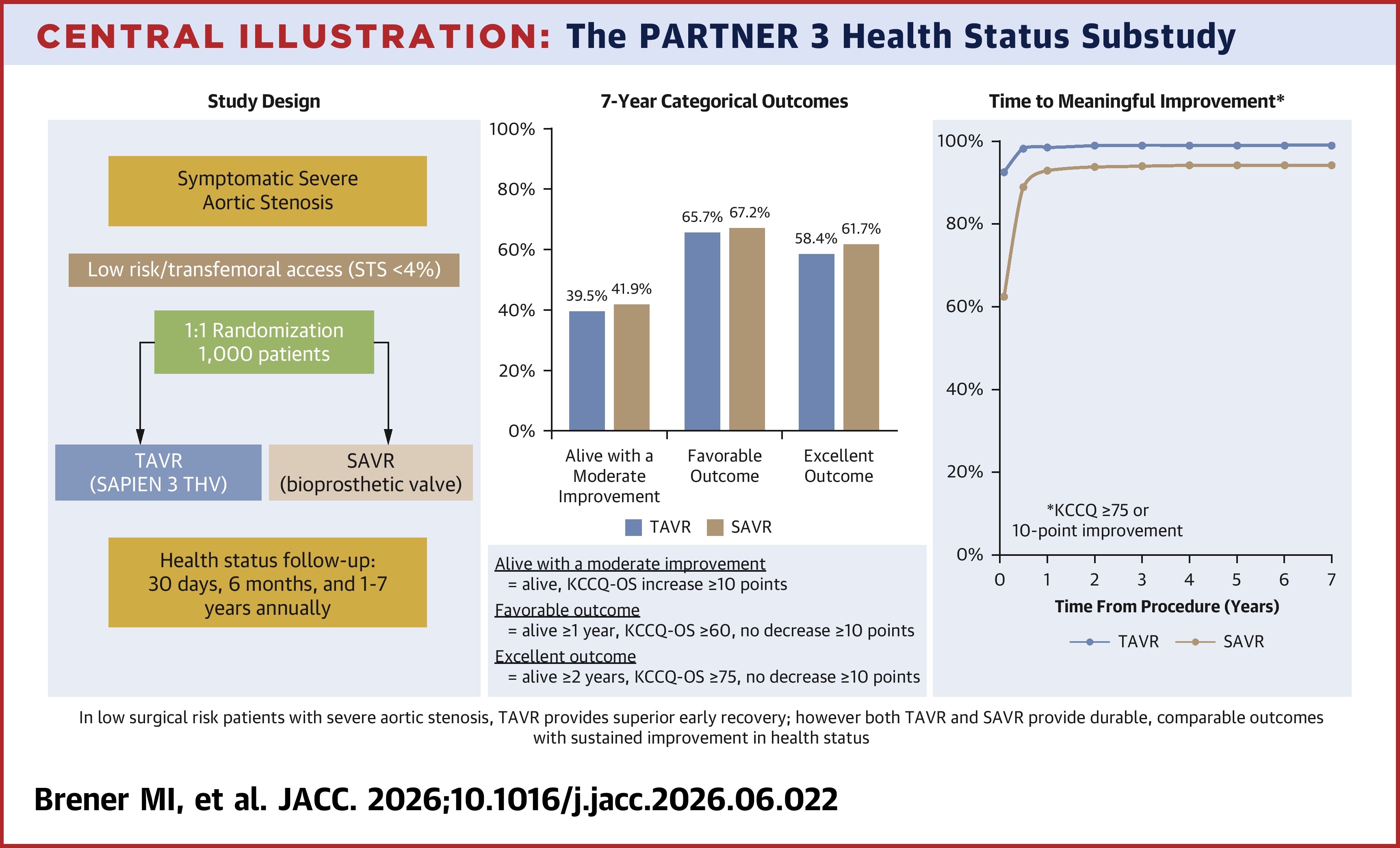
Among subgroups, investigators Michael Brener, MD, et al., noted there was significant potential long-term benefit of TAVR over SAVR in patients with a lower LVEF (p=0.027) and borderline possible long-term benefit of SAVR over TAVR in older patients (p=0.053).
Adding that this was the longest follow-up study comparing TAVR with SAVR, Brener and colleagues write that in total, "These findings highlight both the early advantage of a less-invasive approach and the sustained durability of symptom relief with either treatment strategy, providing a more complete understanding of the patient experience after valve replacement that can inform shared decision-making."
Clinical Topics: Cardiac Surgery, Cardiovascular Care Team, Invasive Cardiovascular Angiography and Intervention, Valvular Heart Disease, Aortic Surgery, Cardiac Surgery and VHD, Interventions and Structural Heart Disease
Keywords: Transcatheter Aortic Valve Replacement, Heart Valve Diseases, Aortic Valve Stenosis, Heart Valve Prosthesis, Quality of Life
