
 Log in to MyACC
Million Veteran Program Analysis: Higher CV Risk in Patients With ATTRv V142I Variant
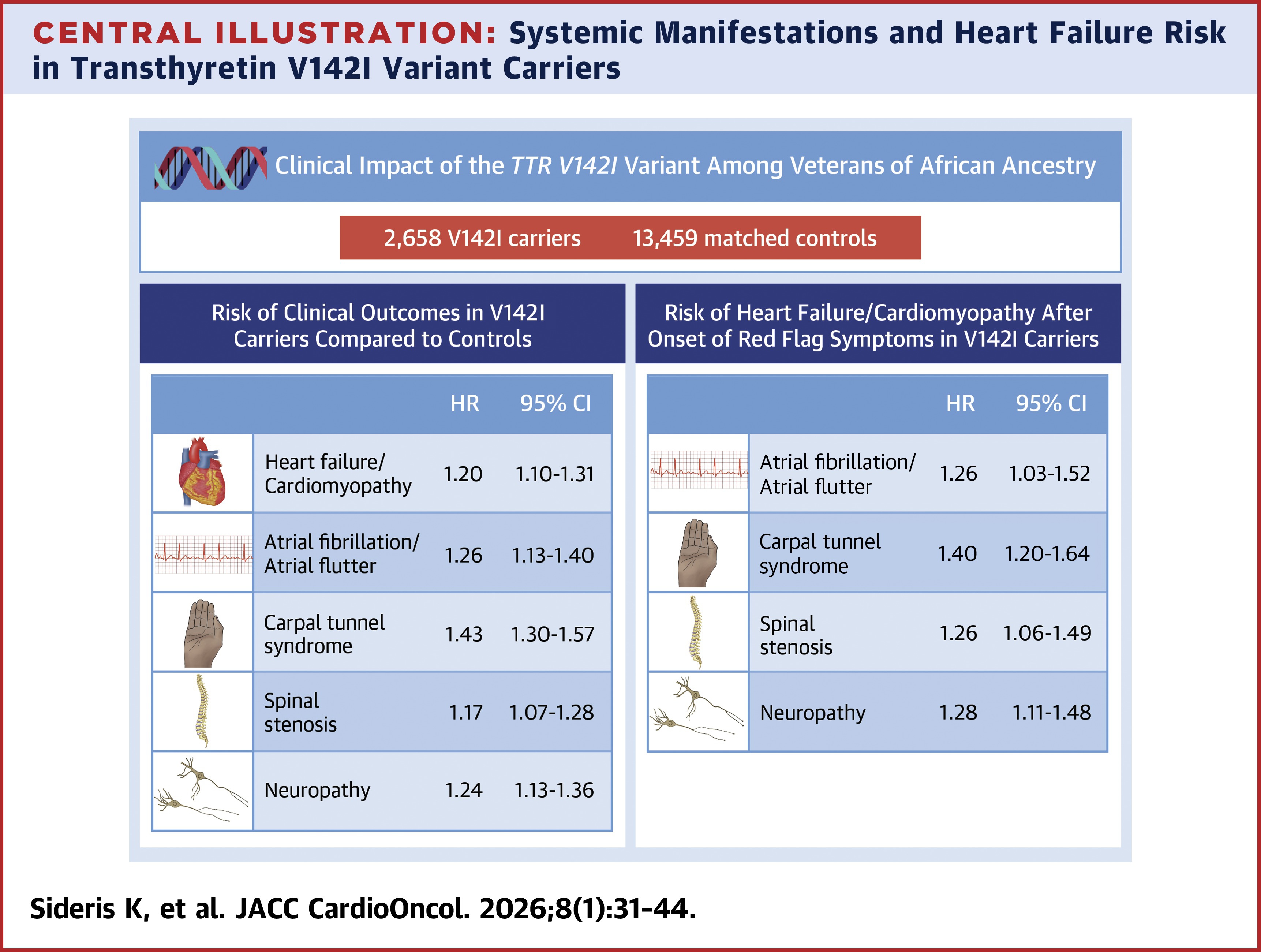
Among individuals with African ancestry, veterans with the V142I variant, the most common one underlying variant amyloidogenic transthyretin (ATTRv) amyloidosis, have a significantly higher risk for heart failure (HF) or cardiomyopathy, HF-related hospitalization, atrial fibrillation (AFib) or atrial flutter, cardiovascular mortality, all-cause mortality, carpal tunnel syndrome and spinal stenosis, compared with matched controls, according an analysis of the Million Veteran Program (MVP) published Feb. 17 in JACC: CardioOncology.
In this retrospective cohort study, there were 2,658 V142I carriers and 13,459 matched controls based on race, sex and birth year. They were 53 years old on average and 13% were women.
Results after multivariable adjustment revealed that V142I carriers had higher risks for HF or cardiomyopathy (hazard ratio [HR] 1.20), AFib or atrial flutter (HR 1.26), carpal tunnel syndrome (HR 1.43), spinal stenosis (HR 1.17), neuropathy (HR 1.24), all-cause mortality (HR 1.12), cardiovascular mortality (HR 1.37) and HF-related hospitalizations (HR 1.25).
There was also a higher incidence of HF or cardiomyopathy among carriers who developed amyloidosis-related red-flag symptoms: AFib or atrial flutter (HR 1.26), carpal tunnel syndrome (HR 1.40), spinal stenosis (HR 1.26) and neuropathy (HR 1.28), "highlighting a systemic, age-related ATTRv amyloidosis phenotype in which musculoskeletal, neuropathic and arrhythmic manifestations often precede overt HF or [cardiomyopathy]," according to study authors Konstantinos Sideris, MD, et al.
"With an estimated 1.6 million carriers in the [U.S.], the V142I variant represents a large at-risk population with a well-described pattern of extracardiac and cardiac manifestations," write Artur Schneider, DO; Elizabeth A. Mauricio, MD; and Melissa A. Lyle, MD, FACC; in an accompanying editorial comment, "yet recognition frequently occurs only after advanced disease has developed, despite the availability of disease modifying therapies for ATTR amyloidosis."
They note that during the study period, only 3.3% of carriers and 0.4% of controls received a clinical diagnosis of amyloidosis, despite 83.0% of carriers and 49.2% of controls already exhibiting HF or cardiomyopathy.
"How many V142I carriers with evidence of clinical disease are we missing in practice?" ask Schneider et al. "It is a sobering question, particularly when the present study highlights the heightened [cardiovascular] risk that V142I carriers face."
Clinical Topics: Arrhythmias and Clinical EP, Heart Failure and Cardiomyopathies, Atrial Fibrillation/Supraventricular Arrhythmias, Acute Heart Failure
Keywords: Cardiomyopathies, Amyloidosis, Heart Failure, Heart Disease Risk Factors, Cardio-oncology, Atrial Fibrillation, Prealbumin
< Back to Listings


