ACC Releases New Guidance For Managing Resistant Hypertension
A new 2026 ACC Expert Consensus Decision Pathway focuses on “Optimizing Blood Pressure Care in Patients With Resistant Hypertension” and addresses implementation gaps not covered in the 2025 AHA/ACC/Multisociety High Blood Pressure Guideline. Read the full Expert Consensus Decision Pathway document in JACC.
Chaired by Leslie L. Davis, PhD, RN, ANP-BC, FACC, and Vice Chair Eugene Yang, MD, MS, FACC, the document provides clinicians with practical guidance and best practices for standardizing blood pressure (BP) measurement across care settings, distinguishing resistant hypertension from other forms of difficult-to-control BP, and selecting appropriate pharmacologic, nonpharmacologic, and device-based treatment strategies.
The report specifically emphasizes “on timely escalation of treatment based on BP thresholds and patient responses” and introduces a five-question framework designed to help clinicians overcome common barriers to achieving BP control.
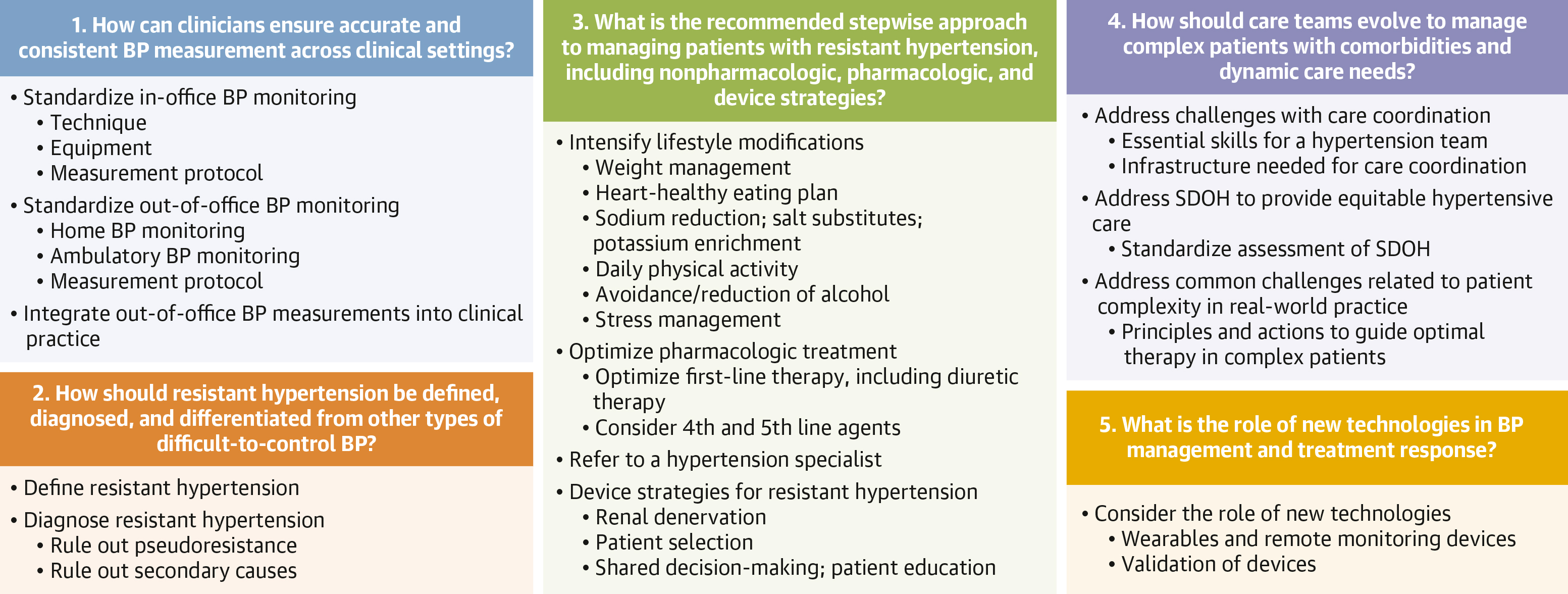
The framework addresses five key questions:
- How can clinicians ensure accurate and consistent BP measurement across clinical settings?
- How should resistant hypertension be defined, diagnosed, and differentiated from other forms of difficult-to-control BP?
- What is the recommended stepwise approach to managing patients with resistant hypertension, including nonpharmacologic, pharmacologic, and device-based strategies?
- How should care teams evolve to manage complex patients with comorbidities and changing care needs?
- What role can new technologies play in BP management and assessing treatment response?
“This [document] operationalizes the [High Blood Pressure Guideline] for adults with resistant hypertension by offering a practical, stepwise framework to support accurate diagnosis and appropriate treatment escalation,” write Davis, Yang, et al. “It addresses therapeutic inertia and medication nonadherence, which remain major barriers to BP control, through simplified regimens, single-pill combinations, and team-based care models.”
The document also highlights strategies for addressing social and societal barriers that affect BP management and outlines best practices for care coordination across multidisciplinary teams. Additional areas of focus include shared decision-making and the growing role of emerging technologies and treatments, including renal denervation, wearable devices, and remote monitoring tools.
Clinical Topics: Prevention, Hypertension
Keywords: Blood Pressure, Medication Adherence, Patient Care Team, Hypertension, Wearable Electronic Devices, Denervation
