
HI-PEITHO and the Evolution of Reperfusion Strategies in Pulmonary Embolism
Quick Takes
- The HI-PEITHO (Ultrasound-facilitated, Catheter-directed, Thrombolysis in Intermediate-high Risk Pulmonary Embolism) trial was the first randomized controlled trial whose findings demonstrated that catheter-directed fibrinolysis reduces early clinical deterioration in intermediate-risk PE compared with anticoagulation alone.
- Ultrasound-facilitated catheter-directed fibrinolysis achieved this benefit without a significant increase in major bleeding and with no intracranial hemorrhage observed.
- The findings support catheter-directed fibrinolysis in carefully selected patients with intermediate-risk PE and right ventricular dysfunction, myocardial injury, and signs of cardiorespiratory distress.
Background and Clinical Context
Management of intermediate-risk pulmonary embolism (PE) remains one of the most challenging areas in venous thromboembolism care. These patients are hemodynamically stable but have right ventricular (RV) dysfunction and myocardial injury, placing them at increased risk of clinical deterioration. The results of the pivotal PEITHO (Ultrasound-facilitated, Catheter-directed, Thrombolysis in Intermediate-high Risk Pulmonary Embolism) trial demonstrated that systemic tenecteplase reduced hemodynamic decompensation; however, this benefit came at the cost of substantially increased bleeding, including 11.5% major bleeding and 2% intracranial hemorrhage (ICH).1 Consequently, routine systemic thrombolysis has not been adopted for most patients with intermediate-risk PE, and anticoagulation alone remains standard therapy despite a persistent risk of clinical worsening.1,2
Catheter-directed fibrinolysis emerged as an attractive alternative by delivering low-dose thrombolytic therapy directly into the pulmonary arteries to reduce thrombus burden while limiting systemic exposure and bleeding risk. Early studies—including the ULTIMA (Ultrasound Accelerated Thrombolysis of Pulmonary Embolism), with 59 patients, and SEATTLE II (Prospective, Single-Arm, Multi-Center Trial of EkoSonic Endovascular System and Activase for Treatment of Acute Pulmonary Embolism), with 150 patients—demonstrated improvements in surrogate endpoints, particularly RV/left ventricular (LV) ratio, leading to Food and Drug Administration (FDA) clearance of the EkoSonic Endovascular System (Boston Scientific) in 2014.1 However, as highlighted by Harvey, Huang, and Uberoi in 2022 and others, no randomized trial had shown improvement in clinical outcomes compared with anticoagulation alone.2,3 The HI-PEITHO trial was designed to address this evidence gap.4
Trial Design and Population
The HI-PEITHO trial was a multinational, randomized controlled trial (RCT) with an adaptive design and blinded outcome adjudication. Eligible patients had acute intermediate-risk PE confirmed by computed tomography pulmonary angiography, RV dysfunction (RV/LV ratio ≥1), and elevated troponin levels. To enrich for patients at greater risk of deterioration, investigators additionally required at least two markers of cardiorespiratory distress: systolic blood pressure ≤110 mm Hg, heart rate ≥100 bpm, respiratory rate ≥20 breaths/min, or hypoxemia.4
This strategy identified a particularly vulnerable subgroup within the intermediate-risk spectrum—patients without overt shock but with signs of impending hemodynamic compromise. Patients with established hemodynamic instability were excluded.
A total of 544 patients were randomly assigned 1:1 to ultrasound-facilitated catheter-directed fibrinolysis with low-dose alteplase plus anticoagulation or anticoagulation alone, with stratification by age and RV/LV ratio. The mean age was 58.2 years, and 42.6% of participants were women.4
Key Findings
The primary endpoint was a composite of PE-related death, cardiorespiratory decompensation or collapse, or recurrent symptomatic PE within 7 days.
The primary outcome occurred in 4% of patients receiving catheter-directed fibrinolysis compared with 10.3% receiving anticoagulation alone (relative risk 0.39; 95% confidence interval, 0.2-0.77; p = 0.005). This result corresponds to a 61% relative risk reduction, a 6.3% absolute risk reduction, and a number needed to treat of approximately 16.4
The benefit was primarily driven by a reduction in cardiorespiratory decompensation or collapse, mirroring the principal efficacy signal observed in the original PEITHO (Pulmonary Embolism Thrombolysis Study). Although mortality rates were low, preventing clinical deterioration remains highly relevant because it may avert rescue thrombolysis, mechanical circulatory support, intensive care utilization, and prolonged hospitalization.
The safety profile was favorable. Major bleeding at 7 days occurred in 4.1% of the intervention group and in 2.2% of the control group (p = 0.32); at 30 days, it occurred in 4.1% of the intervention group and in 3% of the control group (p = 0.64). No ICH occurred in either group. These data contrast sharply with data from the PEITHO, in which ICH occurred in 2% of patients receiving systemic thrombolysis.1 No substantial differences in other serious adverse events were observed through 30 days.4
These findings suggest that localized, low-dose catheter-directed fibrinolysis may preserve clinical benefit while substantially reducing the most feared bleeding complication.
Strengths
The HI-PEITHO trial represents a landmark trial in PE management. It was the first adequately powered RCT to demonstrate that catheter-directed fibrinolysis improves clinically meaningful outcomes rather than surrogate imaging markers. Previous evidence supporting catheter-based reperfusion largely originated from registries, observational studies, and small mechanistic trials5,6; the HI-PEITHO results therefore provide the highest level of evidence available for this strategy.
The investigators also employed thoughtful risk-enrichment criteria. By requiring clinical signs of cardiorespiratory distress in addition to RV dysfunction and troponin level elevation, the trial focused on patients most likely to benefit from reperfusion therapy. This approach resulted in a control-group event rate exceeding 10%, substantially higher than the 5.6% observed in the PEITHO. The multinational design, randomized methodology, and blinded endpoint adjudication further strengthened the validity of the findings.
Limitations
Several limitations warrant consideration. First, the trial was unblinded, and knowledge of treatment assignment may have influenced decisions regarding escalation of care. Although endpoint adjudication was blinded, subjective components of clinical deterioration remain susceptible to bias.
Second, the intervention used the EkoSonic ultrasound-facilitated platform and was sponsored by the device manufacturer, Boston Scientific. The SUNSET sPE (Standard Versus Ultrasound-Assisted Thrombolysis for Submassive Pulmonary Embolism) trial findings demonstrated similar thrombus reduction with ultrasound-assisted and conventional multiside-hole catheters, suggesting that local delivery of low-dose fibrinolytic therapy, rather than ultrasound itself, may be the key mechanism.7
Third, long-term outcomes remain unknown. Prevention of chronic thromboembolic pulmonary hypertension, post-PE syndrome, exercise limitation, and impaired quality of life may ultimately prove as important as short-term stabilization. The planned 12-month follow-up data will therefore be important.
Finally, although major bleeding was not significantly increased, the observed 4.1% bleeding rate is not trivial. Careful patient selection remains essential, particularly in older patients and those at increased bleeding risk.
Implications for Clinical Practice
The HI-PEITHO trial arrived at a pivotal moment. The 2026 ACC/AHA/Multisociety Guideline for the Evaluation and Management of Acute PE in Adults noted that catheter-directed thrombolysis trials had not been adequately powered to demonstrate reductions in clinical deterioration compared with anticoagulation alone.2 The HI-PEITHO trial directly addressed this limitation.
Importantly, these findings should not be generalized to all patients with intermediate-risk PE. The benefit was demonstrated in a carefully selected population characterized by RV dysfunction, myocardial injury, and objective signs of cardiorespiratory distress. Whether patients with lower-risk PE derive similar benefit remains unknown.
The trial also reinforces the importance of multidisciplinary pulmonary embolism response teams (or PERTs), which are well positioned to identify appropriate candidates for advanced reperfusion strategies and balance competing risks of deterioration and bleeding.
Conclusion
The HI-PEITHO trial was the first RCT whose findings demonstrated that catheter-directed fibrinolysis reduces early clinical deterioration in select patients with intermediate-risk PE. This benefit was achieved without a significant increase in major bleeding and with no ICH observed. These findings support a greater role for catheter-directed reperfusion in carefully selected patients while reinforcing the importance of multidisciplinary, individualized treatment decisions. Figure 1 provides a visual summary of the trial design, key findings, and clinical implications.
Figure 1: Summary of Findings From the HI-PEITHO Trial
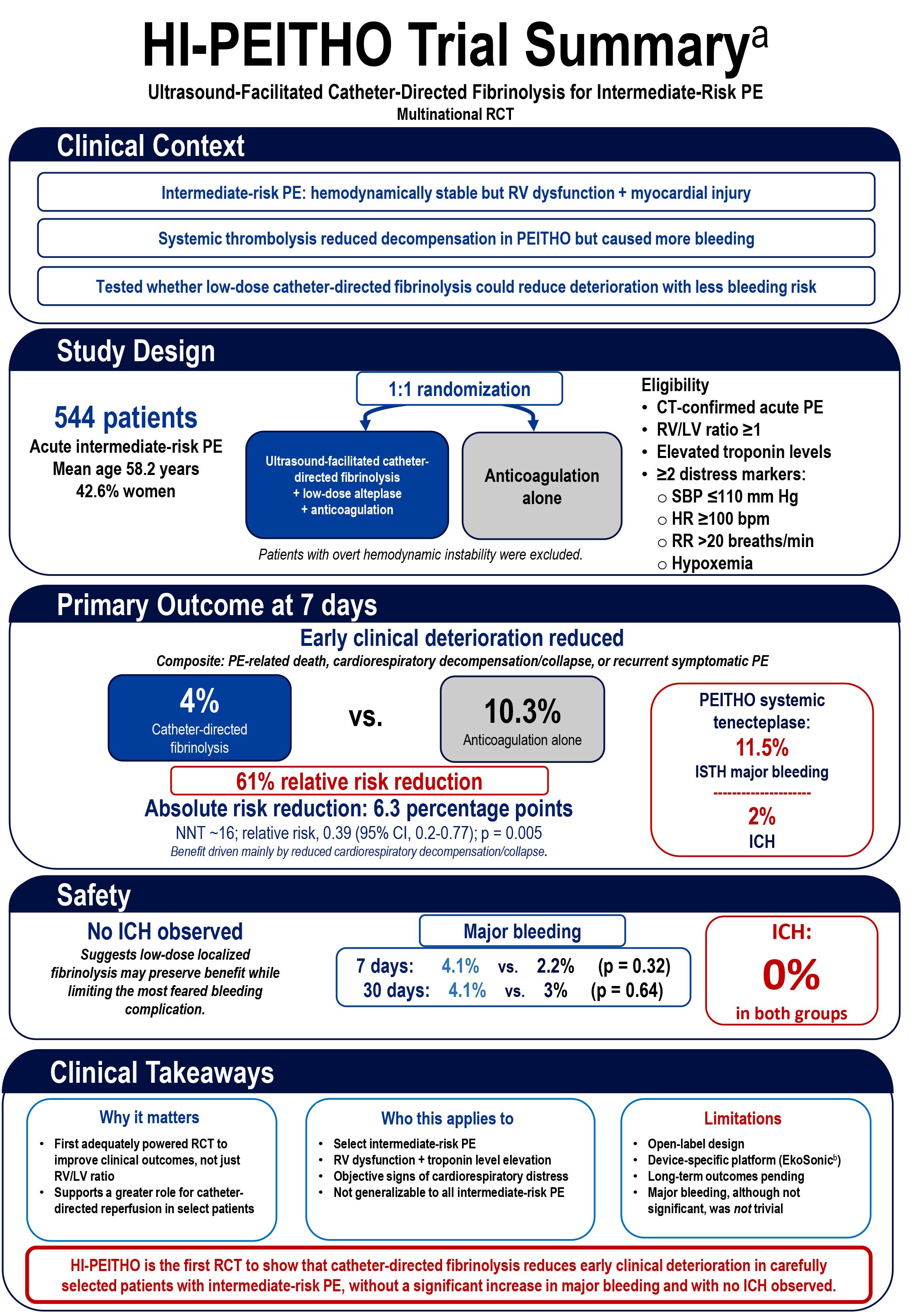
a Data adapted from Rosenfield K, Klok FA, Piazza G, et al. Ultrasound-facilitated, catheter-directed fibrinolysis for acute pulmonary embolism. N Engl J Med. 2026;394(20):1979-1990. doi:10.1056/NEJMoa2516567.
b Product of Boston Scientific
CI = confidence interval; CT = computed tomography; HI-PEITHO = Ultrasound-facilitated, Catheter-directed, Thrombolysis in Intermediate-high Risk Pulmonary Embolism; HR = heart rate; ICH = intracranial hemorrhage; ISTH = International Society of Thrombosis and Haemostasis; LV = left ventricle; NNT = number needed to treat; PE = pulmonary embolism; PEITHO = Pulmonary Embolism Thrombolysis Study; RCT = randomized controlled trial; RR = respiratory rate; RV = right ventricle; SBP = systolic blood pressure.
References
- Rashedi S, Leyva H, Hamade N, et al. Fibrinolytic therapy for thromboembolic diseases: approved indications and future directions. J Am Coll Cardiol. 2025;86(14):1065-1087. doi:10.1016/j.jacc.2025.07.061
- Creager MA, Barnes GD, Giri J, et al. 2026 AHA/ACC/ACCP/ACEP/CHEST/SCAI/SHM/SIR/SVM/SVN guideline for the evaluation and management of acute pulmonary embolism in adults: a report of the American College of Cardiology/American Heart Association Joint Committee on Clinical Practice Guidelines. J Am Coll Cardiol. 2026;87(13):1626-1710. doi:10.1016/j.jacc.2025.11.005
- Harvey JJ, Huang S, Uberoi R. Catheter-directed therapies for the treatment of high risk (massive) and intermediate risk (submassive) acute pulmonary embolism. Cochrane Database Syst Rev. 2022;8(8):CD013083. Published 2022 Aug 8. doi:10.1002/14651858.CD013083.pub2
- Rosenfield K, Klok FA, Piazza G, et al. Ultrasound-facilitated, catheter-directed fibrinolysis for acute pulmonary embolism. N Engl J Med. 2026;394(20):1979-1990. doi:10.1056/NEJMoa2516567
- Balakrishna AM, Kalathil RAM, Pusapati S, et al. Comparative outcomes of catheter-directed thrombolysis plus systemic anticoagulation versus systemic anticoagulation alone in the management of intermediate-risk pulmonary embolism in a systematic review and meta-analysis. Am J Cardiol. 2023;205:249-258. doi:10.1016/j.amjcard.2023.07.170
- Planer D, Yanko S, Matok I, et al. Catheter-directed thrombolysis compared with systemic thrombolysis and anticoagulation in patients with intermediate- or high-risk pulmonary embolism: systematic review and network meta-analysis. CMAJ. 2023;195(24):E833-E843. doi:10.1503/cmaj.220960
- Expert Panel on Interventional Radiology, Plett S, Fidelman N, et al. ACR Appropriateness Criteria® management of acute pulmonary embolism. J Am Coll Radiol. 2025;22(11S):S586-S596. doi:10.1016/j.jacr.2025.08.039
Clinical Topics: Invasive Cardiovascular Angiography and Intervention, Vascular Medicine, Interventions and Vascular Medicine, Pulmonary Hypertension and Venous Thromboembolism
Keywords: Pulmonary Embolism, Fibrinolysis, Reperfusion, Critical Care Outcomes
