
CKM Syndrome: Insights From and Comparison of Recent Guidelines
Quick Takes
- The heart failure (HF) risk-stratification gap has been closed: The PREVENT-CVD (Predicting Risk of Cardiovascular Disease EVENTs–Cardiovascular Disease [AHA]) calculator quantifies the spectrum of cardiovascular risk to include HF risk.
- Obesity-related HFpEF is recognized as a distinct entity, highlighting metabolic dysfunction as the therapeutic target with GLP-1 receptor agonists.
- The cardiovascular-kidney-metabolic guidelines endorse SGLT2 inhibitors for patients without diabetes mellitus who have albuminuria (urinary albumin-to-creatinine ratio 30-199 mg/g), expanding cardiorenal protection to earlier disease stages.
The 2026 ACC/AHA/Multisociety Guideline for the Prevention, Detection, Evaluation, and Management of Cardiovascular-Kidney-Metabolic Syndrome provides an expanded framework for assessing and managing interconnected metabolic risk factors, including diabetes mellitus (DM), obesity, metabolic dysfunction–associated steatotic liver disease, hypertriglyceridemia, and chronic kidney disease (CKD) that drive cardiovascular disease (CVD) and kidney disease progression.1 The 2023 European Society of Cardiology (ESC) Guidelines for the Management of CVD in Patients With DM addresses similar therapeutic considerations but focuses specifically on adults with established DM.2 This expert analysis compares the two guidelines across three domains: conceptual framework, risk-estimation tools, and therapeutic interventions.
The fundamental difference lies in scope. The 2023 ESC guideline exclusively targets patients with established DM, whereas the 2026 ACC/AHA/multisociety guideline defines a broader syndrome encompassing the intersection of metabolic disorders with CVD and kidney disease, positioning dysfunctional adipose tissue, inflammation, and insulin resistance as the core pathophysiologic drivers.1,2
Cardiovascular-kidney-metabolic (CKM) syndrome is stratified into five progressive stages reflecting escalating CVD risk (Table 1).
Table 1: Five Progressive Stages of CKM Syndrome Reflecting Escalating CVD Risk
| Stage | Criteria |
Definition |
| 0 | No CV-kidney risk factors |
|
| 1 | Excess or dysfunctional adiposity |
|
| 2 | Metabolic risk factors, CKD, or both |
|
| 3 | Subclinical CVD |
|
| 4 | Clinical CVD |
|
a BP ≥130/80 mm Hg
b CAC with Agatston score ≥100, coronary catheterization/CTA, low ABI without claudication symptoms
c Including NT-proBNP, hs-cTnT, and hs-cTnI
d eGFR <15 mL/min/1.73 m2 or need for chronic kidney replacement therapy
ABI = ankle-brachial index; AF = atrial fibrillation; BP = blood pressure; CKD = chronic kidney disease; CKM = cardiovascular-kidney-metabolic; CTA = CT angiography; CV = cardiovascular; CVD = cardiovascular disease; echo = echocardiographic; eGFR = estimated glomerular filtration rate; HbA1c = hemoglobin A1c; HF = heart failure; hs-cTnI = high-sensitivity cardiac troponin I; hs-cTnT = high-sensitivity cardiac troponin T; HTN = hypertension; KDIGO = Kidney Disease Improving Global Outcomes; MetS = metabolic syndrome; NHLBI = National Heart, Lung, and Blood Institute; PAD = peripheral artery disease; T2DM = type 2 diabetes mellitus.
Designed for implementation across the lifespan, this staging system enables risk stratification, disease progression prevention, and promotion of regression through lifestyle modification and therapeutic interventions, engaging patients far earlier in life. In comparison, the 2023 ESC guidelines engage risk predominantly once a DM diagnosis is established to prevent CVD in this population.1
A notable CKM insight involves GLP-1 receptor agonists (GLP1RAs) in heart failure (HF). The SELECT (Semaglutide Effects on Cardiovascular Outcomes in People With Overweight or Obesity) trial data demonstrated that semaglutide reduced cardiovascular (CV) events in patients with established CVD and obesity who did not have DM, including those with prior HF.3 The 2026 ACC/AHA/multisociety guideline accordingly recommends GLP1RAs for patients with heart failure with preserved ejection fraction (HFpEF) and concomitant obesity and DM.1 This recommendation represents recognition that obesity-related HFpEF constitutes a distinct phenotype requiring targeted metabolic intervention beyond standard HF therapy.4
Furthermore, the 2026 ACC/AHA/multisociety guideline acknowledges that patients with HF and concurrent CKD (CKM stage 4) represent the patients at highest risk requiring aggressive multimodal therapy.1 Bidirectional cardiorenal interactions in this population necessitate careful medication titration, with SGLT2 inhibitors (SGLT2is) demonstrating consistent benefits regardless of baseline kidney function down to estimated glomerular filtration rate (eGFR) 20 mL/min/1.73 m2.5
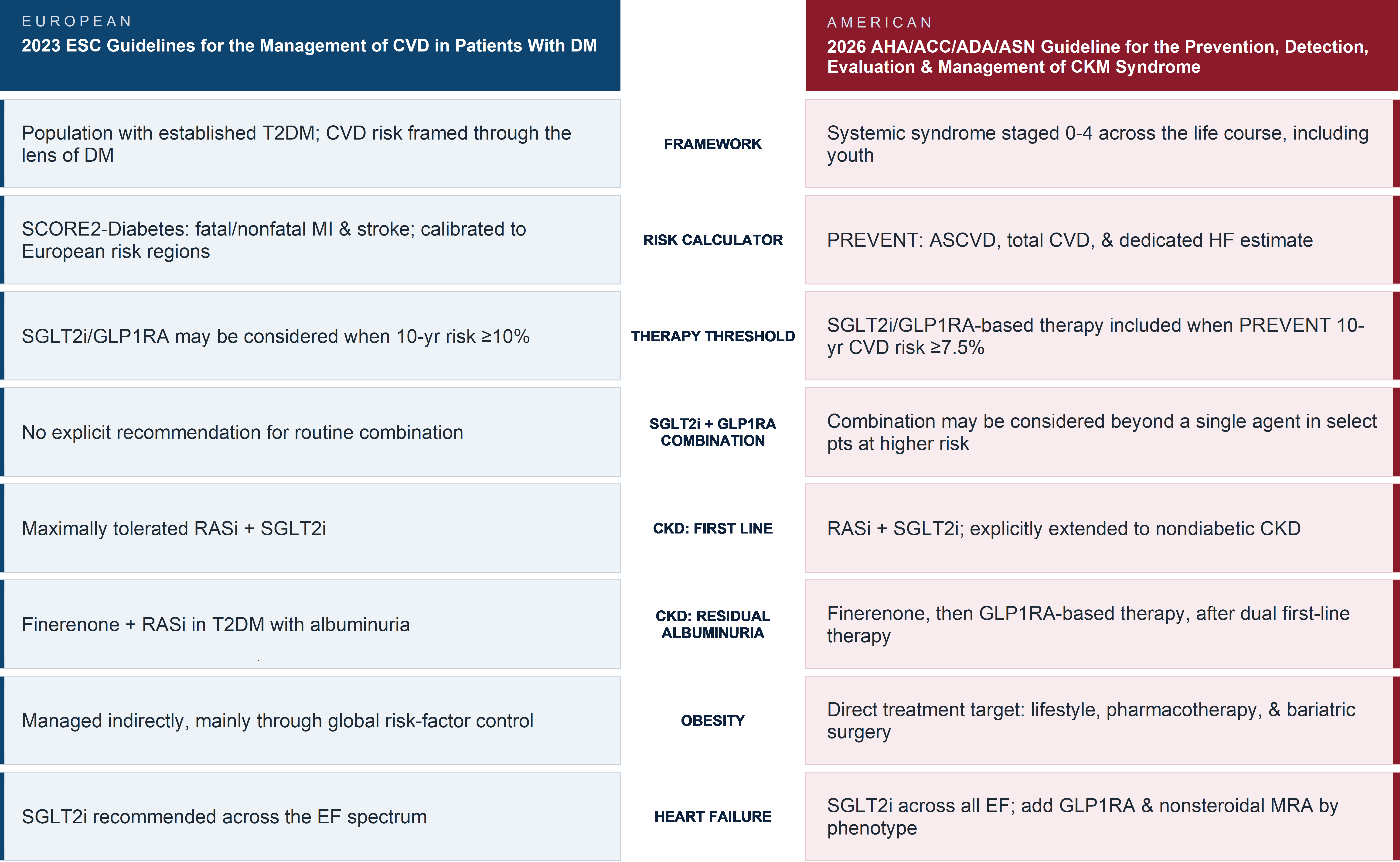
Both guidelines recommend prioritization of glucose-lowering agents with proven CV benefits at different thresholds for initiation.1,2 The 2026 ACC/AHA/multisociety guideline recommends starting an SGLT2i or GLP1RA in patients with CKM stages 2 or 3, type 2 diabetes mellitus (T2DM), and 10-year PREVENT-CVD (Predicting Risk of Cardiovascular Disease EVENTs–Cardiovascular Disease [AHA]) score ≥7.5% (Class 1), with consideration for combination therapy (Class 2b).1 Unlike the SCORE2-Diabetes (Systematic Coronary Risk Evaluation 2–Diabetes) tool, the PREVENT (Predicting Risk of Cardiovascular Disease EVENTs [AHA]) score incorporates kidney function and estimates HF risk.6
The 2023 ESC guidelines recommend single cardioprotective therapy in patients with T2DM who do not have ASCVD when their 10-year CVD risk is ≥10%, without combination therapy recommendations.2 The 2026 ACC/AHA/multisociety guideline recommends metformin as an adjuvant antiglycemic agent when hemoglobin A1c concentration is 0.5-1% above target (Class 2a), whereas the 2023 ESC guidelines recommend metformin for CV risk reduction in patients with T2DM who do not have ASCVD or severe target-organ damage and who are at risk of CVD (class IIa/IIb).1,2 Both guidelines recommend maximally tolerated doses of renin-angiotensin inhibitors (RASi), including ARBs and ACEIs, for patients with eGFR ≥30 mL/min/1.73 m2.1,2
The most notable difference in the 2026 ACC/AHA/multisociety guideline, with no ESC corresponding recommendation, is the consideration of an SGLT2i in patients without DM but with CKD and urinary albumin-to-creatinine ratio (UACR) ≥30-199 mg/g (Class 2a).1 This recommendation reflects data from the DAPA-CKD (Dapagliflozin And Prevention of Adverse outcomes in Chronic Kidney Disease) and EMPA-KIDNEY (Study of Heart and Kidney Protection With Empagliflozin) trials demonstrating kidney and CV protection independent of DM status.6 The 2026 ACC/AHA/multisociety guideline recommends SGLT2is in the setting of eGFR ≥20 mL/min/1.73 m2 as first-line therapy in patients with DM to reduce the risk of kidney function loss and to lower CVD risk (Class 1).1 Additional nephroprotective strategies in this guideline include adding a nonsteroidal mineralocorticoid-receptor antagonist (nsMRA; finerenone) or a GLP1RA in CKM stages 2 and 3 explicitly as a third-line agent after failure of maximally tolerated RASi and SGLT2is (Class 1), with eGFR ≥25 mL/min/1.73 m2 for nsMRA and UACR ≥100 mg/g for GLP-1.1
Finerenone is recommended in the 2023 ESC guidelines in addition to ACEI/ARB in the setting of UACR ≥30 mg/mmol and eGFR >60 mL/min/1.73 m2 or UACR ≥3 mg/mmol and eGFR 25-60 mL/min/1.73 m2. GLP-1–based therapy is recommended as an antiglycemic agent at eGFR >15 mL/min/1.73 m2 (class I).2
Obesity is addressed indirectly in the 2023 ESC guidelines through risk-factor control.2 The 2026 ACC/AHA/multisociety guideline demonstrates obesity as a therapeutic gradient through lifestyle modifications (Class 1) plus pharmacologic and bariatric surgical interventions, highlighting dysfunctional adiposity as CKM syndrome's root.1
Although both guidelines endorse SGLT2is across the HF spectrum,1,2 key distinctions emerge in their therapeutic approach. The 2026 ACC/AHA/multisociety guideline codifies quadruple therapy as foundational management of HF with reduced ejection fraction and explicitly recommends GLP1RAs for patients with HFpEF, obesity, and DM, positioning dysfunctional adiposity as a direct therapeutic target rather than an indirect risk factor as framed by the ESC.1 Important aspects of the CKM paradigm are also addressed in the practice-changing 2026 ACC/AHA/Multisociety Guideline on the Management of Dyslipidemia and 2025 ACC/AHA/Multisociety Guideline for the Prevention, Detection, Evaluation, and Management of High Blood Pressure in Adults.7,8
Ultimately, these guidelines are complementary, reaching concordant therapeutic endpoints through different methodological routes. The CKM framework distinguishes itself through earlier intervention across the disease continuum, systematic integration of social drivers of health, and emphasis on interdisciplinary coordination to deliver patient-centered, holistic care. In conclusion, CKM syndrome reframes cardiometabolic disorder as a single, complex, interconnected pathophysiologic process (Figure 1).
Figure 1: Two Frameworks, One Evidence Base: A Point-by-Point Comparison of CKM Syndrome Management1,2
Note: PREVENT is a trademark of the AHA.
ADA = American Diabetes Association; ASN = American Society of Nephrology; CKD = chronic kidney disease; CKM = cardiovascular-kidney-metabolic; CVD = cardiovascular disease; DM = diabetes mellitus; EF = ejection fraction; ESC = European Society of Cardiology; GLP1RA = GLP-1 receptor agonist; HF = heart failure; MI = myocardial infarction; MRA = mineralocorticoid-receptor antagonist; PREVENT = Predicting Risk of Cardiovascular Disease EVENTs; RASi = renin-angiotensin system inhibitors; SCORE2-Diabetes = Systematic Coronary Risk Evaluation 2–Diabetes; SGLT2i = SGLT2 inhibitor; T2DM = type 2 diabetes mellitus.
References
- Ndumele CE, Rodriguez F, Dixon DL, et al. 2026 AHA/ACC/ADA/ASN guideline for the prevention, detection, evaluation, and management of cardiovascular-kidney-metabolic syndrome: a report of the American College of Cardiology/American Heart Association Joint Committee on Clinical Practice Guidelines. J Am Coll Cardiol. 2026;87(22S):e1889-e2007. doi:10.1016/j.jacc.2026.03.056
- Marx N, Federici M, Schütt K, et al. 2023 ESC guidelines for the management of cardiovascular disease in patients with diabetes. Eur Heart J. 2023;44(39):4043-4140. doi:10.1093/eurheartj/ehad192
- Lincoff AM, Brown-Frandsen K, Colhoun HM, et al. Semaglutide and cardiovascular outcomes in obesity without diabetes. N Engl J Med. 2023;389(24):2221-2232. doi:10.1056/NEJMoa2307563
- Borlaug BA, Jensen MD, Kitzman DW, Lam CSP, Obokata M, Rider OJ. Obesity and heart failure with preserved ejection fraction: new insights and pathophysiological targets. Cardiovasc Res. 2023;118(18):3434-3450. doi:10.1093/cvr/cvac120
- The EMPA-KIDNEY Collaborative Group, Herrington WG, Staplin N, et al. Empagliflozin in patients with chronic kidney disease. N Engl J Med. 2023;388(2):117-127. doi:10.1056/NEJMoa2204233
- Khan SS, Matsushita K, Sang Y, et al. Development and validation of the American Heart Association's PREVENT equations. Circulation. 2024;149(6):430-449. doi:10.1161/CIRCULATIONAHA.123.067626
- Jones DW, Ferdinand KC, Taler SJ, et al. 2025 AHA/ACC/AANP/AAPA/ABC/ACCP/ACPM/AGS/AMA/ASPC/NMA/PCNA/SGIM guideline for the prevention, detection, evaluation, and management of high blood pressure in adults: a report of the American College of Cardiology/American Heart Association Joint Committee on Clinical Practice Guidelines. J Am Coll Cardiol. 2025;86(18):1567-1678. doi:10.1016/j.jacc.2025.05.007
- Blumenthal RS, Morris PB, Gaudino M, et al. 2026 ACC/AHA/AACVPR/ABC/ACPM/ADA/AGS/APhA/ASPC/NLA/PCNA guideline on the management of dyslipidemia: a report of the American College of Cardiology/American Heart Association Joint Committee on Clinical Practice Guidelines. J Am Coll Cardiol. 2026;87(19):2624-2757. doi:10.1016/j.jacc.2025.11.016
Clinical Topics: Diabetes and Cardiometabolic Disease, Dyslipidemia, Geriatric Cardiology, Prevention, Stable Ischemic Heart Disease
Keywords: GLP-1 Receptor, Sodium-Glucose Transporter 2 Inhibitors, Obesity, Metabolic Syndrome, Kidney, Diabetes, Glucagon-Like Peptide 1
