CLASP IID: Residual MR and Gradient at 1 Year Post M-TEER
Patients who underwent mitral transcatheter edge-to-edge repair (M-TEER) with an optimal result were more likely to have improved hemodynamics and less likely to experience major adverse events, all-cause mortality, heart failure (HF) hospitalization or reintervention at one year, according to results from the CLASP IID trial published June 3 in JACC: Cardiovascular Imaging. Among patients who had a suboptimal result, optimizing MR suggested a greater clinical benefit over preserving lower gradients.
Akhil Narang, MD, FACC, et al., included 284 patients who underwent M-TEER – 72.6% achieved an optimal result (MR ≤1+ and mitral valve gradient (MVG) ≤5 mm Hg) and 27.5% achieved a suboptimal result (MR ≤1+ and MVG >5 mm Hg, MR ≥2+ and MVG ≤5 mm Hg, or MR ≥2+ and MVG >5 mm Hg). The study analyzed one-year outcomes by MR and MVG at discharge, including freedom from major adverse events, mortality and a composite of mortality, HF hospitalization and reintervention.
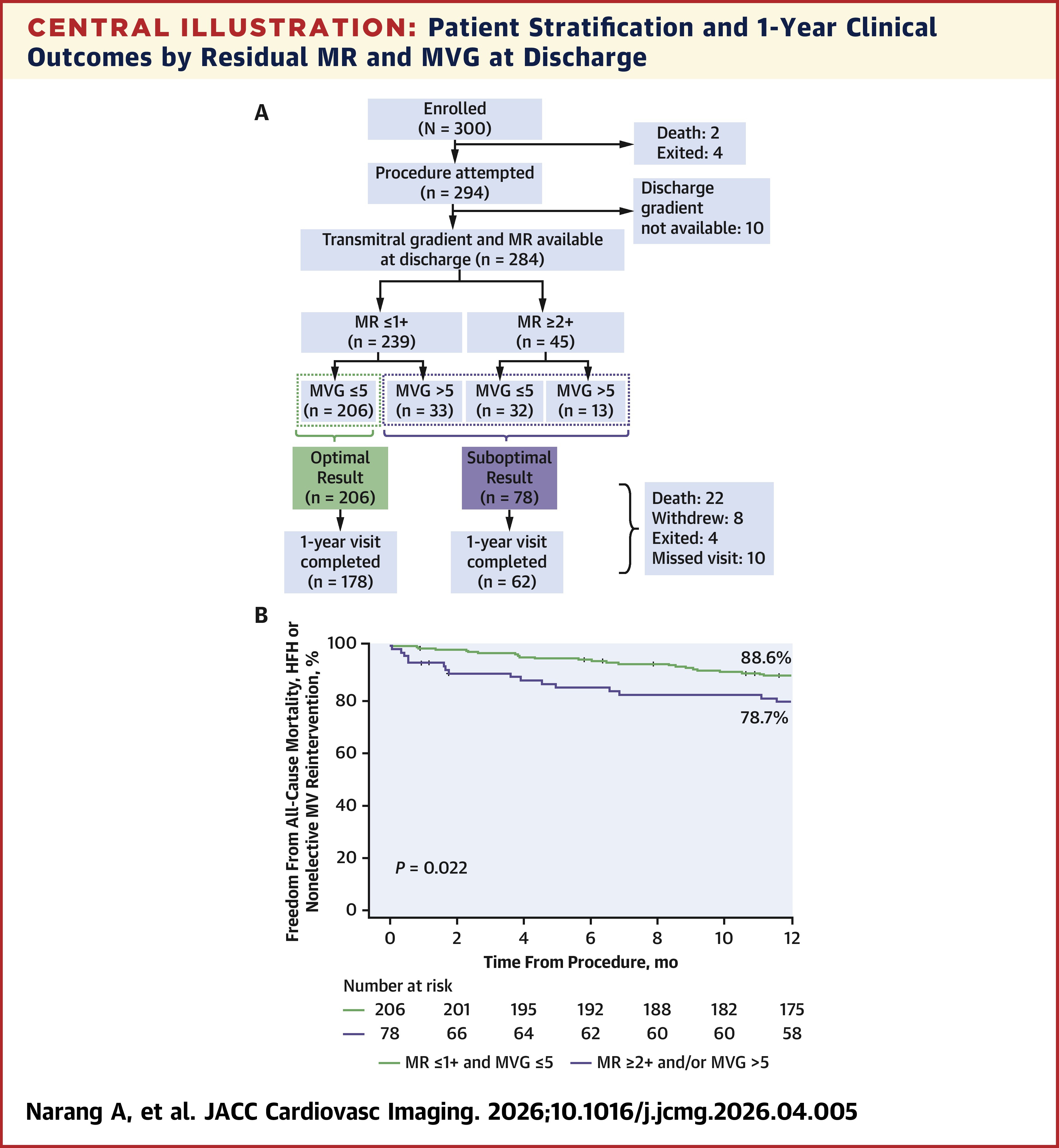
The authors observed significantly improved pulmonary vein flow and tricuspid annular plan systolic excursion in patients who achieved an optimal result. This patient group also exhibited higher freedom from major adverse events (89.5% vs. 79.7%; p=0.023), mortality (94.1% vs. 85.4%; p=0.016) and composite events (88.6% vs. 78.7%; p=0.022).
Suboptimal patients with MR ≤1+ and MVG >5 mm Hg demonstrated greater freedom from major adverse events, mortality and the composite measure compared with the others in the suboptimal result group. "This suggests that the reduction of MR is a more critical determinant of prognosis than maintaining lower gradients and that strategies to reliably reduce MR to ≤1+ should be prioritized," note the authors.
"The CLASP IID trial highlights the importance of understanding and achieving optimal results in M-TEER," they add. "...Future research should focus on developing procedural techniques and device technologies that maximize the likelihood of reliably achieving MR ≤1+ in more patients.
Clinical Topics: Cardiovascular Care Team, Heart Failure and Cardiomyopathies, Acute Heart Failure
Keywords: Pulmonary Veins, Mitral Valve, Hemodynamics, Heart Failure, Prognosis
