Follow-Up of FAVOR III Suggests QFR-Guided PCI Improves 5-Year Outcomes
When compared with angiography guidance, quantitative flow ratio (QFR)-guided PCI improved five-year clinical outcomes with benefits primarily achieved in the first two years, according to a follow-up study of the multicenter, sham-controlled FAVOR III trial published June 10 in JACC.
The investigator-initiated FAVOR III trial took place across 26 centers in China from December 2018 to January 2020. Researchers randomized 3,825 patients (mean age of 63 years, 70% men) with at least one angiographically intermediate coronary lesion (50-90% diameter stenosis) in a vessel ≥2.5 mm diameter to either QFR-guided PCI or to angiography-guided PCI.
Han Zhang, MD, et al., defined the primary endpoint as major adverse cardiac events (MACE), a composite of all-cause death, myocardial infarction (MI) or ischemia-driven revascularization, at five years.
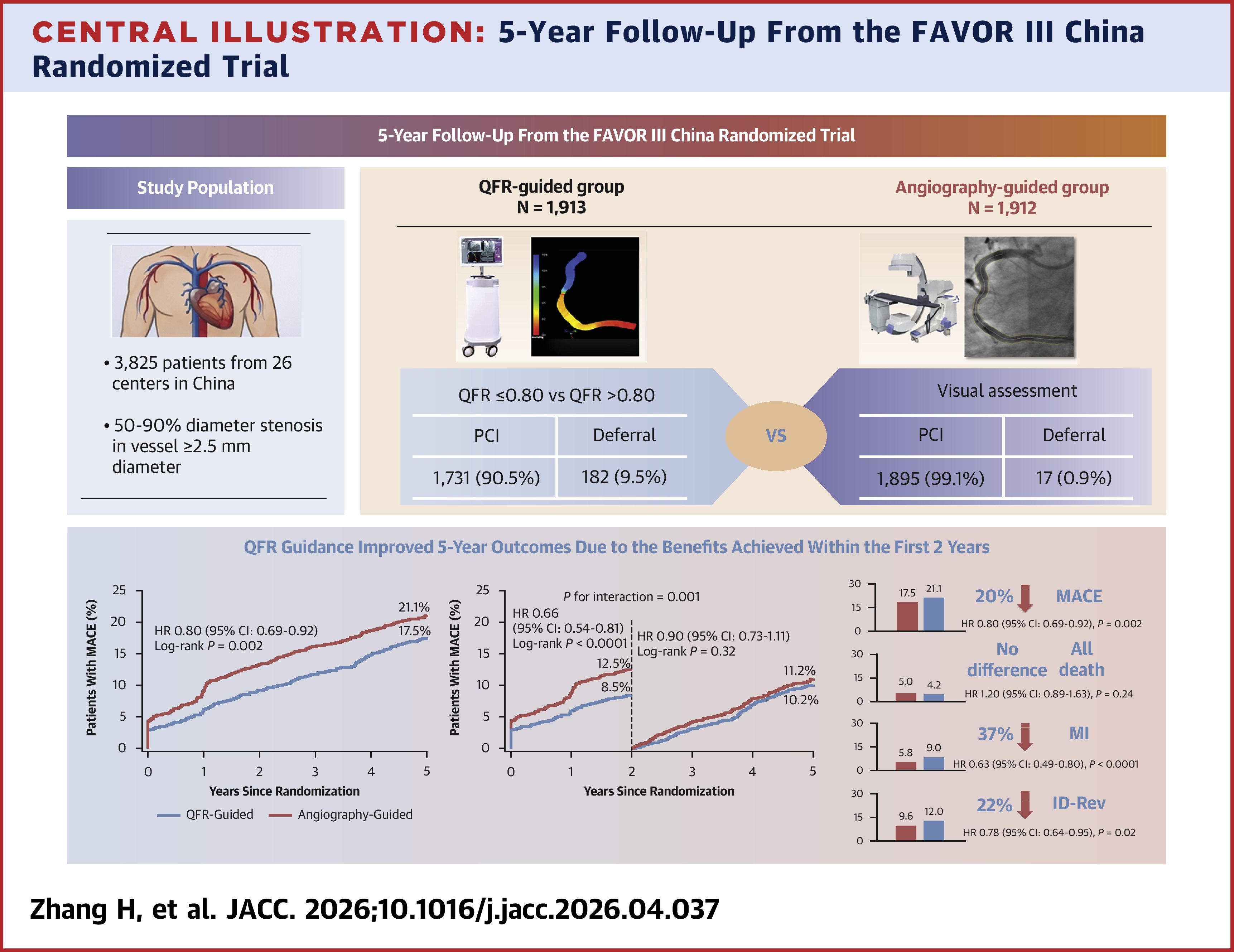
Results showed the primary endpoint was lower with QFR guidance than angiography guidance (18% vs. 21%; hazard ratio [HR], 0.80; p=0.002). This was driven by fewer MI (6% vs. 9%; HR, 0.63; p<0.0001) and ischemia-driven revascularizations (10% vs. 12%; HR, 0.78; p=0.02) in QFR-guided patients. Notably, all-cause death did not differ between groups.
A landmark analysis found the benefit of QFR guidance occurred mainly within the first two years (9% vs. 13%; HR, 0.66; p<0.0001) and outcomes were similar between two and five years for both groups 10% vs. 11%; HR, 0.90; p=0.32; pinteraction =0.001).
"Our results extend and complement prior evidence establishing the value of physiology-guided revascularization with wire-based indices ([fractional flow reserve (FFR)], instantaneous wave-free ratio or resting full-cycle ratio) relative to angiographic guidance," write the authors. "Future studies should focus on integrating next-generation angiography-derived indices with invasive physiology and formal cost-effectiveness analyses to enable personalized revascularization pathways in contemporary practice."
"[Zhang et al.] are commended for conducting and extending follow-up of a large clinical trial comparing angiographic guidance with QFR guidance for PCI – to our knowledge no other comparable trial has been performed or planned," write Arnold H. Seto, MD, FACC; Gautam Kumar, MD, FACC; and Morton J. Kern, MD, FACC, in an accompanying editorial. "QFR, like other [invasive angiographic images] systems, will certainly be improved by more advanced iterations over time."
Clinical Topics: Invasive Cardiovascular Angiography and Intervention, Interventions and Imaging, Angiography, Nuclear Imaging
Keywords: Percutaneous Coronary Intervention, Angiography
