Lower Ambient Temperature Associated With Greater SCA Risk at Marathon Races in Japan
Runners participating in Japanese marathon races largely held in autumn and winter had a greater risk of sudden cardiac arrest (SCA) when the ambient temperature was lower at race start, while no significant relationship between ambient air pollutants and SCA risk was identified, according to a study published June 30 in JACC: Advances.
Jo Kato, MD, et al., included 4.53 million runners who participated in marathon races in Japan between April 2011 and March 2020. They assessed several meteorological variables at race start, including ambient temperature, humidity, solar radiation, wind speed, precipitation and air pressure as well as ambient air pollutants to see if there were any associations with incidence of SCA.
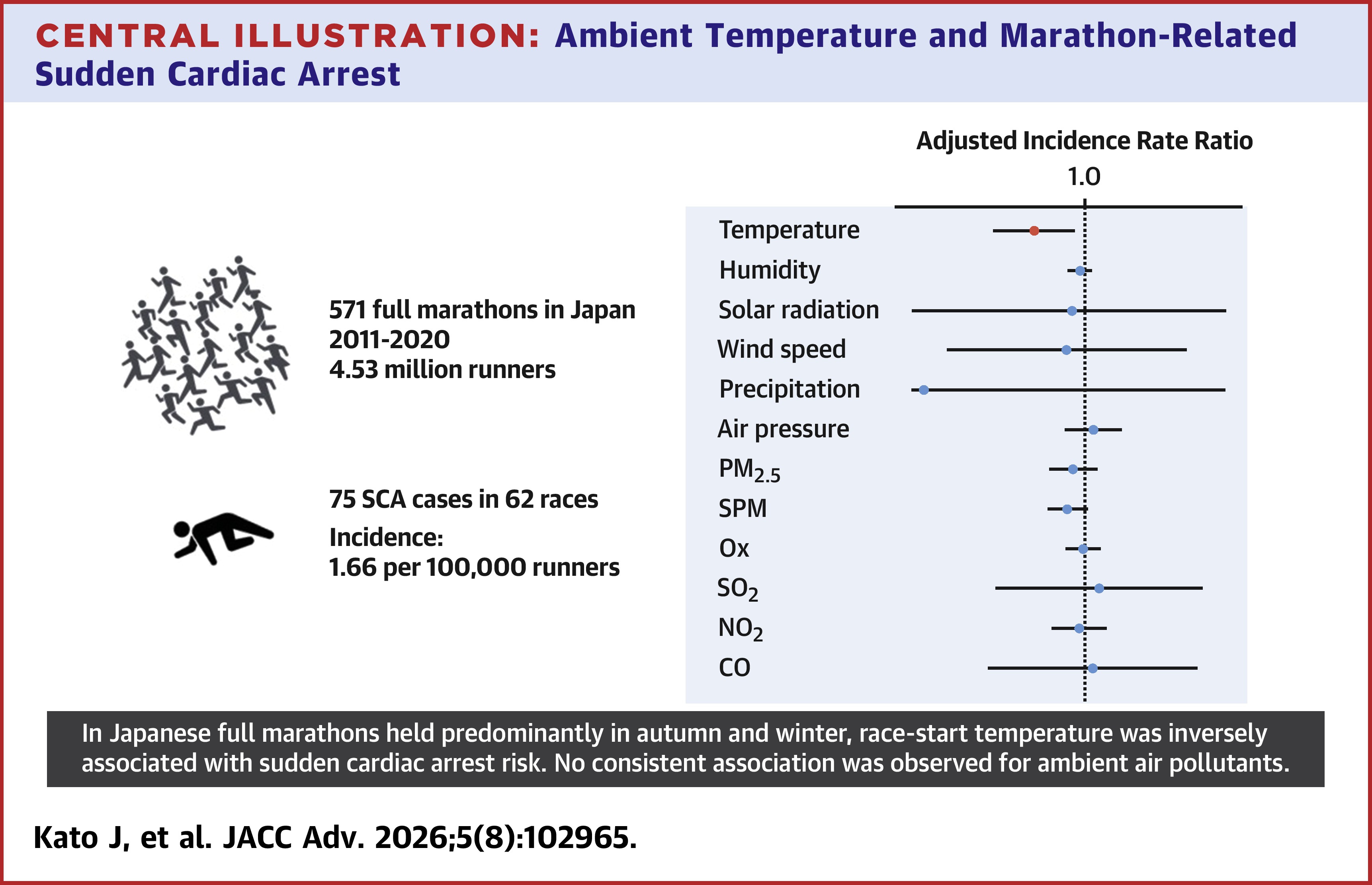
Overall, there were 75 cases of SCA. The authors report an inverse association between ambient temperature at race start and SCA risk (adjusted incidence rate ratio per 1-degree Celsius increase: 0.94; 95% CI, 0.90-0.99), translating to a greater risk at lower temperatures.
"Exposure to cold environments may increase several physiological responses aimed at preserving core body temperature, including peripheral vasoconstriction mediated by sympathetic activation and heat production through shivering," note the authors. "These responses may be accompanied by increases in blood pressure and heart rate, thereby increasing cardiac workload. In addition, cold exposure has also been associated with electrophysiological changes, including QT prolongation, and hemorheological changes that may further increase vulnerability to acute cardiovascular events."
Although previous studies have demonstrated an association between particulate and gaseous air pollutants and increased risk of acute myocardial infarction and out-of-hospital cardiac arrest in the general population, this study's results found no significant association between ambient air pollutants and SCA risk.
The authors point to the following factors as possible explanations for why no association was identified: 1) generally low air pollutant concentrations during the included races, 2) the exposure assessment being based on the immediate environment of the race as opposed to each runner's past exposure and 3) the potential for incomplete measurement of each runner's inhaled exposure throughout the course.
Clinical Topics: Arrhythmias and Clinical EP, Diabetes and Cardiometabolic Disease, Prevention, Sports and Exercise Cardiology, SCD/Ventricular Arrhythmias, Exercise
Keywords: Death, Sudden, Cardiac, Air Pollutants, Marathon Running, Out-of-Hospital Cardiac Arrest, Japan, Temperature
