
Beyond BMI: Body Composition Patterns Emerge in HF
Study participants with heart failure (HF), compared with controls, had had more visceral adipose tissue (VAT), more adverse muscle changes and weaker grip strength, according to research published Aug. 6 in JACC: Heart Failure.
In the study, Javed Butler, MD, MPH, MBA, FACC, et al., matched 185 UK Biobank participants with HF to 925 controls in a 1:5 ratio based on age, sex and BMI. Participants with HF had a mean age of 69 years, 19% were women, mean BMI was 28.1 kg/m2, and mean waist circumference was 96.6 cm. Of these participants, 42 had HF with reduced ejection fraction (HFrEF), 72 had HF with mildly reduced ejection fraction (HFmrEF) and 71 had HF with preserved ejection fraction (HFpEF).
Butler and colleagues catalogued several measures of body composition, adiposity, muscle mass and sarcopenia. These included whole-body magnetic resonance-quantified VAT, abdominal subcutaneous adipose tissue, liver fat, thigh fat-free muscle volume (MV), muscle fat infiltration (MFI), and adverse muscle composition (AMC), defined as a low MV z score and high MFI.
Results showed that participants with HF had higher VAT (z score, 0.46 vs. 0.07; p<0.001), MFI (8.4 vs. 7.6; p<0.001) and AMC (36% vs. 17%; p<0.001), as well as lower MV (z score, –0.7 vs. –0.1; p<0.001) and weaker grip strength (32.3 vs. 34.5 kg; p<0.01; adjusted p=0.003), compared with controls.
Body composition differed considerably across HF phenotypes. Participants with HFmrEF had the highest VAT and lowest MV; those with HFpEF had greater fat and MFI; and those with HFrEF had the highest prevalence of AMC and weakest grip strength.
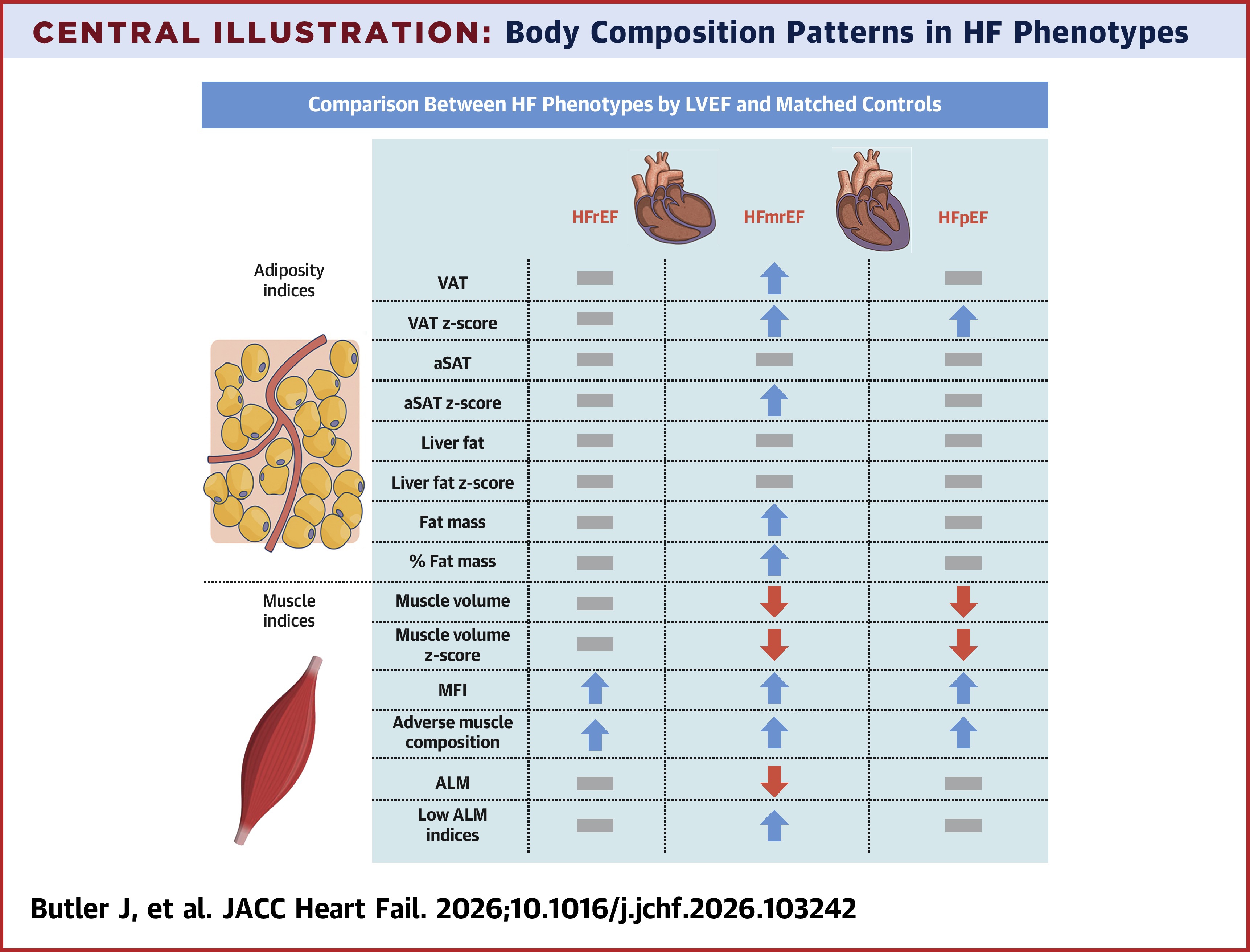
Sarcopenia prevalence among participants with HF also varied considerably depending on the definition used, with diagnosis based on grip strength and dual-energy x-ray absorptiometry-derived lean mass parameters. Prevalence was 17.3% using EWGSOP1 criteria, compared with 1.6%, 5.5% and 0.8% using EWGSOP2, FNIH and EASO/ESPEN criteria, respectively. The authors note that these definitions may underdetect muscle abnormalities, while traditional measures such as BMI may underestimate important metabolic and musculoskeletal anomalies.
"HF is characterized less by overt obesity or sarcopenia and more by subtle but consistent alterations in fat distribution and marked muscle derangements, with patterns varying by HF phenotype," write Butler and colleagues. "Body composition profiling may provide incremental value for HF risk stratification, particularly in identifying early muscle deterioration and maladaptive fat distribution. Detecting phenotype-specific trajectories raises the possibility of tailoring therapeutic approaches according to underlying body composition."
Clinical Topics: Cardiovascular Care Team, Heart Failure and Cardiomyopathies, Acute Heart Failure
Keywords: Subcutaneous Fat, Abdominal, Body Mass Index, Abdominal Fat, Intra-Abdominal Fat, Sarcopenia, Adiposity, Heart Failure, Obesity
