State-of-the-Art Review Proposes Changes to Current CV Subspecialty Training Model
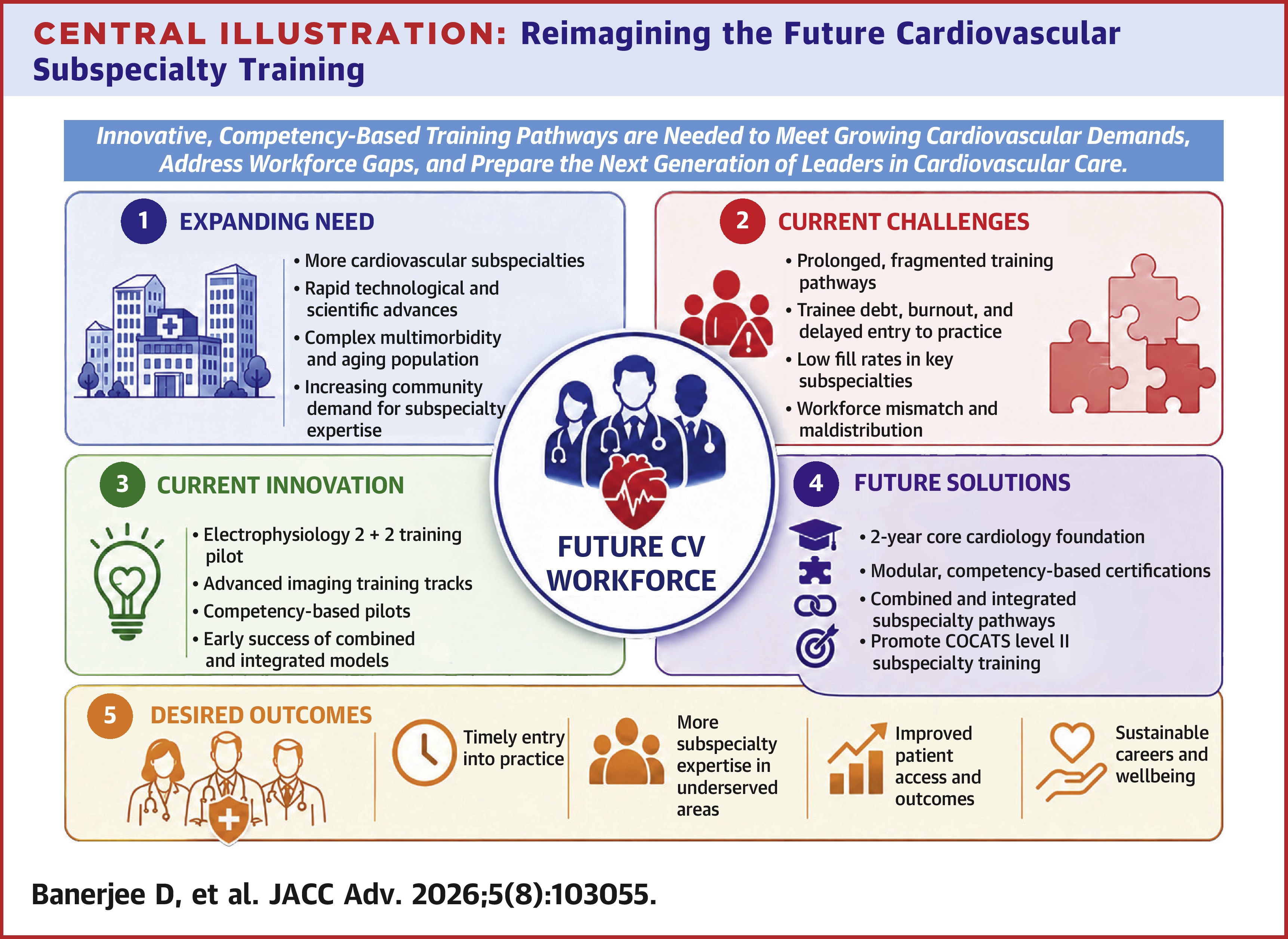
As cardiovascular subspecialties continue to grow, deficiencies have been exposed in the current training model. A recent State-of-the-Art Review published in JACC: Advances reviews the current training model and how it is being redefined and proposes new training models that can help meet the growing needs of trainees, programs, patients and health care institutions.
In the Review, Dipanjan Banerjee, MD, FACC, along with other members of ACC's Program Directors and Graduate Medical Educators Member Section, first discuss the current training landscape and how it focuses on time spent in training rather than measurable outcomes, as well as the challenges for trainees and programs because of the expanding number of subspecializations that require additional training beyond general cardiovascular fellowships, including the lack of standardization.
To address the issues related to the growing need for subspeciality training, the authors write that subspeciality training must be made more appealing for cardiologists and provide an alternative to the current "all or none" paradigm outlined in the Core Cardiology Training Symposium level III training.
The authors propose the following changes to cardiovascular subspecialty training:
- Shorten core general cardiology training by one year and use a 2+2 model instead.
- Focus on competency over time-based subspecialty training.
- Utilize modular cardiovascular subspecialty curriculum design.
- Combine and integrate training for subspecialties that have overlapping skill sets.
- Consider subspeciality certifications for practicing cardiologists.
"[Cardiovascular] medicine is a fast-changing field with an expanding array of therapeutics, requiring a nimble but robust training paradigm to satisfy the evolving requirements of trainees, health care systems and patients," write Banerjee and colleagues. "Exciting and thoughtful efforts are underway to transform [cardiovascular] subspecialty training in a way that meets the needs of these stakeholders. These will require new organizational structures and collaboration to provide the best [cardiovascular] care for the country."
Keywords: Education, Workforce, Health Educators, Education, Medical, Graduate, Education, Graduate, Physician Executives
