CAUGHT-CAD Analysis: Statin Therapy and Plaque Passivation
Statin treatment in asymptomatic, intermediate-risk individuals was associated with plaque passivation, a shift toward higher density calcium within coronary plaques, with greater increases in high- and very high-density calcium among patients achieving an LDL-C reduction ≥30%, according to a post-hoc analysis of the CAUGHT-CAD trial published Oct. 20 in JACC: Cardiovascular Imaging.
"The concept of plaque passivation, defined as the transition of vulnerable, lipid-rich plaque toward a more stable, calcified phenotype, has emerged as a central mechanistic paradigm linking statin therapy to improved clinical outcomes," write authors Sheran A. Vasanthakumar, MBBS, and colleagues. "A means of understanding plaque passivation, or its failure, could carry important prognostic and therapeutic implications."
The prospective, open-blinded CAUGHT-CAD trial randomized 449 statin-naïve Australian participants (mean age, 58 years; 43% women) with family histories of premature coronary artery disease to either a coronary artery calcium-score informed primary prevention strategy including statin treatment, or usual care.
This post hoc analysis included 338 participants with quantifiable plaque on coronary computed tomographic angiography (CTA) at baseline and three years. After treatment allocation and crossover, 161 participants were treated with statins (mean age, 58 years; 40% women) while 177 remained statin-naïve (mean age, 59 years; 45% women).
The analysis quantified five lesion-level plaque subtypes based on CT density: noncalcified (≤350 Hounsfield Units [HU]), low-density calcium (351-500 HU), intermediate-density calcium (501-700 HU), high-density calcium (701-1,000 HU) and very high-density calcium (>1,000 HU).
CTA results at three-years from 840 total lesions (394 statin-treated, 446 statin-naïve) found that statin therapy was not associated with a change in overall lesion-level calcium volume (p=0.22) but was associated with greater progression of intermediate-density (β=0.89; p=0.02) and high-density calcium (β=0.79; p=0.001) following adjustment for cardiovascular risk factors, LDL-C level and baseline plaque volume. Statin therapy was also associated with regression of noncalcified plaque (NCP; β=–9.83; p<0.001) following these same adjustments. These associations remained robust in sensitivity analyses.
Furthermore, among statin-treated participants, an LDL-C reduction ≥30% was associated with greater progression of high-density (β=1.11; p=0.03) and very high density (β=1.68; p=0.04) calcium.
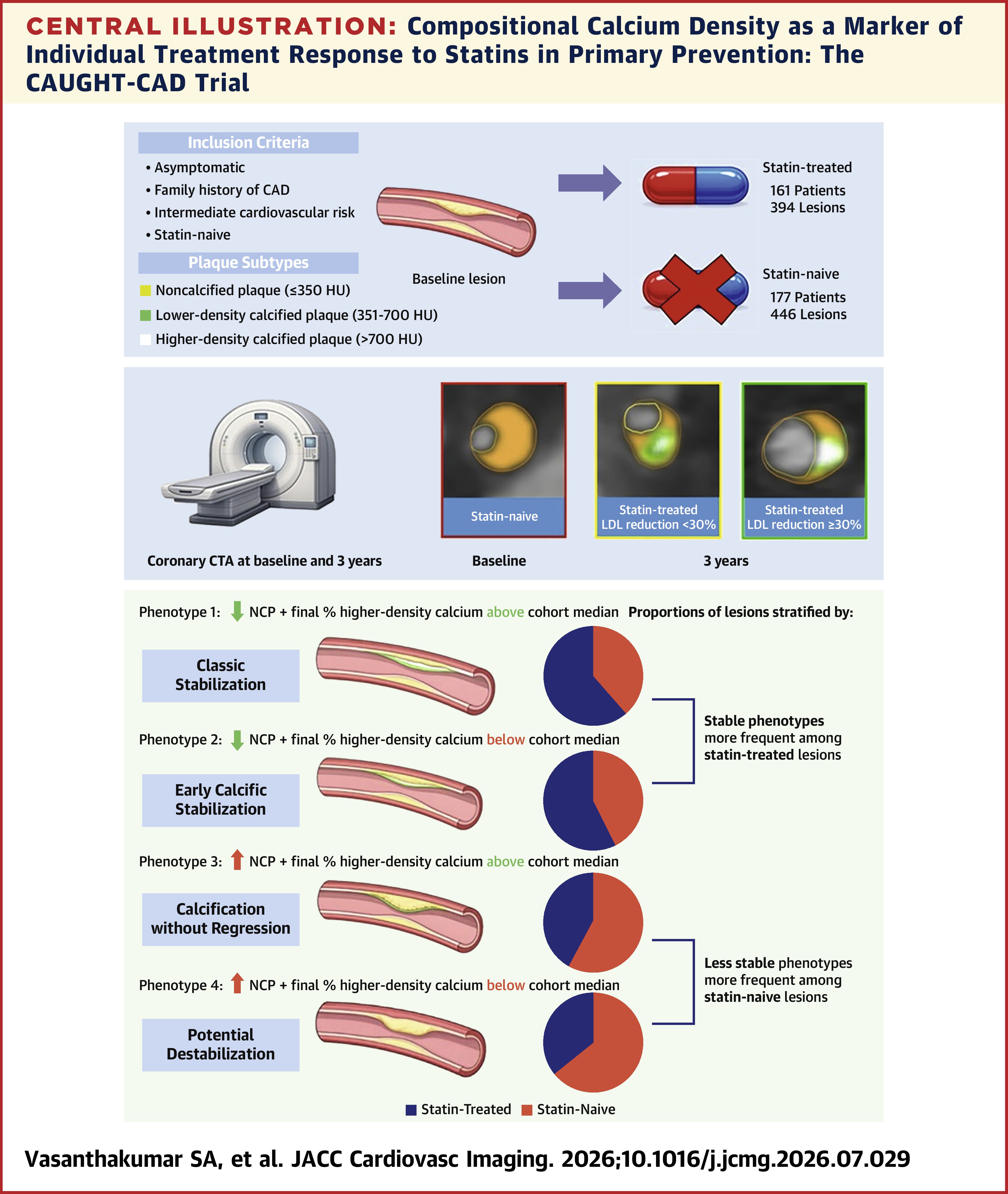
Vasanthakumar and colleagues constructed a framework integrating NCP dynamics and calcium density to identify four distinct phenotypes of plaque transformation: classic stabilization, early calcific stabilization, calcification without regression and potential destabilization. Within this framework, classic stabilization was more common among statin-treated vs. statin-naïve lesions (61.4% vs. 38.6%), while potential destabilization was more common among statin-naïve lesions (64.7% vs. 35.3%; both p<0.01), although the authors note that these phenotypes have not been validated against clinical outcomes and should be regarded as hypothesis-generating rather than used to guide individual treatment decisions.
Clinical Topics: Dyslipidemia, Invasive Cardiovascular Angiography and Intervention, Noninvasive Imaging, Prevention, Atherosclerotic Disease (CAD/PAD), Lipid Metabolism, Nonstatins, Novel Agents, Statins, Interventions and Coronary Artery Disease, Interventions and Imaging, Angiography, Computed Tomography, Nuclear Imaging
Keywords: Hydroxymethylglutaryl-CoA Reductase Inhibitors, Tomography, X-Ray Computed, Primary Prevention, Cholesterol, LDL, Coronary Artery Disease, Angiography
