JACC State-of-the-Art Review Supports hs-cTn Classification in Clinical Practice
In a JACC State-of-the-Art Review published Oct. 28, Michail Spanos, MD, and James L. Januzzi, MD, FACC, examine the interpretation of high-sensitivity cardiac troponin (hs-cTn) levels, including differences between assays, guideline-endorsed serial testing, distinctions between myocardial injury and myocardial infarction (MI), common non-acute coronary syndrome (ACS) conditions associated with troponin elevation and emerging advances that may improve diagnostic specificity.
While hs-cTn assays have improved detection of myocardial injury, the authors emphasize that the challenge has shifted from detection to accurate classification. They highlight that hs-cTn has distinct diagnostic and prognostic roles, as elevations that do not establish MI may still signal increased cardiovascular risk.
Accurate classification requires, they write, "integrated, context-aware interpretation grounded in 4 domains": 1) the analytical and biological properties of hs-cTnI and hs-cTnT; 2) the capabilities and limitations of guideline-endorsed serial testing; 3) rigorous application of the Fifth Universal Definition of Myocardial Infarction; and 4) recognition of the non–acute coronary syndrome conditions. Each domain is addressed in the Review.
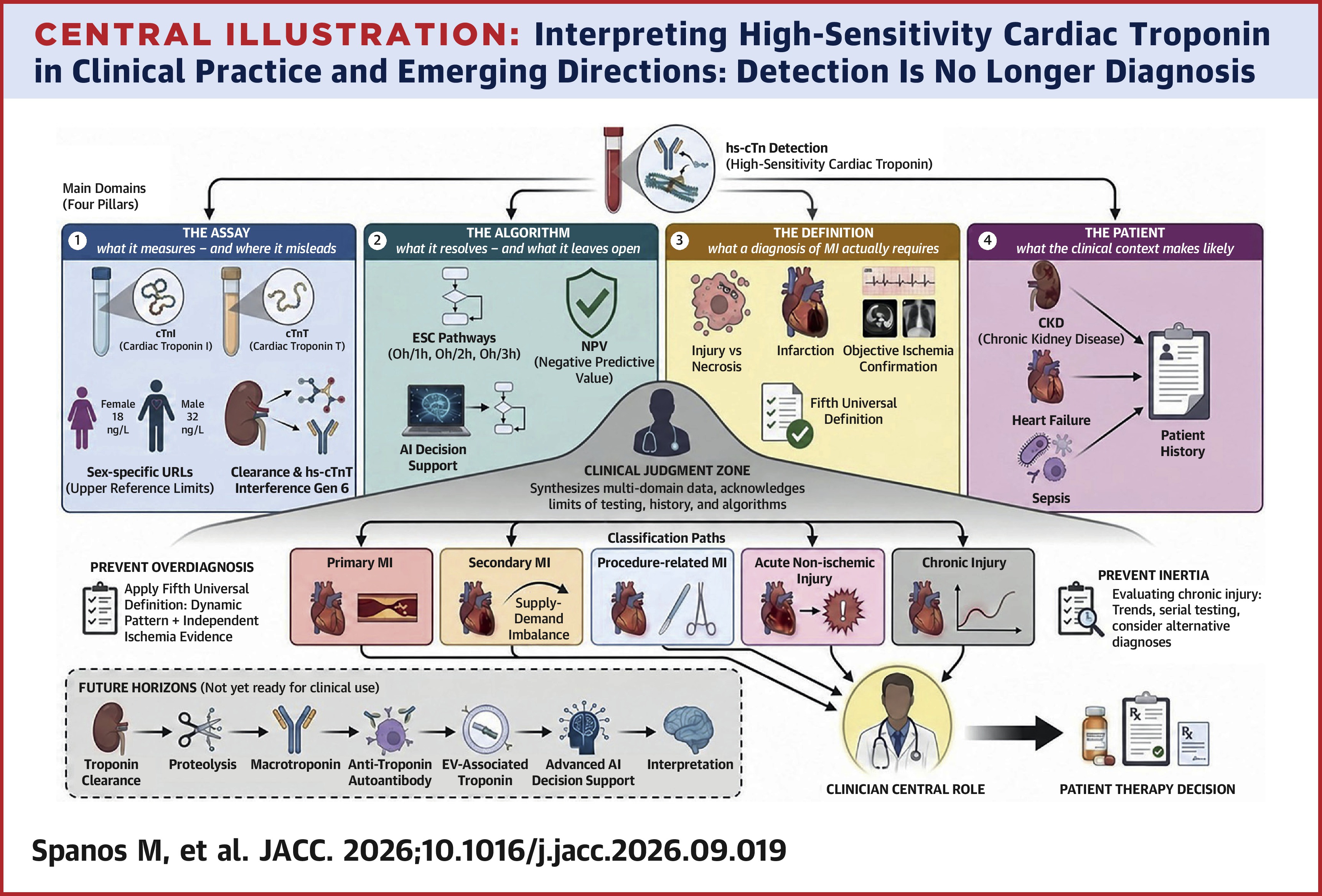
Accurate interpretation begins with understanding what the assays measure. Cardiac troponin I (cTnI) and cardiac troponin T (cTnT) are distinct proteins measured by different assays, and numerical results are not interchangeable across platforms. The Review summarizes key analytical differences and assay-specific thresholds, while noting that sex-specific thresholds, analytical interferences and imprecision can also affect interpretation.
Assay results should be interpreted within an appropriate diagnostic algorithm – but the authors emphasize these algorithms are triage tools rather than diagnostic verdicts. Guideline-endorsed pathways, including the ESC 0/1-hour and 0/2-hour algorithms, use baseline hs-cTn concentrations and subsequent changes to classify patients into rule-out, observe or rule-in categories. However, a rule-in result identifies acute myocardial injury requiring further evaluation but does by itself establish MI, while a rule-out result does not exclude coronary syndromes without myocardial injury.
The definition of MI provides the next step. Under the Fifth Universal Definition of Myocardial Infarction, the anchor of both ESC and ACC/AHA Guidelines, an hs-cTn concentration above the sex-specific 99th-percentile upper reference limit indicates myocardial injury, while a significant rise or fall identifies acute injury. A diagnostic framework outlined by the authors illustrates how an hs-cTn elevation is classified as acute or chronic myocardial injury and, in cases of acute injury, how evidence of ischemia distinguishes MI from acute nonischemic injury. Notably, secondary MI requires both a recognized supply-demand imbalance and objective evidence that the resulting injury was ischemic.
Ultimately, the findings must be interpreted in the context of the individual patient. Elevated hs-cTn is common in conditions other than ACS, including chronic kidney disease, heart failure, myocarditis, takotsubo syndrome, sepsis, pulmonary embolism and tachyarrhythmias.
Chronic myocardial injury also should not be dismissed once acute MI has been excluded. In a meta-analysis of 120,734 patients with suspected ACS cited in the Review, chronic myocardial injury was associated with a threefold higher risk of subsequent MI or cardiovascular death compared with no myocardial injury, highlighting its prognostic significance. "Recognizing chronic myocardial injury is therefore not the end of the diagnostic process but the beginning of a preventive one," the authors write.
Looking ahead, troponin fragment profiling, recognition of macrotroponin and antitroponin autoantibodies, extracellular vesicle-associated troponin and artificial-intelligence-based decision support could complement conventional testing and may improve diagnostic specificity. However, these approaches are not yet ready to wholly replace clinical interpretation.
"Detection is now easy, but classification is not," Spanos and Januzzi conclude. "The limiting step in troponin interpretation is no longer analytical sensitivity but diagnostic discipline and approach."
Keywords: Troponin T, Troponin I, Myocardial Infarction
