RELIEVE-HF Analysis: Interatrial Shunt Safety Outcomes Differ By HF Phenotype
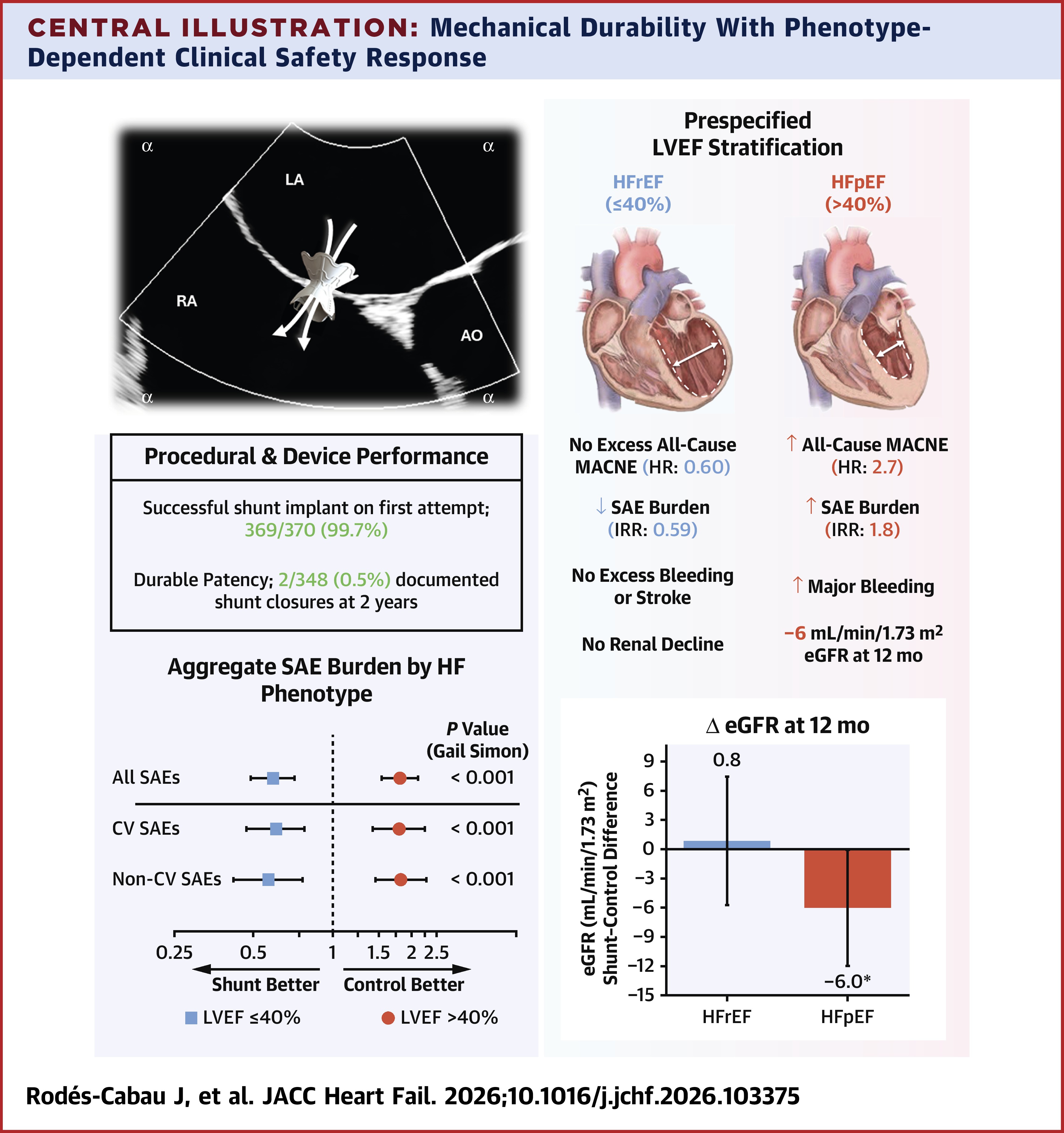
Interatrial shunt implantation was mechanically reliable and durable through two years in patients with symptomatic heart failure (HF), with safety outcomes differing by phenotype, according to findings published Oct. 20 in JACC: Heart Failure. A prespecified secondary safety analysis of RELIEVE-HF outcomes showed there were no excess clinical safety events in patients with HF with reduced ejection fraction (HFrEF), but there was an increase in these events in patients with HF with preserved ejection fraction (HFpEF).
The main results of the prospective, multicenter, double-blind RELIEVE-HF trial, presented at ACC.24, showed it met its primary safety endpoint, with no device- or procedure-related major adverse cardiovascular or neurological events (MACNE) through 30 days.
A total of 605 patients were enrolled, including 508 patients randomized 1:1 to the Ventura interatrial shunt or sham control; 97 patients were enrolled in an open-label roll-in cohort. Shunt implantation was successful in 369 of 370 patients.
In this analysis, long-term device outcomes were assessed in 348 patients: 151 with HFrEF (mean age, 70 years; 14% women) and 197 with HFpEF (mean age, 74 years; 48% women).
Results at two years showed that no patients experienced a device- or procedure-related MACNE, defined as a composite of death, stroke, open cardiac surgery or major vascular repair. Shunt patency was 99.4%.
In the combined randomized intention-to-treat population, all-cause MACNE did not differ between shunt and sham (18.7% vs. 17.6%; hazard ratio [HR], 1.18). When stratified by LVEF, shunt therapy in HFrEF was not associated with excess all-cause MACNE (17.5% vs. 32.7% control; HR, 0.60), major bleeding or renal decline and was associated with a lower aggregate burden of serious adverse events (SAEs).
Conversely, shunt therapy in HFpEF was associated with higher all-cause MACNE (19.4% vs. 7.2% control; HR, 2.69), greater aggregate SAE burden, increased major bleeding and greater renal decline. The authors note these were prespecified secondary analyses meant to be hypothesis-generating only.
“These observations distinguish device-related safety from a potential differential biological response to therapy,” write Josep Rodés-Cabau, MD, PhD, and colleagues. “Noncardiovascular SAE findings, including respiratory, renal, infectious, traumatic injuries, and the like, should be interpreted within the context of the overall phenotype-dependent safety pattern rather than as evidence of a specific treatment- or device-related mechanism.”
“Collectively, the present data add to the emerging unfavorable risk-benefit calculus of implanting a permanent atrial shunt in most patients with HFpEF, without meaningful quality-of-life benefit across [two] sham-controlled trials,” write Yogesh N.V. Reddy, MBBS, MSc, and James C. Fang, MD, FACC, in an accompanying editorial comment, referring to the RELIEVE-HF and REDUCE-LAP-HF 2 trials. “Moving congestive volume from one vascular compartment to another doesn’t address the fundamental issue driving congestion and disease progression, such as systemic neurohormonal activation and escape.”
Clinical Topics: Cardiac Surgery, Cardiovascular Care Team, Heart Failure and Cardiomyopathies, Invasive Cardiovascular Angiography and Intervention, Cardiac Surgery and Heart Failure, Acute Heart Failure
Keywords: Heart Failure, Stroke Volume, Cardiac Surgical Procedures
