Racial, Ethnic and Place-Based Disparities in CVD Mortality in the US
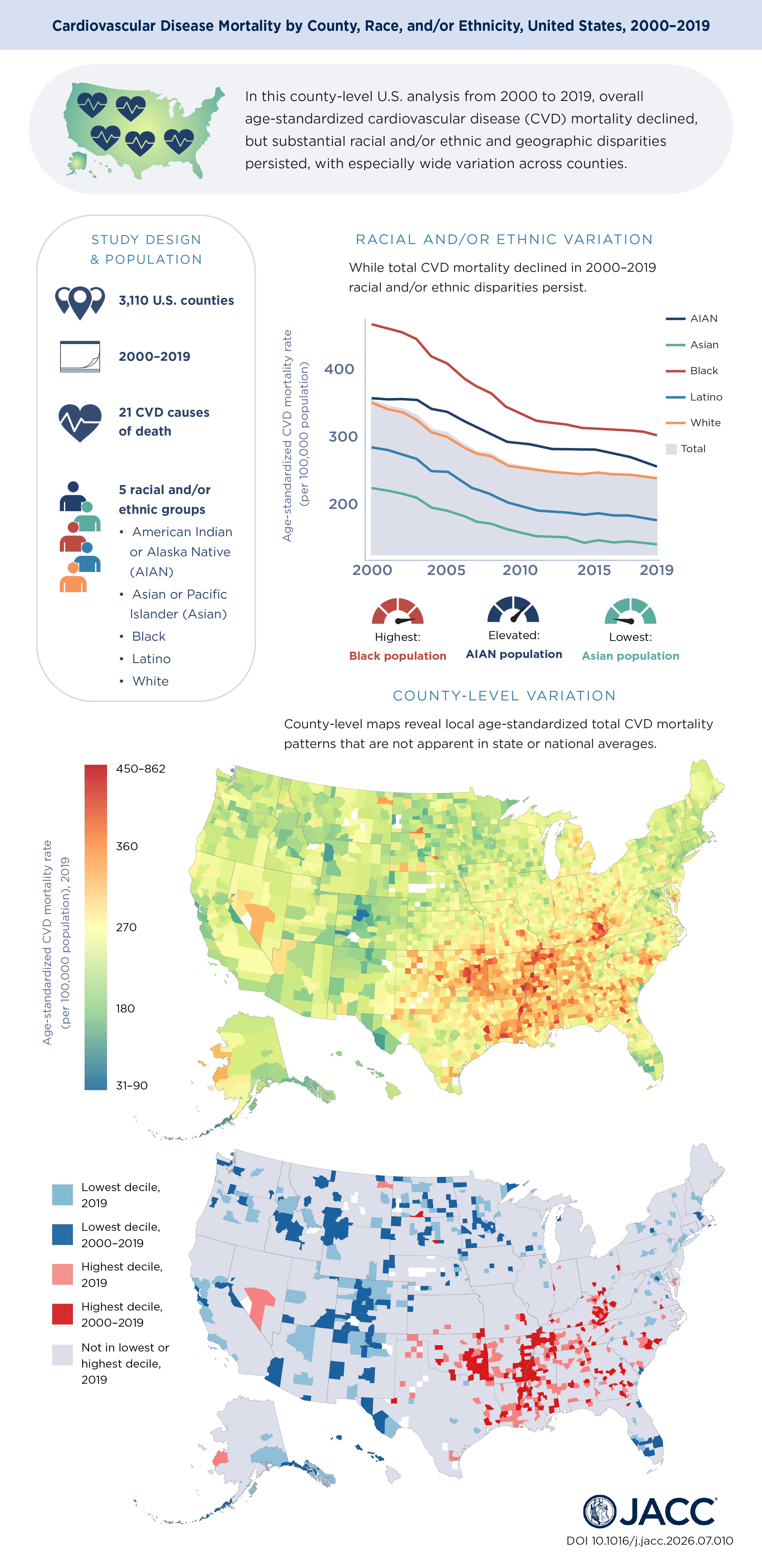
Despite sustained declines in overall cardiovascular disease mortality in the U.S., racial, ethnic and place-based disparities persist, with mortality varying far more across counties than states, according to a county-by-cause-by-population analysis published in JACC.
The new analysis explores county-level cardiovascular disease mortality considering race and/or ethnicity and cardiovascular disease cause of death. Researchers estimated age-standardized mortality rates (ASMRs) for five racial and/or ethnic groups across 3,110 counties and 21 causes of cardiovascular disease death from 2000 to 2019 using death certificate data from the U.S. National Vital Statistics System. They leveraged methods previously developed for estimating cause specific mortality by county and race and/or ethnicity for a comprehensive set of causes of death from the Global Burden of Diseases cause list.
"Detailed knowledge of county-level variation is important for all racial and/or ethnic populations," said George A. Mensah, MD, FACC, lead author of the study and director of the Center for Translation Research and Implementation Science at National Heart, Lung, and Blood Institute. "It can inform appropriate local-level clinical and public health practices, policies and strategies needed to have a sustained effect on reducing or eliminating racial, ethnic and place-based cardiovascular disease disparities."
In 2019, the ASMR for total cardiovascular disease was 237.8 deaths per 100,000 individuals. Over the course of the study period, mortality declined for total cardiovascular disease as well as 12 of the 17 detailed causes of death that included rheumatic heart disease, ischemic heart disease, ischemic stroke, intracerebral hemorrhage, subarachnoid hemorrhage, hypertensive heart disease, nonrheumatic calcific aortic valve disease, non-rheumatic degenerative mitral valve disease, myocarditis, alcoholic cardiomyopathy, other cardiomyopathy, pulmonary arterial hypertension, atrial fibrillation and flutter, aortic aneurysm, lower extremity peripheral arterial disease, endocarditis and the remaining cardiovascular and circulatory diseases (as other).
In other findings, Mensah and colleagues noted that the pace of overall improvement slowed after 2011. This deceleration was seen in several detailed causes of death and was accompanied by adverse trends in specific conditions. For example, hypertensive heart disease and atrial fibrillation and flutter increased overall, and ischemic stroke showed a post-2011 increase despite longer-term declines.
Additionally, mortality rates increased for three detailed causes of death – stroke, non-rheumatic valvular heart disease and cardiomyopathy and myocarditis.
Broken down by ethnicity, the Black population suffered the highest mortality rate for total cardiovascular disease and 12 of 17 detailed causes, while the Asian population suffered the lowest for total cardiovascular disease and 13 of 17 detailed causes. Mortality varied much more by county than by state, both within and among racial and/or ethnic populations, and spatial mortality patterns also varied significantly by cardiovascular disease cause.
"For clinical practice, these findings point to the value of integrating local epidemiology into risk assessment, outreach and care delivery," Mensah said. "Health systems and clinicians need to align prevention strategies with the dominant local causes and the populations experiencing the greatest burden."
In a related editorial comment, ACC President Roxana Mehran, MD, FACC, said the findings are a reminder that heart disease statistics on a national scale can hide the realities patients are facing on a local level. She highlights how the ACC is leading a coordinated approach to reducing disparities and improving cardiovascular health for all through partnerships, education, advocacy and workforce initiatives.
"Dr. Mensah et al., provided an essential pre-pandemic map of cardiovascular disparities across time, place, race and ethnicity," Mehran said. "The next challenge is to turn this map into a roadmap for action. Our commitment to cardiovascular health equity should be measured not by how precisely we describe inequities, but by how effectively we close them."
Meanwhile, a separate study published in JAMA Cardiologysheds light on the growing global burden of heart failure, with all-ages prevalence increasing by 124.6% between 1990 and 2023, driven largely by population growth and aging. Although age-standardized prevalence remained relatively stable, ischemic heart disease, hypertensive heart disease, and cardiomyopathy continued to be leading causes, with important differences across age groups and geographic regions.
The findings highlight the need for targeted prevention and treatment strategies to address the growing global burden of heart failure. A research letter also published in JAMA Cardiology found that a polypill implementation strategy for heart failure with reduced ejection fraction in Sri Lanka may offer one practical approach for improving outcomes, particularly in low- and middle-income countries where the burden of heart failure remains high and continues to grow.
Clinical Topics: Arrhythmias and Clinical EP, Cardiac Surgery, Cardiovascular Care Team, Heart Failure and Cardiomyopathies, Pulmonary Hypertension and Venous Thromboembolism, Valvular Heart Disease, Atherosclerotic Disease (CAD/PAD), Atrial Fibrillation/Supraventricular Arrhythmias, Aortic Surgery, Cardiac Surgery and Arrhythmias, Cardiac Surgery and Heart Failure, Cardiac Surgery and VHD, Acute Heart Failure, Pulmonary Hypertension
Keywords: Heart Valve Diseases, Aortic Valve Disease, Aortic Aneurysm, Lower Extremity, Heart Failure, Endocarditis, Workforce, Peripheral Arterial Disease, Rheumatic Heart Disease, Myocardial Ischemia, Cerebral Hemorrhage, Stroke Volume, Pulmonary Arterial Hypertension, Global Burden of Disease, Ischemic Stroke, Mitral Valve, Atrial Fibrillation, Health Equity, Myocarditis
