SirPAD Redefines Drug-Coated Balloon Therapy in PAD
Quick Takes
- Sirolimus-coated balloon angioplasty significantly reduced the 1-year composite of major amputation or chronic limb-threatening ischemia (CLTI)–driven revascularization compared with uncoated-balloon angioplasty (8.8% vs. 15%).
- One-year all-cause mortality was similar between groups (11.8% vs. 12.8%), supporting the safety of sirolimus-coated balloon angioplasty.
- The SirPAD (Sirolimus-Coated Balloon for Peripheral Artery Disease) trial was the first drug-coated balloon trial to demonstrate improvement in hard clinical limb outcomes, beyond vessel patency, in a broad infrainguinal peripheral artery disease population of which nearly 50% of patients had CLTI.
Background and Clinical Context
Peripheral artery disease (PAD) affects >113 million people worldwide and remains a major cause of limb loss, cardiovascular morbidity, and cardiovascular mortality.1 Chronic limb-threatening ischemia (CLTI), the most advanced manifestation of PAD, is associated with high rates of major amputation and death at 1 year.2 Although endovascular revascularization has become the predominant treatment strategy for infrainguinal disease, prior randomized trials of drug-coated balloons (DCBs) primarily demonstrated improvements in surrogate endpoints such as vessel patency and target-lesion revascularization (TLR), without evidence of reduced major adverse limb events. Paclitaxel-coated balloon use improves procedural outcomes; however, due to concerns about potential association with late mortality, there has been an interest in developing alternative antiproliferative therapies.3,4 Sirolimus, a cytostatic mammalian target of rapamycin (mTOR) inhibitor with an established safety profile in coronary interventions, has emerged as a promising alternative that may inhibit neointimal hyperplasia while preserving vascular healing. Additional support for sirolimus-coated balloon technology comes from the SIRONA (Sirolimus- vs Paclitaxel-Drug Coated Balloons in Patients With Peripheral Artery Disease) trial findings, which demonstrated comparable clinical outcomes between sirolimus-coated and paclitaxel-coated balloons in femoropopliteal disease.5 The SirPAD (Sirolimus-Coated Balloon for Peripheral Artery Disease) trial was designed to determine whether sirolimus-coated balloon angioplasty could translate these mechanistic advantages into meaningful improvements in clinical limb outcomes for patients with symptomatic infrainguinal PAD.6
Trial Design and Population
The SirPAD trial was an investigator-initiated, multicenter, phase 3 randomized controlled trial conducted in Switzerland that enrolled 1,252 patients (median age 75 years; 35.1% women) with symptomatic infrainguinal PAD. Participants, who were predominantly white, were randomly assigned 1:1 to angioplasty with either a sirolimus-coated balloon or an uncoated balloon. By Fontaine classification, 34.2% of patients had CLTI of the target limb (Fontaine stages III and IV), and 9.8% presented with acute limb ischemia. The median lesion length was 150 mm, 57.1% of patients had total occlusion of the target lesion, and disease extended below the knee in approximately 30% of patients, reflecting a substantially more complex population than that included in many prior DCB studies.6,7 Intravascular imaging was not required and was left to the operator's discretion.
Importantly, the study adopted an all-comer design with minimal exclusion criteria, enhancing its real-world applicability.
The trial employed blinded outcome adjudication and a prespecified hierarchical testing strategy, first assessing noninferiority and subsequently superiority. This design strengthened the robustness of the efficacy findings while minimizing statistical bias.6
Key Results
At 1 year, the primary composite endpoint of major target-limb amputation or TLR for CLTI occurred in 8.8% of patients treated with sirolimus-coated balloons compared with 15% of those treated with uncoated balloons (absolute risk difference, -4.9 percentage points; 95% confidence interval [CI], -8.5 to -1.3; pnoninferiority < 0.001; psuperiority = 0.009).6
The key secondary composite endpoint—any unplanned amputation (major or minor) or TLR for critical or noncritical limb ischemia—occurred in 23% versus 30.8% (absolute risk difference, -7.8 percentage points; 95% CI, -12.7 to -2.9; p = 0.002). The reduction was driven by concordant effects on both individual components: Unplanned major amputation occurred in 1.3% versus 2.7% (absolute risk difference, -1.4 percentage points; 95% CI, -3.1 to 0.2), and TLR for CLTI occurred in 8.3% versus 13.3% (absolute risk difference, -5 percentage points; 95% CI, -8.4 to -1.5).6 Notably, the Kaplan-Meier curves for the primary outcome separated early and maintained divergence throughout the follow-up period.6
Although restenosis, patency, and TLR remain important procedural outcomes, patients and clinicians are ultimately concerned with limb preservation, symptom relief, and avoidance of repeat interventions. The SirPAD trial findings demonstrate that the benefits of DCB technology can translate into outcomes that matter directly to patients.
Safety Reassurance in the Drug-Coated Device Era
Safety remains a critical consideration for drug-coated technologies. Concerns regarding late mortality associated with paclitaxel-coated devices have been raised.8 However, the SAFE-PAD (Safety Assessment of Femoropopliteal Endovascular Treatment with Paclitaxel-Coated Devices) study, the largest real-world analysis to date, evaluated 168,553 Medicare beneficiaries with up to 9 years of follow-up and found no increased mortality associated with drug-coated devices (adjusted HR, 0.98; 95% CI, 0.97-0.99).4 These conflicting findings have fueled interest in alternative antiproliferative platforms.
In the SirPAD trial, 1-year all-cause mortality was similar between the sirolimus-coated and uncoated-balloon groups (11.8% vs. 12.8%; p = 0.67), with no evidence of excess mortality.6 Although longer-term follow-up is ongoing, these findings provide reassuring short-term safety data for sirolimus-coated balloon technology.
Why Sirolimus May Matter
Unlike paclitaxel, which exerts cytotoxic effects through microtubule disruption, sirolimus inhibits the mTOR pathway and acts cytostatically, suppressing neointimal hyperplasia while potentially preserving vascular healing.6,7 Emerging systematic reviews report favorable efficacy and safety across diverse lesion complexities, supporting sirolimus-coated balloons as a viable therapeutic platform.9
Strengths and Limitations
The SirPAD trial's strengths include its large sample size, all-comer population, clinically relevant hard endpoints, blinded adjudication, and hierarchical statistical design. The use of hard clinical outcomes rather than solely anatomical or procedural measures represents a particularly important advance. However, several limitations warrant consideration. Follow-up was limited to 1 year, and durability of benefit beyond this time frame remains uncertain. The open-label design may have influenced reintervention decisions, particularly for less severe ischemic events. The trial was conducted within a single-country health care system with a predominantly white population, thus limiting generalizability. In addition, the study compared sirolimus-coated balloons with uncoated balloons rather than with paclitaxel-coated devices, which remain widely used in contemporary practice—leaving the direct comparative effectiveness question unanswered.
Conclusion
The SirPAD trial data established sirolimus-coated balloon angioplasty as an effective alternative to uncoated-balloon angioplasty for infrainguinal PAD, with meaningful reductions in both amputation and CLI-driven revascularization. Figure 1 provides a visual summary of the trial design, key results, safety findings, and clinical implications.
Figure 1: Summary of Findings From the SirPAD Trial
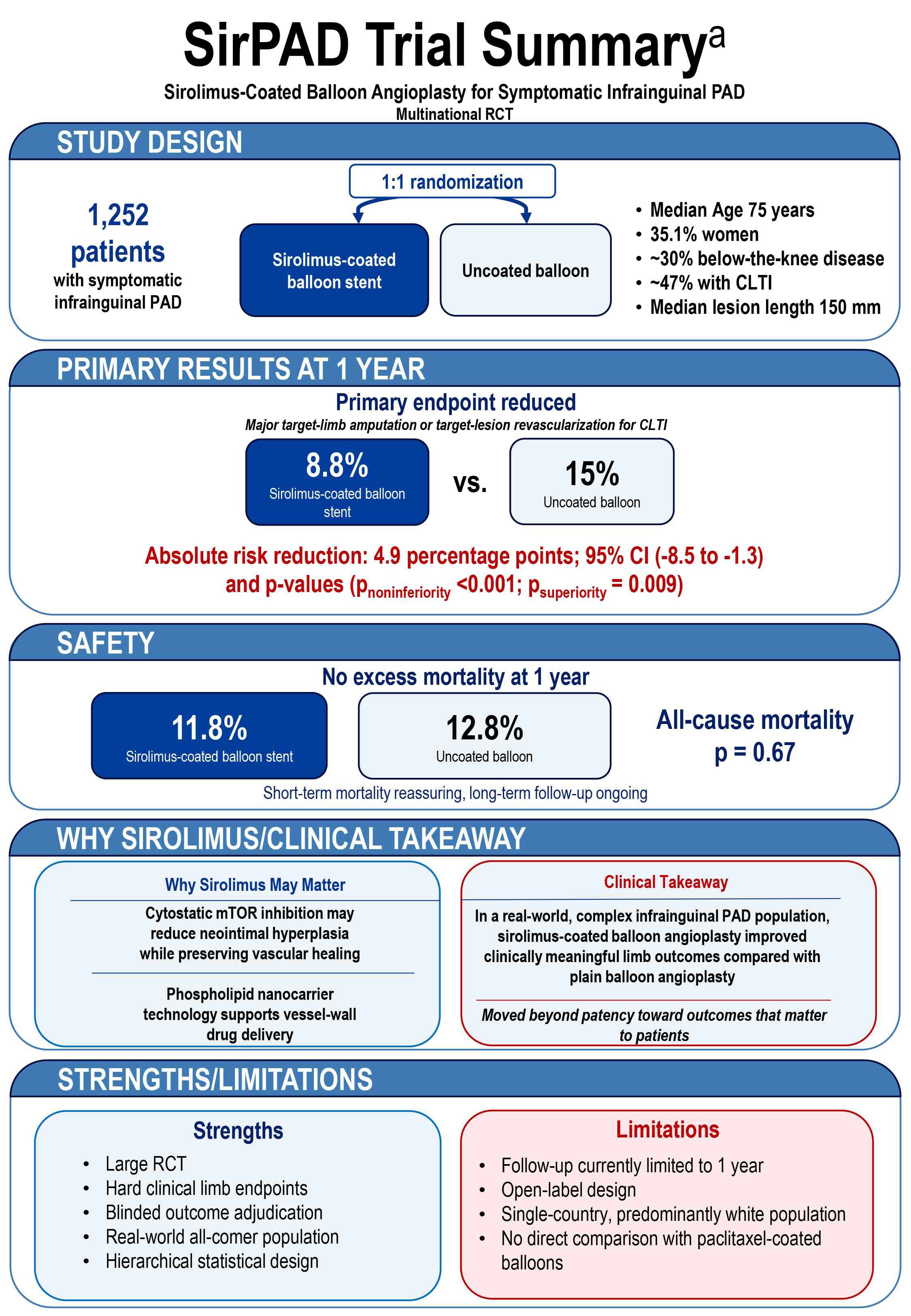
CI = confidence interval; CLTI = chronic limb-threatening ischemia; mTOR = mammalian target of rapamycin; PAD = peripheral artery disease; RCT = randomized controlled trial; SirPAD = Sirolimus-Coated Balloon for Peripheral Artery Disease.
For practicing clinicians, the clinical message is clear: Sirolimus-coated balloon angioplasty offers superior limb-related outcomes compared with conventional balloon angioplasty—not just vessel patency in an unselected, real-world population. Ongoing 5-year follow-up and future head-to-head trials against paclitaxel-coated devices in broader populations will be essential to define the long-term role of this technology.
References
- GBD 2019 Peripheral Artery Disease Collaborators. Global burden of peripheral artery disease and its risk factors, 1990-2019: a systematic analysis for the Global Burden of Disease Study 2019. Lancet Glob Health. 2023;11(10):e1553-e1565. doi:10.1016/S2214-109X(23)00355-8
- Criqui MH, Matsushita K, Aboyans V, et al. Lower extremity peripheral artery disease: contemporary epidemiology, management gaps, and future directions: a scientific statement from the American Heart Association. Circulation. 2021;144(9):e171-e191. doi:10.1161/CIR.0000000000001005
- Nordanstig J, Hinchliffe R, Lejay A, Behrendt CA; ESVS Peripheral Arterial Disease Guidelines Writing Committee; ESVS Guidelines Steering Committee. Editor's choice - focused update on paclitaxel coated technologies, from the 2024 European Society for Vascular Surgery (ESVS) guidelines on the management of asymptomatic peripheral arterial disease and intermittent claudication. Eur J Vasc Endovasc Surg. 2026;71(6):923-927. doi:10.1016/j.ejvs.2026.04.037
- Kim JM, Yeh RW, Song Y, Secemsky EA. Drug-coated vs non-drug-coated devices for femoropopliteal artery interventions: long-term outcomes of the SAFE-PAD study. Eur Heart J. 2026;47(17):2093-2103. doi:10.1093/eurheartj/ehaf721
- Teichgräber U, Ingwersen M, Lehmann T, et al. Comparison of sirolimus- vs paclitaxel-coated balloon angioplasty for femoropopliteal artery disease: the SIRONA randomized noninferiority trial. J Am Coll Cardiol. Published online February 18, 2026. doi:10.1016/j.jacc.2025.12.017
- Barco S, Engelberger RP, Held U, et al. Sirolimus-coated balloon angioplasty for infrainguinal artery disease. N Engl J Med. 2026;395(6):561-570. doi:10.1056/NEJMoa2600360
- Barco S, Sebastian T, Voci D, et al. Major adverse limb events in patients with femoro-popliteal and below-the-knee peripheral arterial disease treated with either sirolimus-coated balloon or standard uncoated balloon angioplasty: a structured protocol summary of the "SirPAD" randomized controlled trial. Trials. 2022;23(1):334. Published 2022 Apr 21. doi:10.1186/s13063-022-06242-8
- Katsanos K, Spiliopoulos S, Saratzis A, et al. Editor's choice - dynamic risk of death following application of paclitaxel coated devices in the femoropopliteal artery: a contemporary meta-analysis of randomised controlled trials. Eur J Vasc Endovasc Surg. 2026;71(6):928-941. doi:10.1016/j.ejvs.2026.01.030
- Taneva GT, Muñoz Castellanos J. Emerging sirolimus-based drug-coated technologies for femoropopliteal disease: a systematic review. J Endovasc Ther. Published online March 5, 2026. doi:10.1177/15266028261423157
Clinical Topics: Invasive Cardiovascular Angiography and Intervention, Atherosclerotic Disease (CAD/PAD), Interventions and Coronary Artery Disease, Vascular Medicine
Keywords: Angioplasty, Balloon, Coronary, Coronary Artery Disease, Ischemia, Vascular Diseases
