Beyond Calcium: CTA Plaque Characteristics in South Asian Patients in the DILWALE Registry
Quick Takes
- In the DILWALE (DIL Wellness and Arterial health Longitudinal Evaluation) Registry computed tomography angiography analysis of 341 clinically referred South Asian adults, 63% had coronary plaque that was predominantly noncalcified.
- Plaque was common and increased with age, but overall plaque burden was not elevated relative to the burden in reference cohorts.
- A coronary artery calcium score of 0 remained reassuring, with low plaque burden and rare low-attenuation plaque.
Background
South Asian (SA) individuals experience a disproportionate burden of premature atherosclerotic cardiovascular disease (ASCVD), and this excess risk is not fully explained by traditional risk factors. Standard calculators may underestimate risk in SA adults. Accordingly, contemporary prevention guidance recognizes SA ancestry as a risk-enhancing factor when considering preventive pharmacotherapy.1
Coronary artery calcium (CAC) scoring helps personalize risk assessment, but CAC testing does not capture noncalcified plaque (NCP) or low-attenuation plaque (LAP). Coronary computed tomography angiography (CTA), especially when paired with artificial intelligence–enabled quantitative coronary plaque analysis (AIQCPA), can quantify plaque volume and composition beyond calcium alone.2 The DILWALE (DIL Wellness and Arterial health Longitudinal Evaluation) Registry offers one of the largest US-based SA cohorts for evaluating these features.3
Design
The DILWALE CTA analysis included 341 SA adults who underwent clinically indicated coronary CTA within the Baylor Scott & White Health system. Heartflow AIQCPA (Heartflow, Inc.) quantified calcified plaque (CP), NCP, LAP, total plaque volume (TPV), and percent atheroma volume (PAV). Consistent with prior AIQCPA plaque-volume analyses, TPV <20 mm3 was operationally classified as an unremarkable finding to reduce false-positive plaque detection.2,4 CTAs with a CAC score of 0 and TPV <20 mm3 underwent visual review to reduce the likelihood of missing visually significant NCP. The cohort had a median age of 54 years and 31% were women. Risk factors were common: 60% had hypertension, 32% diabetes mellitus, and 82% hyperlipidemia. Multivariable models assessed associations between clinical risk factors and any plaque or LAP ≥10 mm3.
Key Findings
Overall, 63% of patients had any coronary plaque by AIQCPA (Figure 1). Plaque was more frequent in men than women and increased with age, reaching nearly 89% among patients >65 years of age. Nearly one-half of patients 40-54 years of age already had plaque, supporting the early emergence of coronary atherosclerosis in clinically referred SA adults.
Figure 1: Beyond Calcium in South Asian Adults: What the DILWALE CTA Analysis Adds
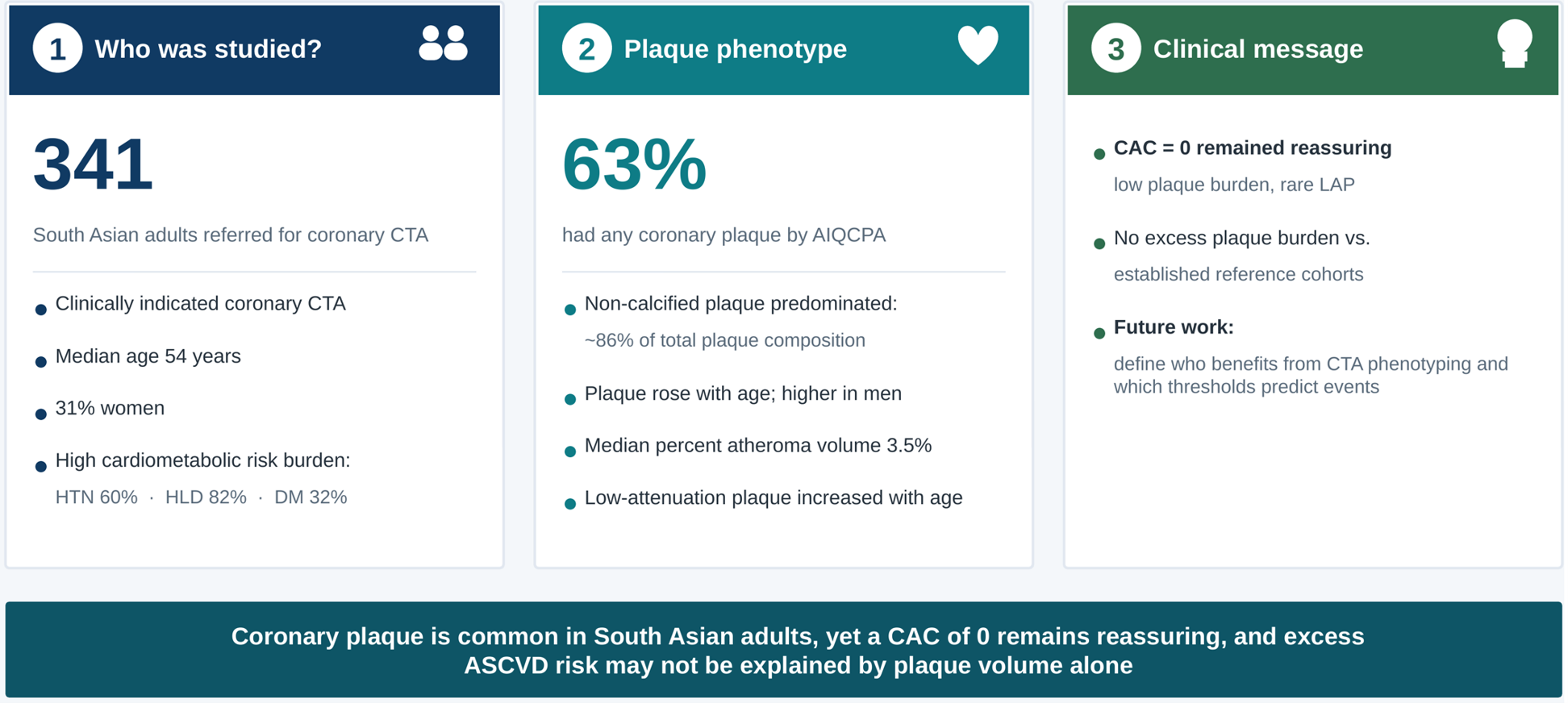
The DILWALE CTA analysis included 341 SA adults undergoing clinically indicated CCTA. The patients had a median age of 54 years and high cardiometabolic risk burden; 31% of patients were women and 63% had any plaque. The plaque was predominately NCP in composition, and the plaque prevalence and volume increased with age, with both being higher in men. A CAC score of 0 remained reassuring and the overall plaque burden was not elevated compared with the burden in reference cohorts. Future work should define who benefits from CTA plaque phenotyping and which thresholds predict events.
AIQCPA = artificial intelligence–enabled quantitative coronary plaque analysis; ASCVD = atherosclerotic cardiovascular disease; CAC = coronary artery calcium; CCTA = coronary computed tomography angiography; CTA = computed tomography angiography; DILWALE = DIL Wellness and Arterial health Longitudinal Evaluation; DM = diabetes mellitus; HLD = hyperlipidemia; HTN = hypertension; LAP = low-attenuation plaque; NCP = noncalcified plaque; SA = South Asian.
NCP was the dominant plaque subtype across age groups, accounting for approximately 86% of plaque composition overall. CP volume increased with age, consistent with plaque maturation. LAP ≥10 mm3 was present in 42 patients (12%) and became more common with age.
Plaque prevalence and quantitative plaque burden told different stories (Table 1). Despite frequent plaque detection, the overall quantitative burden was not higher than expected compared with reference cohorts. Median PAV was 3.5%, lower than the 9.1% reported in a large multicenter AIQCPA clinical cohort using the same software platform.5 TPV and NCP volume also appeared lower than in a previously reported SA CCTA cohort, although direct comparisons are limited by differences in age, sex distribution, referral setting, and baseline cardiometabolic risk.6 Approximately one-third of the cohort had a CAC score of 0; among these patients, plaque burden was low and LAP was rare. Older age and male sex independently predicted any plaque and LAP. Traditional risk factors were associated with plaque in univariable analyses, but most did not remain independently significant after adjustment. Statin use remained associated with any plaque, likely reflecting treatment selection among patients already recognized as being at higher risk rather than a causal relationship.6
Table 1: The DILWALE CTA Analysis: Key Findings and Clinical Interpretation
| Key Finding | Clinical Interpretation |
| 63% had any coronary plaque by AIQCPA | Plaque is common among clinically referred SA adults |
| NCP accounted for approximately 86% of plaque composition | CAC alone may not fully capture plaque phenotype in select patients |
| Median PAV was 3.5% | Frequent plaque detection did not translate into elevated overall plaque burden |
| CAC = 0 was associated with low plaque burden and rare LAP | CAC = 0 remains clinically reassuring in this cohort |
| Older age and male sex predicted plaque and LAP | Risk refinement should still integrate age, sex, clinical context, and ancestry |
| Outcome-linked quantitative CTA plaque thresholds have been proposed in non-SA cohorts but are unvalidated in SA cohorts | Longitudinal SA studies are needed before quantitative plaque thresholds guide population-specific screening or treatment escalation |
AIQCPA = artificial intelligence–enabled quantitative coronary plaque analysis; CAC = coronary artery calcium; CTA = computed tomography angiography; DILWALE = DIL Wellness and Arterial health Longitudinal Evaluation; LAP = low-attenuation plaque; NCP = noncalcified plaque; PAV = percent atheroma volume; SA = South Asian.
Clinical Implications
These findings should not be interpreted as support for indiscriminate CTA screening in all SA adults. In this clinically referred cohort, a CAC score of 0 was associated with low plaque burden and rare LAP, reinforcing CAC as a useful and accessible first-line risk-refinement tool.
Nevertheless, the predominance of NCP, especially among younger patients, suggests that CAC alone may not fully characterize total atherosclerosis burden in select SA patients. CTA plaque phenotyping may be most useful when CAC may underestimate risk, such as a CAC score of 0 with risk-enhancing features, when symptoms prompt CTA, or when clinicians are deciding how intensively to escalate preventive pharmacotherapy in a patient whose risk profile suggests possible underestimation by traditional calculators.
The absence of markedly elevated plaque volume despite high ASCVD risk also raises an important hypothesis: Excess risk in SA individuals may not be explained by plaque volume alone. Plaque biology, vessel size, cardiometabolic exposures, lipoprotein(a) levels, health care access, and thresholds at which plaque translates into events may all matter.
Although outcome-linked quantitative CTA plaque thresholds have been proposed in non-SA cohorts, their calibration and clinical utility in SA adults remain unvalidated.7 In one derivation and external-validation study, a PAV threshold of ≥2.6% identified patients at higher long-term risk of acute coronary syndrome (ACS), whereas a PAV threshold of <2.6% had a 99% negative predictive value for ACS.7 Whether this threshold applies to SA populations requires prospective validation.
References
- Rohatgi A, Anand SS, Gadgil M, et al. South Asians and cardiometabolic health: a framework for comprehensive care for the individual, community, and population - an American Society for Preventive Cardiology clinical practice statement. Am J Prev Cardiol. 2025;22:101000. Published 2025 Apr 22. doi:10.1016/j.ajpc.2025.101000
- Satish P, Vajramani A, Gupta S, et al. Age and sex specific coronary plaque characteristics among South Asians: insights from the DILWALE CTA study. Am J Prev Cardiol. 2026;29:101567. Published 2026 Mar 18. doi:10.1016/j.ajpc.2026.101567
- Agarwala A, Satish P, Ma TW, et al. Cardiovascular disease risk in South Asians in the Baylor Scott and White Health DILWALE Registry. JACC Adv. 2024;3(12):101349. Published 2024 Oct 30. doi:10.1016/j.jacadv.2024.101349
- Ichikawa K, Ronen S, Bishay R, et al. Coronary plaque volume in an asymptomatic population: Miami Heart Study at Baptist Health South Florida. JACC Cardiovasc Imaging. 2026;19(1):49-60. doi:10.1016/j.jcmg.2025.08.001
- Tzimas G, Gulsin GS, Everett RJ, et al. Age- and sex-specific nomographic CT quantitative plaque data from a large international cohort. JACC Cardiovasc Imaging. 2024;17(2):165-175. doi:10.1016/j.jcmg.2023.05.011
- Manubolu VS, Kinninger A, Lakshmanan S, et al. Ethnic differences in coronary plaque burden and characteristics: a matched CCTA cohort study of South Asians and non-Hispanic whites. Atherosclerosis. 2025;409:120455. doi:10.1016/j.atherosclerosis.2025.120455
- Bär S, Knuuti J, Saraste A, et al. Derivation and validation of an artificial intelligence-based plaque burden safety cutoff for long-term acute coronary syndrome from coronary computed tomography angiography. Eur Heart J Cardiovasc Imaging. 2025;26(7):1163-1173. doi:10.1093/ehjci/jeaf121
Clinical Topics: Invasive Cardiovascular Angiography and Intervention, Noninvasive Imaging, Prevention, Atherosclerotic Disease (CAD/PAD), Interventions and Coronary Artery Disease, Interventions and Imaging, Angiography, Nuclear Imaging, Dyslipidemia, Stable Ischemic Heart Disease
Keywords: Coronary Artery Disease, Plaque, Atherosclerotic, Coronary Angiography, Calcium, Cardiovascular Diseases, Primary Prevention, Asian Americans, Asia, Southeastern
