Beyond the Tumor: Dyslipidemia Management in Patients With and Survivors of Cancer
Quick Takes
- Patients with cancer have a 2.7-10.5 higher ASCVD risk, yet statin use often declines after cancer diagnosis.
- Statin therapy should be initiated in survivors of cancer with a life expectancy of ≥2 years and continued in patients with active cancer unless drug interactions or prognosis alter the risk-benefit balance.
- Statins are safe in patients with cancer who have manageable drug interactions and may offer anticancer therapeutic benefits, particularly in those with breast cancer.
ASCVD prevention has historically targeted the general adult population, with survivors of cancer and patients with active cancer being underrepresented. Cancer and its therapies may increase cardiovascular (CV) risk and accelerate vascular disease through treatment-related dyslipidemia; chest, breast, or lung radiation-induced atherosclerosis; and increasing hypertension and insulin resistance. Traditional CV risk calculators underestimate the additional risk of cancer in this patient population.1
Survivors of cancer have increased CV risk, with 2.7-10.5 times higher 10-year ASCVD risk across bladder, kidney, prostate, colorectal, lung, melanoma, or testicular cancers and a 20-30% elevated risk among women with breast or gynecologic cancers.2,3 In an analysis of 12,414 participants in the ARIC (Atherosclerosis Risk In Communities) study, survivors of cancer had 37% higher cardiovascular disease (CVD) risk, 52% higher heart failure risk, and 22% higher stroke risk after adjustment for traditional CVD risk factors. Breast, lung, colorectal, and hematologic/lymphatic cancers were independently associated with CVD, underscoring the need for improved risk stratification and prevention in survivors of cancer.4
Statin adherence declines after a cancer diagnosis, particularly among patients with advanced disease or high treatment burden.5 Statins may also be discontinued with a cancer diagnosis. This pattern reflects differences in prognosis, polypharmacy, and competing clinical priorities, although concerns about drug interactions and safety play a role.
The 2026 ACC/AHA/Multisociety Guideline on the Management of Dyslipidemia provides targeted recommendations for patients with cancer to increase their continuation of statin therapy.6 This expert analysis highlights key clinical takeaways, reaffirms the safety profile of statins, and discusses potential therapeutic benefits of statin use in patients with cancer (Figure 1).
Figure 1: Beyond the Tumor: Dyslipidemia Management in Patients With and Survivors of Cancer
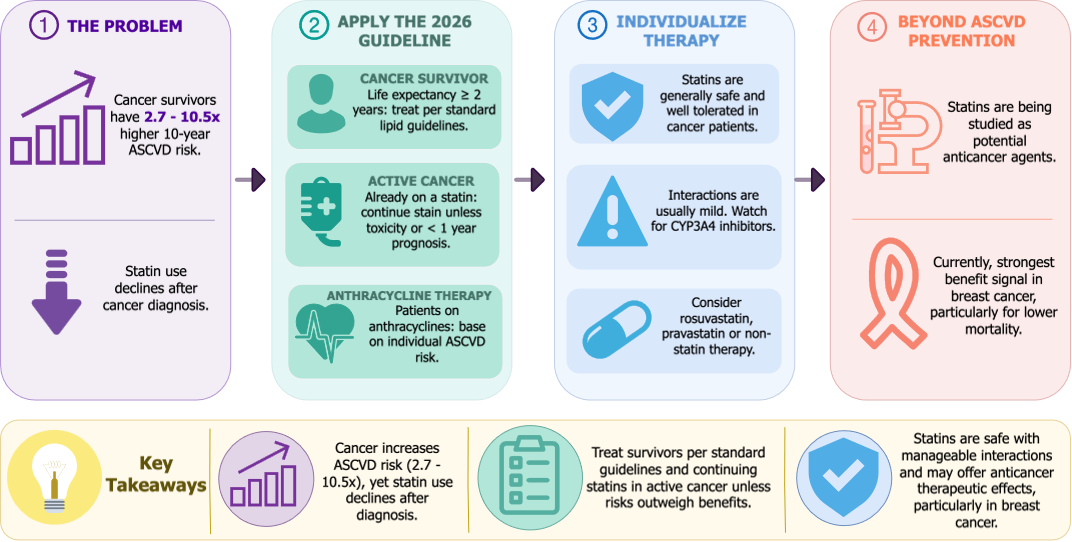
CYP3A4 = cytochrome P450 3A4.
The 2026 Guideline Update
One contributor to the lack of continued dyslipidemia pharmacotherapy in this population has been the absence of clear guidelines to inform clinician management. The first strong recommendation regarding statin use in patients with cancer appeared in the 2025 European Society of Cardiology/European Atherosclerosis Society (ESC/EAS) Focused Update of the 2019 ESC/EAS Guidelines for the Management of Dyslipidemias7; however, this document focused on statin use in the prevention of chemotherapy-induced cardiotoxicity.
The 2026 ACC/AHA/multisociety guideline on dyslipidemia represents a milestone for cardio-oncology by providing dedicated recommendations. Cancer history, treatment-related toxicity and metabolic derangements, ASCVD risk factors, competing mortality, prognosis, and drug interactions must be incorporated into lipid-management decisions rather than treated as secondary considerations.6
This guideline also recommends that adult survivors of cancer with a life expectancy of ≥2 years who otherwise meet criteria for lipid-lowering therapy (LLT) be managed similarly to adults without a history of cancer. Additionally, statin therapy should be continued in adults with active cancer who are already receiving therapy, unless clinically important toxicity occurs or life expectancy of <1 year shifts the balance of benefits and harms of drug continuation. If drug interactions are a concern, the guidelines advise a referral to preventive cardiology.6
For cancer treatment–related cardiotoxicity, the 2025 ESC/EAS focused update on dyslipidemias provides a class IIa recommendation for statin use in adults at high risk of cancer treatment–related cardiotoxicity, particularly those receiving anthracycline-based regimens. The authors acknowledge that the evidence to support statin use for chemotherapy-induced cardiotoxicity prevention is not unequivocal but consider the available randomized data from large studies such as the STOP-CA (Statins to Prevent the Cardiotoxicity of Anthracyclines) study sufficient to support statin use in select patients.7
The 2026 ACC/AHA/multisociety guideline on dyslipidemia provides a weaker Class 2b recommendation for statin initiation when anthracycline therapy raises concern for cardiotoxicity in adults with active cancer who are not already receiving a statin. The authors suggest an individualized approach to guide clinical prescribing based on the patient's underlying ASCVD risk, especially when the decision to initiate a statin is uncertain.6
Reassessing Statin Safety
Statin therapy is generally well tolerated for use in patients with cancer, with myalgias and elevated hepatic laboratory measurements being the most common adverse effects, similar to those in patients without cancer. A 2024 systematic review that evaluated the prevalence of these adverse effects in 16 randomized trials involving 2,640 patients with cancer taking a statin revealed no cases of myopathy or hepatotoxicity requiring medical attention.8
Nevertheless, polypharmacy presents a barrier to statin initiation in patients with cancer. A 2025 review of 138 oncology therapies found that 33 agents (23.8%) had potential interactions with ≥1 of the 5 commonly used statins. Pravastatin exhibited the lowest interaction rates and simvastatin the highest. Clinically significant interactions between statins and oncology drugs were rare, with only 7% of interactions identified as contraindicated; 88% of statin–oncology drug interactions were assigned a risk rating of C, indicating that the benefit of concomitant therapy outweighs the risks and suggesting that routine clinical monitoring is sufficient.9
Clinical management must be individualized to patients and their specific medication regimens. This individualization is important for chemotherapy regimens that include cytochrome P450 3A4 (CYP3A4) inhibitors such as taxanes and vinca alkaloids, which can raise serum simvastatin and atorvastatin concentrations and increase the risk of adverse events. In these situations, statins that are minimally metabolized by CYP3A4 (e.g., rosuvastatin, fluvastatin, pitavastatin, pravastatin) should be preferentially prescribed along with nonstatin LLTs such as ezetimibe and PCSK9 inhibitors.9
Statins as Potential Anticancer Agents
Statins are being studied as potential adjuvant anticancer agents. Hydroxy-methyl-glutaryl coenzyme A reductase inhibitors block the mevalonate pathway that produces cholesterol and other organic compounds involved in tumor proliferation and survival.
Data in breast cancer are encouraging. A large meta-analysis of 31 cohorts involving 261,834 women with breast cancer showed that prediagnostic statin use was associated with lower overall and breast cancer–specific mortality. Postdiagnostic statin use was also associated with decreased breast cancer recurrence, overall mortality, and breast cancer–specific mortality. This finding was supported by the results of a Finnish cohort study of 7,389 women, which showed that postdiagnostic statin use was associated with lower breast cancer–specific mortality (hazard ratio [HR], 0.68) and all-cause mortality (HR, 0.83), particularly in cohorts with hormone-receptor positive disease, compared with patients who did not take statins.10
Summary
The recent ACC/AHA/multisociety and ESC/EAS guidelines on dyslipidemia provide guidance for people living with cancer. Statin use should be continued in those undergoing cancer therapy unless life expectancy is estimated to be <1 year or there is expected interaction between chemotherapy and statins. As survivorship increases for those with cancer, increased focus on ASCVD prevention is of utmost importance.
References
- Zhang L, Iliescu C, Ferencik M, et al. Coronary atherosclerosis in patients with cancer and survivors: a scientific statement from the American Heart Association. Circulation. 2026;153(10):e916-e933. doi:10.1161/CIR.0000000000001391
- Zhang X, Pawlikowski M, Olivo-Marston S, Williams KP, Bower JK, Felix AS. Ten-year cardiovascular risk among cancer survivors: the National Health and Nutrition Examination Survey. PLoS One. 2021;16(3):e0247919. Published 2021 Mar 4. doi:10.1371/journal.pone.0247919
- Williams KP, Lin CJ, Felix AS, et al. The association between cardiovascular disease and breast and gynecologic cancers among black female patients. J Natl Med Assoc. 2023;115(5):466-474. doi:10.1016/j.jnma.2023.07.004
- Florido R, Daya NR, Ndumele CE, et al. Cardiovascular disease risk among cancer survivors: the Atherosclerosis Risk In Communities (ARIC) study. J Am Coll Cardiol. 2022;80(1):22-32. doi:10.1016/j.jacc.2022.04.042
- Lund JL, Gupta P, Amin KB, et al. Changes in chronic medication adherence in older adults with cancer versus matched cancer-free cohorts. J Geriatr Oncol. 2021;12(1):72-79. doi:10.1016/j.jgo.2020.04.012
- Blumenthal RS, Morris PB, Gaudino M, et al. 2026 ACC/AHA/AACVPR/ABC/ACPM/ADA/AGS/APhA/ASPC/NLA/PCNA guideline on the management of dyslipidemia: a report of the American College of Cardiology/American Heart Association Joint Committee on Clinical Practice Guidelines. J Am Coll Cardiol. Published online March 13, 2026. doi:10.1016/j.jacc.2025.11.016
- Mach F, Koskinas KC, Roeters van Lennep JE, et al. 2025 focused update of the 2019 ESC/EAS guidelines for the management of dyslipidaemias. Eur Heart J. 2025;46(42):4359-4378. doi:10.1093/eurheartj/ehaf190
- Bikdeli B, Tajrishi FZ, Connors JM. Risk of myopathy and hepatotoxicity in patients with cancer receiving statin therapy: systematic review of randomized controlled trials. Vasc Med. 2024;29(5):556-558. doi:10.1177/1358863X241246471
- Chou E, Legasto CS, Chin AK, Baik AH, Schulte BC. Statin use in patients with cancer: drug interaction and statin usage. JACC Adv. 2025;4(11 Pt 1):102259. doi:10.1016/j.jacadv.2025.102259
- Palmi S, Arponen O, Murto M, Siltari A, Jukkola A, Murtola T. Statin use and survival in early breast cancer according to different intrinsic subtypes. JAMA Netw Open. 2026;9(6):e2616375. Published 2026 Jun 1. doi:10.1001/jamanetworkopen.2026.16375
Clinical Topics: Prevention, Cardio-Oncology, Dyslipidemia, Stable Ischemic Heart Disease
Keywords: Primary Prevention, Dyslipidemia, Cardio-oncology
