LCZ in nHCM: Sacubitril/Valsartan Promotes Cardiac Remodeling, But Not Functional Capacity, in Nonobstructive HCM
Functional capacity as measured by peak oxygen uptake (pVO2) was not improved with sacubitril/valsartan (LCZ696) in patients with nonobstructive hypertrophic cardiomyopathy (nHCM), while there was favorable cardiac structural remodeling, according to research published Aug. 19 in JACC: Heart Failure.
In the phase II international trial, Milena Petranovic, MD, et al., examined the safety, tolerability and efficacy of LCZ696 at 50 weeks in patients with nHCM randomized to LCZ696 uptitrated to 200 mg twice daily or placebo. Each group included 20 patients; the median age was 58 years and 23% were women.
Baseline characteristics were similar in both groups. Most patients were in NYHA functional class II (70% and 90% of the treatment and placebo groups) and the baseline mean pVO2 was 18.4 mL/kg/min in both groups. The mean % predicted pVO2 was 65.8% and 69.6%, respectively.
Results for the primary endpoint of change from baseline in pVO2 showed no significant difference between the two groups (1.0 vs. 0.4 mL/kg/min for LCZ696 and placebo) at 50 weeks.
Other findings showed that, compared with placebo, LCZ696 reduced interventricular septal thickness (by 4.7 mm; p=0.0001) as well as left ventricular mass index (LVMi) (by 22.5 g/m2; p=0.02).
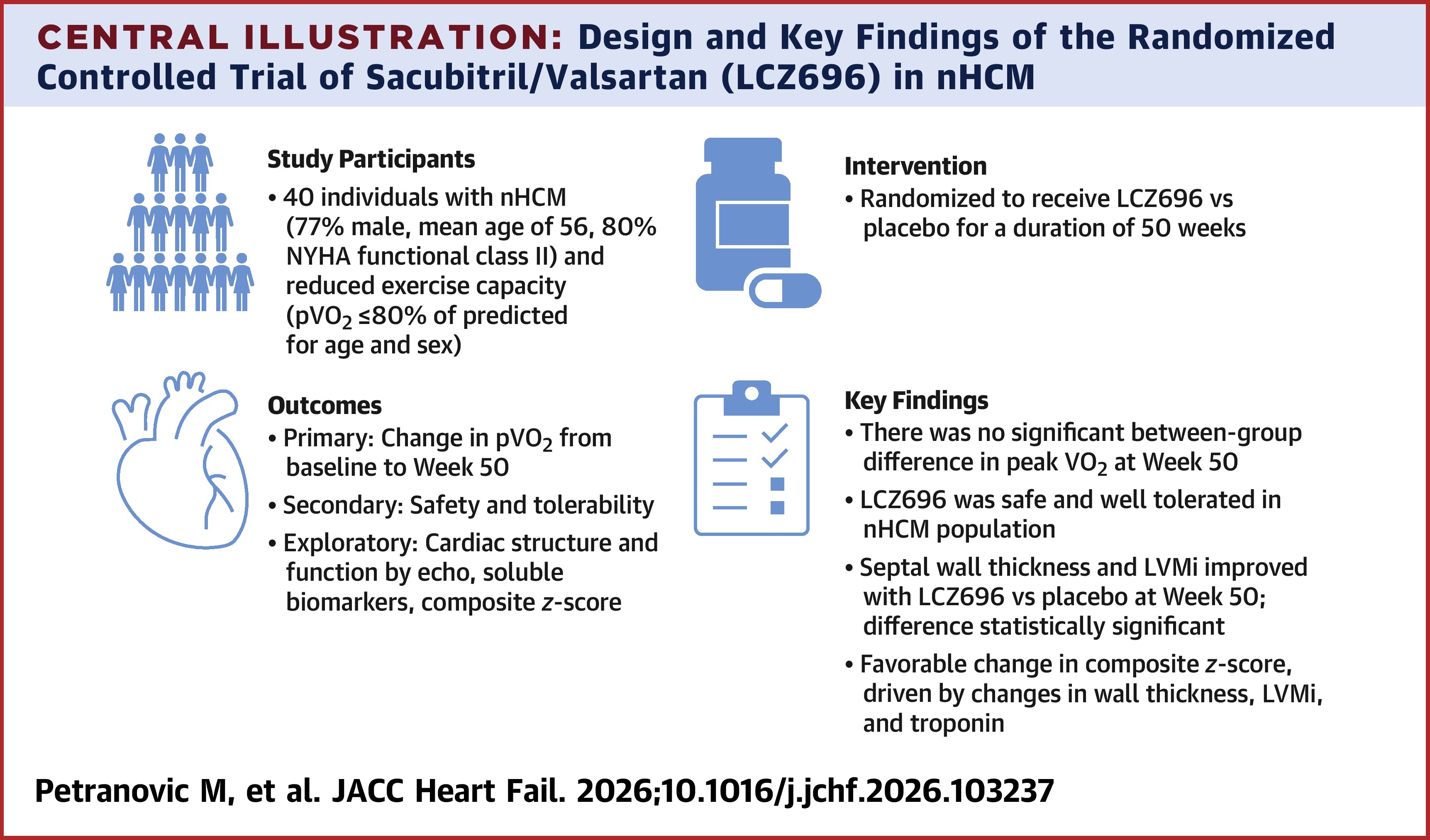
A composite z-score endpoint, an exploratory endpoint added after the study began but before data were locked, comprising changes in echocardiographic features, serum biomarkers and clinically relevant nHCM parameters, improved with LCZ696 vs. placebo (0.18 vs. –0.17; p=0.015). This was mainly driven by changes in wall thickness, LVMi and troponin levels.
No deaths occurred during the study. Three participants, all in the LCZ696 group, experienced serious adverse events but none were considered related to treatment. Rates of mild to moderate hypotension and mild renal impairment were consistent with the known safety profile of LCZ696.
"Because LV hypertrophy has been associated with a higher risk of cardiovascular events, arrhythmias and mortality, even modest reductions in LV mass and wall thickness may be interpreted as favorable," write Petranovic and colleagues. "However, whether the magnitude of remodeling observed with LCZ696 translates into improved clinical outcomes in nHCM remains uncertain."
Clinical Topics: Cardiovascular Care Team, Heart Failure and Cardiomyopathies, Noninvasive Imaging, Acute Heart Failure, Echocardiography/Ultrasound
Keywords: Ventricular Remodeling, Hypertrophic Cardiomyopathy, Heart Failure, Echocardiography
