Poll: Brainstorm: Restarting Anticoagulation After Brain Bleed
An 80-year-old man presents for a cardiovascular (CV) follow-up after a prolonged hospitalization in the setting of an intracerebral hemorrhage (ICH). His medical history is relevant for atrial fibrillation (AF; CHA2DS2-VASc score 6, HAS-BLED 3 score; treated with apixaban 2.5 mg twice daily prior to admission), stage 3b chronic kidney disease, heart failure (HF) with preserved ejection fraction (EF; left ventricular EF 62%), hypertension (HTN), myocardial infarction (MI) 10 years ago (treated with stent to the left anterior descending coronary artery), and type 2 diabetes mellitus.
Two months ago, he presented after a 2-hour onset of aphasia, right-sided weakness, and confusion. There was no history of trauma or seizure, and he was in his normal state of health before presentation. On arrival, his blood pressure (BP) was 170/72 mm Hg and heart rate was 85 bpm (in AF); he was afebrile and saturating well in room air. Initial National Institutes of Health Stroke Scale (NIHSS) score was 16. A stat noncontrast computed tomography head showed a large left lobar intraparenchymal hemorrhage (measuring 5.2 x 4.5 cm) with surrounding edema and mild midline shift (Image 1). There was no underlying mass lesion. According to his daughter, he was compliant with apixaban 2.5 mg twice daily. He was not taking any antiplatelets. Factor eight inhibitor bypassing activity was used as a reversal agent, nicardipine was started for a systolic BP goal of <140 mm Hg, and he was admitted to the neurological intensive care unit for further care.
Image 1: Brain CT Scan: Left Lobar ICH
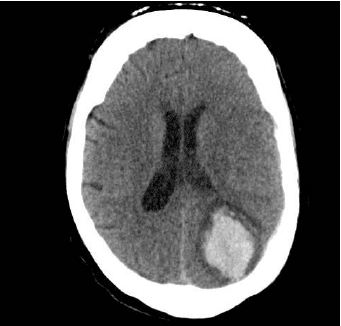
CT = computed tomography; ICH = intracerebral hemorrhage.
He was discharged in stable condition and has been holding apixaban since. He does not have signs or symptoms of ischemia or HF, and is seeking guidance on whether he should restart anticoagulation for his AF.
Clinical Topics: Anticoagulation Management, Arrhythmias and Clinical EP, Cardiovascular Care Team, Geriatric Cardiology, Anticoagulation Management and Atrial Fibrillation, Atrial Fibrillation/Supraventricular Arrhythmias, Vascular Medicine
Keywords: Geriatrics, Atrial Fibrillation, Cerebral Hemorrhage, Anticoagulation Management, Anticoagulants
