EWAS Identifies Associations Between DNA Methylation, Atherosclerosis
An epigenome-wide association study (EWAS) identified a large number of associations between DNA methylation and carotid, coronary and peripheral atherosclerosis, with >90% of sites traceable to the epigenetic signatures of cardiovascular risk factors, predominantly smoking, according to research published June 3 in JACC.
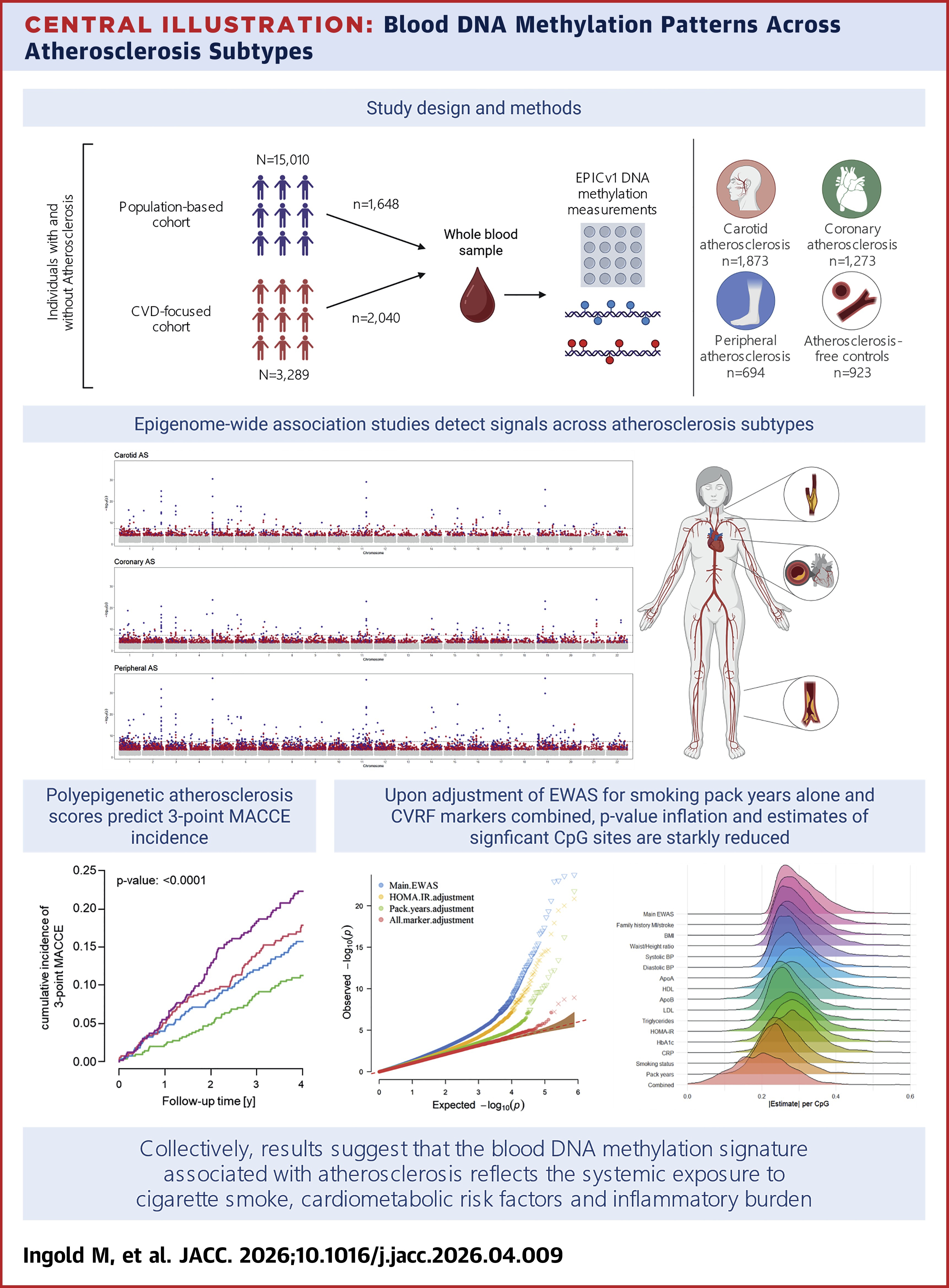
Study authors Markus Ingold, MSc; Vincent Ten Cate, PhD, et al., for the GHS Research Consortium, analyzed blood DNA methylation at 767,735 cytosine-phosphate-guanine (CpG) sites in 3,688 participants of two prospective cohort studies: the Gutenberg Health Study (GHS) and the MyoVasc Study on the Development and Progression of Heart Failure. Among participants, almost exclusively white Europeans, 1,873 had carotid atherosclerosis, 1,243 had coronary atherosclerosis and 694 had peripheral atherosclerosis while 923 served as atherosclerosis-free controls.
Results identified 7,650 CpG sites associated with carotid (1,687 sites), coronary (3,131 sites) and peripheral atherosclerosis (5,852 sites), with 2,155 sites associated in two or more settings and 37% of genes shared between at least two vascular beds.
The most strongly associated sites were mapped to an intergenic region of chromosome 2 (near ALPP/ALPG), AHRR, PRSS23 and F2RL3. In coronary atherosclerosis there were additional strong associations with ABCG1 and DHCR24.
Most (>90%) of these sites intersected with cardiovascular-risk-factor-associated sites, predominantly smoking (up to 90%), followed by inflammation (60%) and metabolic traits (44%). A joint adjustment for all risk factor markers reduced the median absolute estimate of significant sites by 25.5%-32.8%, with adjustment for smoking pack-years alone reducing it by 19.6%-29.0%.
Notably, epigenic scores trained in the GHS cohort were predictive in the MyoVasc cohort of a composite of incident myocardial infarction (MI), cardiac death, stroke or transient ischemic attack over four years of follow-up (hazard ratios, 1.23-1.39; all p<0.001), as well as all-cause death.
"We conclude that in blood, the epigenetic signature of atherosclerosis largely reflects cumulative exposure, particularly smoking and cardiometabolic dysregulation, rather than strongly vasculature-specific biological processes," write the authors.
"A single blood assay therefore can provide a durable readout of cumulative inflammatory and cardiometabolic burden, useful for exposure assessment and risk stratification," add Sarah Constantino, PhD; Alessia Mongelli, MSc; Frank Ruschitzka, MD; and Francesco Paneni, MD, PhD; in an accompanying editorial comment. "The exposome-methylation nexus unveiled by Ingold et al., is a rich and actionable frontier to understand and treat cardiovascular disease."
Clinical Topics: Prevention, Vascular Medicine, Atherosclerotic Disease (CAD/PAD), Smoking
Keywords: DNA Methylation, Carotid Artery Diseases, Coronary Artery Disease, Heart Disease Risk Factors, Atherosclerosis, Smoking
