Combined LDL-C, Lp(a) and hsCRP Assessment Identifies Long-Term Risk of ASCVD
Combined assessment of LDL-C, Lp(a) and hsCRP reflected independent pathways for identifying individuals of varied ethnicities at greater long-term risk of atherosclerotic cardiovascular disease (ASCVD), according to an analysis of the HELIUS cohort published June 24 in JACC.
Maxim E. Annink, MD, MSc, LLM, et al., included 15,676 HELIUS participants (mean age 44 years, 56% women) of African, European and South Asian Surinamese descent without prior myocardial infarction or ischemic stroke. Incident ASCVD was determined via nationwide registries over a median follow-up period of 8.9 years. The authors sought to assess the additive and multiplicative interaction of LDL-C, Lp(a) and hsCRP on ASCVD risk.
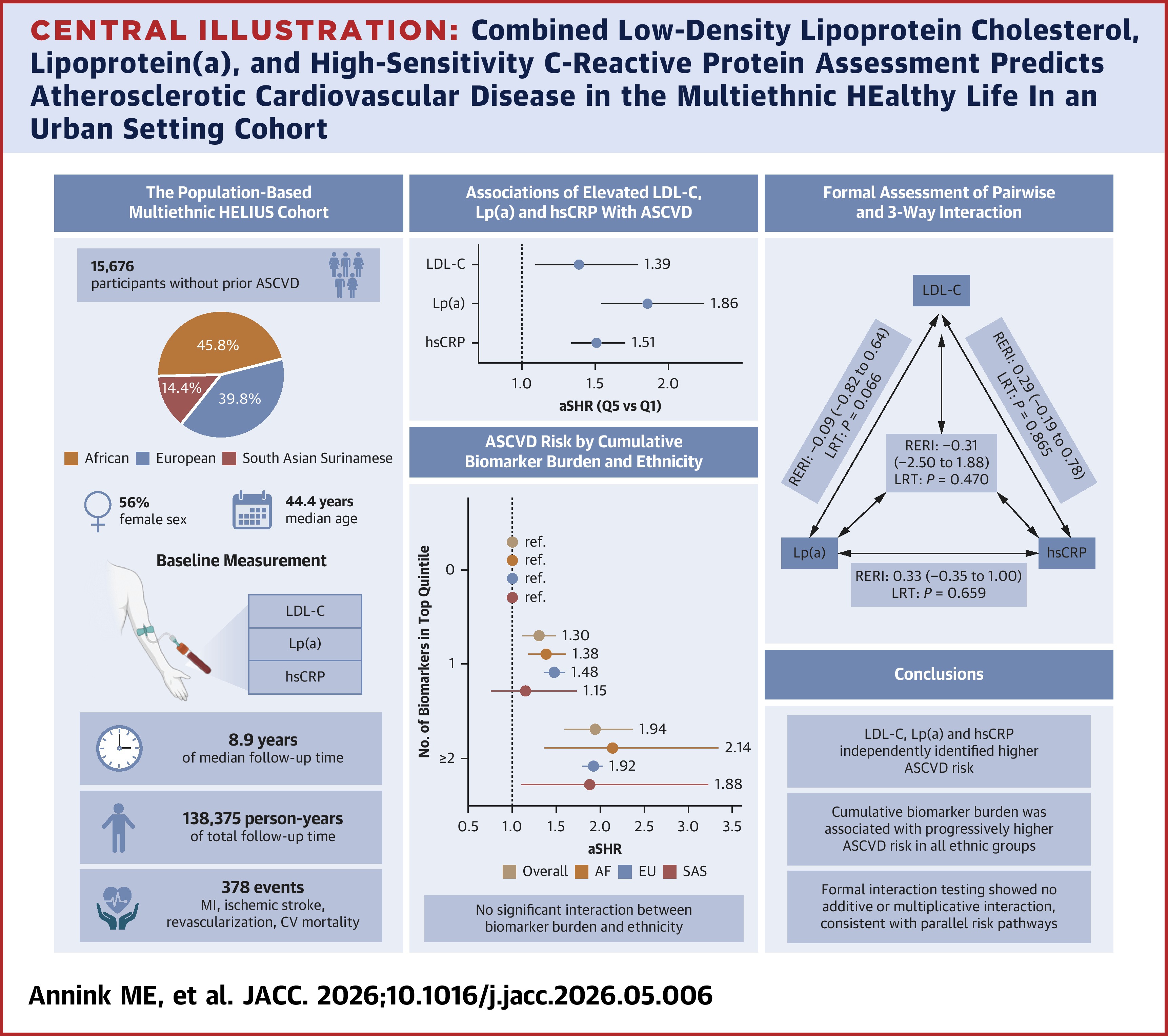
Overall, 378 ASCVD events occurred throughout the study. Hazard ratios comparing top vs. bottom quintiles for each biomarker were 1.39 for LDL-C, 1.86 for Lp(a) and 1.51 for hsCRP. No interaction was observed on the multiplicative or additive scale.
ASCVD risk increased with the number of elevated biomarkers. Participants with all three elevated biomarkers had a 2.44-fold increase in risk. Patterns were consistent across ethnic groups; however, absolute ASCVD risk was highest among participants of South Asian Surinamese descent.
"In HELIUS, individuals with joint elevations of Lp(a) and hsCRP, neither of which appears in standard clinical risk models, had close to two-fold higher ASCVD risk that those without these elevations," add the authors. "Addition of Lp(a) and hsCRP to a PREVENT-ASCVD–based clinical model modestly improved discrimination (ΔAUC: 0.006) and produced a more pronounced improvement in reclassification (NRI: 0.17) at 10 years."
In an accompanying editorial comment, Anurag Mehta, MD, FACC, notes that "the current study does not call for a new risk score, and clinicians should resist the temptation to retrofit one. What it does call for is a pathway-oriented approach to prevention that current guidelines already endorse."
Clinical Topics: Dyslipidemia, Advanced Lipid Testing, Lipid Metabolism, Nonstatins
Keywords: Lipoprotein(a), Cholesterol, LDL, C-Reactive Protein, Cardiovascular Diseases, Risk Factors, Biomarkers
