Central Adiposity as Predictor of CV Outcomes | JACC Special Issue on Obesity
Waist circumference (WC) and waist-to-hip ratio (WHR) provide additional diagnostic and prognostic value compared with conventional BMI categories alone, which may misclassify cardiovascular disease risk, according to results from the Cross-Cohort Collaboration (CCC) Obesity Working Group published Aug. 11 in JACC.
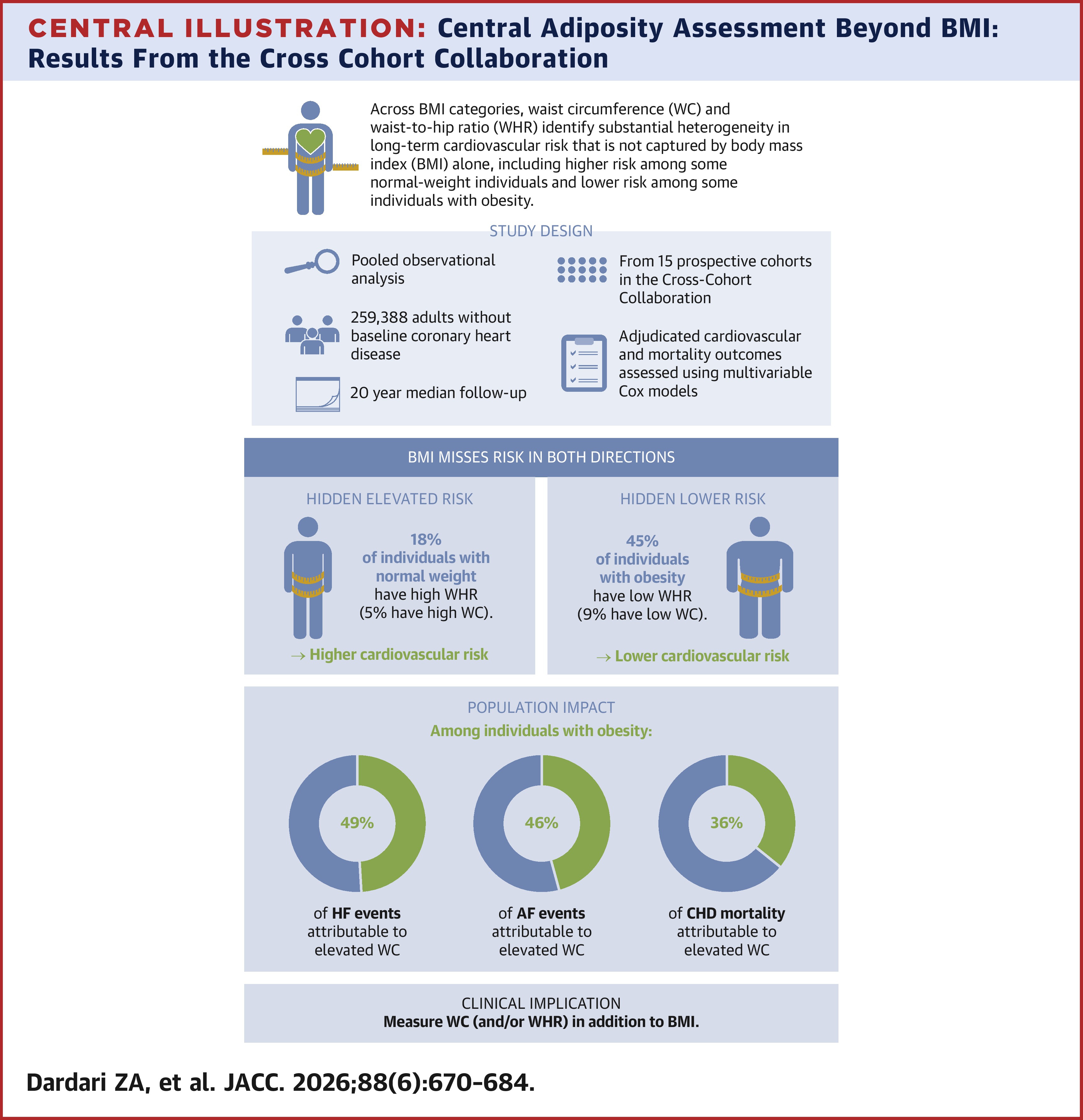
In a pooled analysis of 15 prospective National Institutes of Health and National Heart, Lung and Blood Institute CCC cohorts, study authors examined the association between WC, WHR and nine cardiovascular and mortality outcomes in 259,388 adults without baseline coronary heart disease (CHD).
Over a median follow-up of 20 years, investigators found substantial discordance between BMI-defined weight categories and the two measures of central adiposity. For example, among participants with normal weight, 5% still had elevated WC and 18% had elevated WHR, whereas among those with obesity, 9% had low WC and 45% had low WHR.
Across normal and overweight categories, elevated WC and WHR were generally associated with 15% to 50% higher risk of most of the nine clinical outcomes: time to first fatal and nonfatal MI, fatal and nonfatal stroke, heart failure (HF), atrial fibrillation (AFib), total CHD, total cardiovascular disease, CHD mortality, cardiovascular mortality and/or all-cause mortality.
Participants with obesity but low WC generally had risk profiles similar with normal-weight individuals with low WC, except for all-cause mortality where they had significantly lower risk, but those with high WC or WHR had substantially higher event rates.
"We saw individuals with clinically determined normal weight who had elevated central adiposity and high WHR, associating them with higher risk across most outcomes," stated Michael J. Blaha, MD, MPH, senior author of the study and director of clinical research at Johns Hopkins Ciccarone Center for the Prevention of Cardiovascular Disease.
Central adiposity accounted for a considerable proportion of cardiovascular events among participants with obesity (13%-49%), and elevated WC was associated with nearly half of AFib (46%) and HF (49%) events in this group. Additionally, among participants with obesity, 36% of CHD mortality was attributable to elevated WC.
On the findings, "taken together," write Kershaw Patel, MD, and Neela Thangada, MD, in an accompanying editorial comment, "BMI-based assessment of obesity does not comprehensively evaluate [cardiovascular disease] risk, and central adiposity measures meaningfully refine [cardiovascular disease] risk estimation across BMI levels."
"Relying solely on BMI may result in misclassification of cardiovascular risk across a wide range of cardiovascular outcomes," adds Zeina Dardari, PhD, MS, lead author of the study. "We encourage clinicians to consider central adiposity distribution across the entire BMI spectrum when evaluating cardiovascular risk in primary prevention settings."
The paper is one of several sharing the spotlight in a JACC special issue on obesity. "It is time to abandon a sole focus on [BMI]," writes Harlan M. Krumholz, MD, SM, MACC, Editor-in-Chief of JACC. "This enormously important study, based on data from hundreds of thousands of participants in large-scale cohort studies, authoritatively shows that [WC] and [WHR] provide critical information about cardiovascular risk, even among people with a BMI considered normal. Where fat is distributed matters, and these simple measures should be part of routine cardiovascular risk assessment.
Keywords: Waist Circumference, Waist-Hip Ratio, Adiposity, Body Mass Index, Obesity
