Comparing Add-On Treatments For Resistant or Uncontrolled HTN
No significant differences were identified among add-on treatments to reduce blood pressure (BP) in patients with resistant or uncontrolled hypertension, according to a meta-analysis of 35 randomized trials recently published in JACC: Advances.
Angelo Laino, MD, et al., included data from 8,648 patients and 12 individual treatments and established a primary outcome of change in office systolic BP from baseline. They used the Confidence In Network Meta-Analysis (CINeMA) framework to assess certainty of evidence.
Both spironolactone (mean difference: –12.43 mm Hg; 95% credible interval: –17.68 to –7.18; CINeMA moderate) and radiofrequency renal denervation (RDN) (mean difference: –8.74 mm Hg; 95% credible interval: –12.96 to –4.52; CINeMA moderate) were more effective at reducing office systolic BP vs. baseline treatment among patients with resistant hypertension. Similar results were found in patients with uncontrolled hypertension.
Of note, the authors found "no intervention demonstrated clear superiority over another because most head-to-head comparisons included the possibility of no effect." In pair-wise meta-analyses, aprocitentan, baxdrostat and darusentan outperformed baseline treatment.
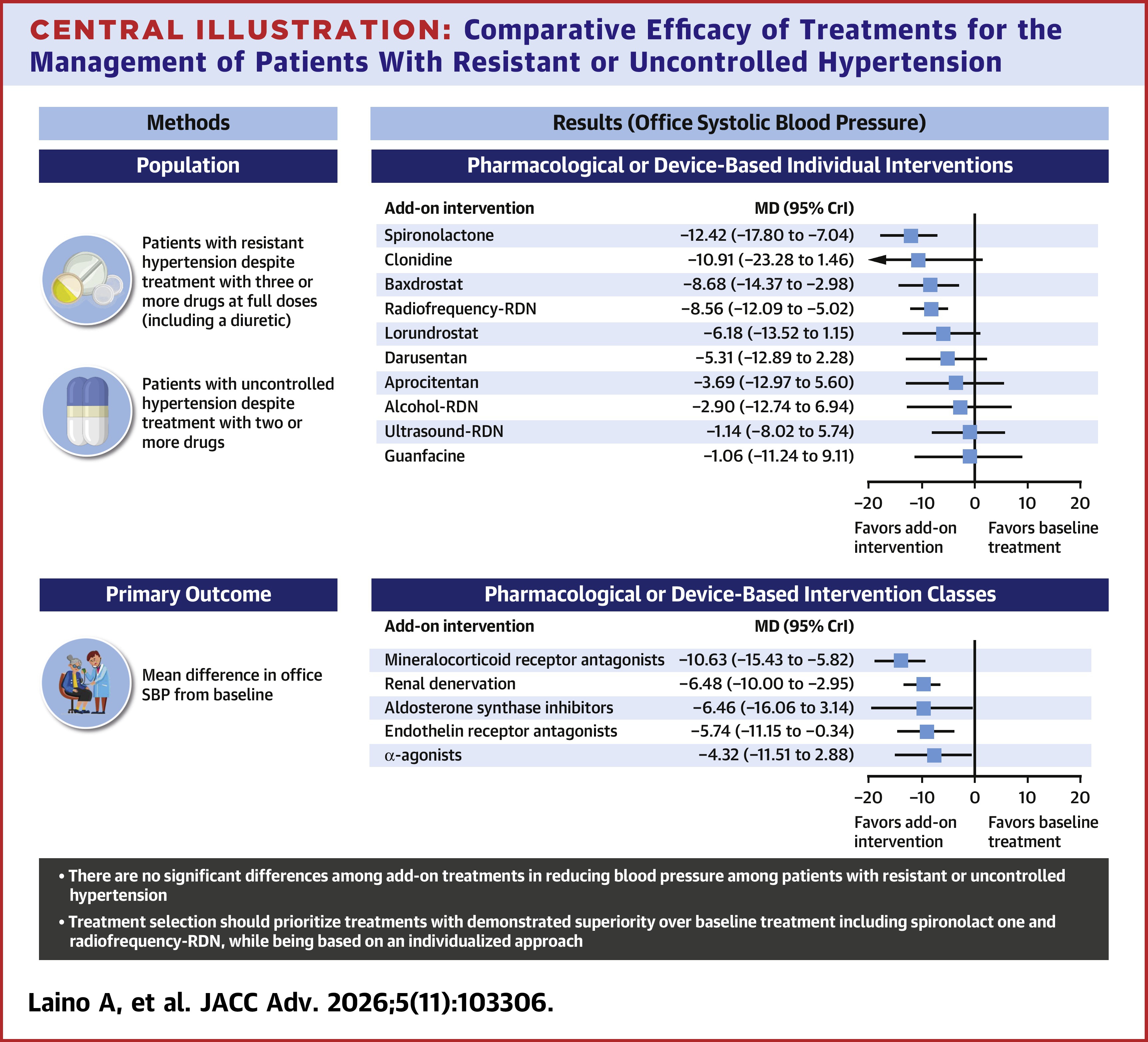
Study limitations include a lack of access to individual patient data, variation in background therapies across trials, high heterogeneity for many outcomes of interest and more. Regardless, Laino and colleagues state that "spironolactone, baxdrostat and radiofrequency-RDN are the treatments supported by a substantial body of evidence that consistently reduced all measures of [BP] in the short term compared by baseline treatment in patients with resistant or uncontrolled hypertension."
Clinical Topics: Prevention, Hypertension
Keywords: Blood Pressure, Hypertension, Denervation, Spironolactone
