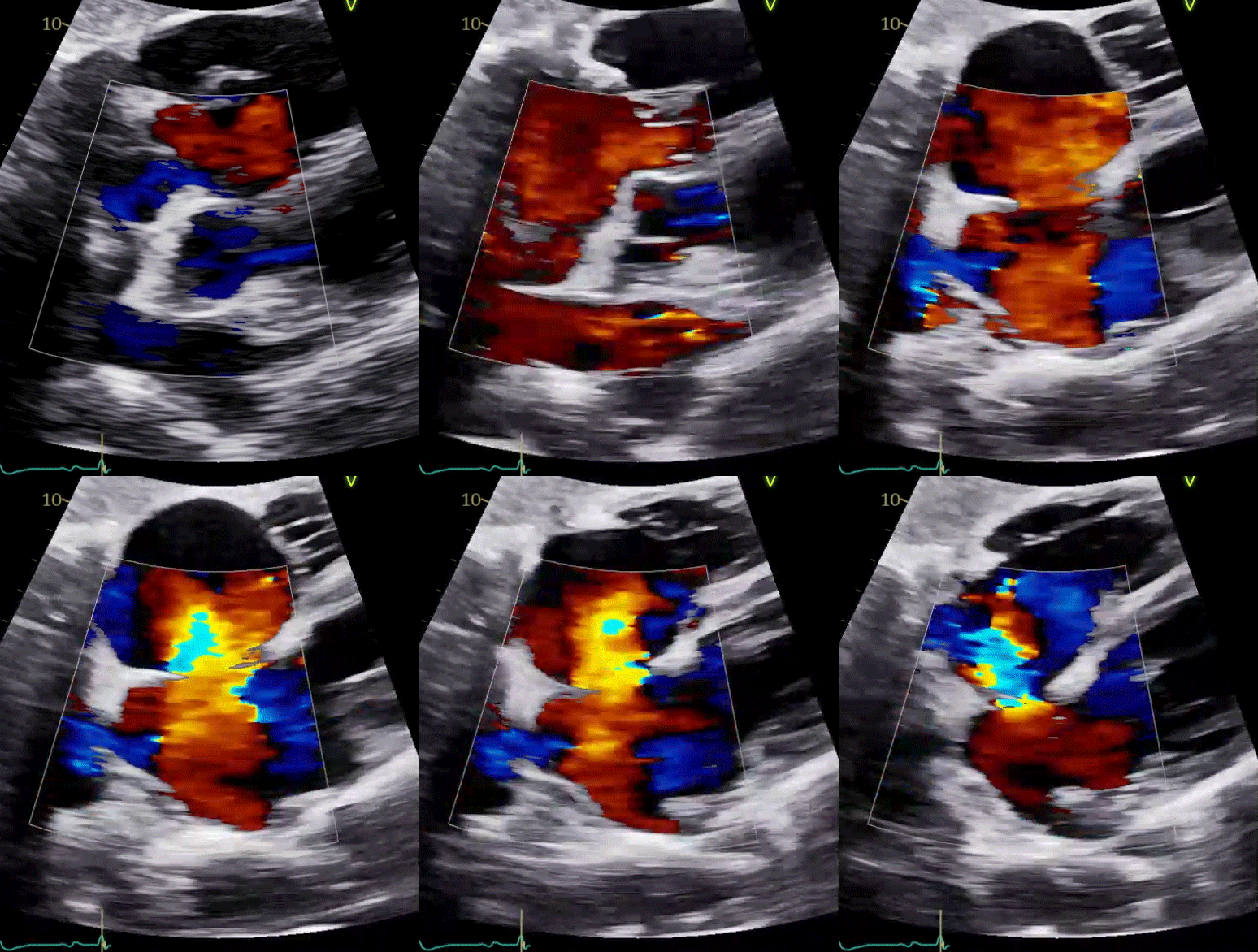
This patient had an ASD complicated by pulmonary arterial hypertension (PAH) on the basis of her symptoms, echocardiogram findings, and RHC findings. The best next step would be to perform vasoreactivity testing. If vasoreactivity testing shows reversibility, initiating pulmonary vasodilator therapy and reassessing in 3-6 months should be considered to potentially lower pulmonary pressures before attempting ASD closure.
Percutaneous and surgical ASD closure would be premature without first addressing the PAH. Lung transplant would be inappropriate because there was the potential to lower the PVR with appropriate management of the PAH and thus make her a better candidate for ASD closure.
A secundum ASD is the most common type of ASD and one of the most frequent congenital heart conditions to present in adulthood.1 Patients with secundum ASDs can remain free of symptoms until they present in adulthood with exertional dyspnea, palpitations, and reduced functional capacity. In patients with secundum ASDs, ECGs often have characteristic features such as RBBB with right-axis deviation. Echocardiography can demonstrate the defect, assess RV size and function, and provide an estimation of PAP. In some cases, additional imaging with magnetic resonance imaging (MRI) or computed tomography may be indicated to evaluate for associated lesions such as partial anomalous pulmonary venous connections. MRI or RHC can quantify the Qp:Qs.
Per the 2018 American Heart Association/American College of Cardiology (AHA/ACC) Guideline for the Managements of Adults With Congenital Heart Disease, adults with isolated secundum ASD closure causing a hemodynamically significant shunt—RA and/or RV dilation with net left-to-right shunt Qp:Qs ≥1.5:1—can be referred for ASD closure provided that they do not have cyanosis at rest or with exercise, the PVR less than one-third the systemic vascular resistance (SVR), and the pulmonary artery systolic pressure (PASP) is ≤50% of the systemic pressure.2 If there is functional impairment, there is a Class 1 indication for surgical or device closure. If there is no functional impairment, there is a Class 2a indication for surgical or device closure. For patients with PVR greater than one-third the SVR and/or PASP ≥50% systemic, the guideline recommends consultation with adult congenital heart disease and pulmonary hypertension experts.
The degree of left-to-right shunting and increased pulmonary blood flow in patients with an ASD depends on the size of the defect and the compliance differences between the RV and left ventricle.3 Although the exact mechanisms of PAH in patients with ASD remain unclear, it is thought that elevated pulmonary blood flow leads to endothelial damage, triggering pulmonary vascular changes such as medial hypertrophy, intimal proliferation, and fibrosis. These changes ultimately result in vasoconstriction and vascular hypertrophy.4 This process can provoke a maladaptive response of the RV in patients with unrepaired ASD-PAH, resembling idiopathic PAH, and is marked by RV dilation and progressive systolic dysfunction. In patients with severe PAH and an ASD, the defect may serve as a safety valve, allowing for intermittent right-to-left shunting to maintain cardiac output when the PVR is severely elevated. Closing the ASD without addressing the PAH increases the risk of RV failure because it removes the pop-off valve effect, causing a sudden rise in the pressure the RV must pump against. This effect leads to acute pressure overload and subsequent RV dysfunction because the RV cannot manage the increased afterload in the context of already elevated PVR. The use of PAH-specific therapies may enable reverse remodeling and facilitate successful ASD repair in patients previously considered noncorrectable.5 In a multicenter retrospective study of 69 patients receiving PAH therapy (74% women, mean age 40 ± 15 years) with mean PAP 51 ± 13 mm Hg, mean PVR 8.7 ± 4.9 WU, and mean Qp:Qs 1.6 ± 0.4, 19 patients underwent ASD closure. On follow-up, the patients who underwent repair had a trend toward lower PVR post PAH therapy (6.4 ± 5 WU) compared with the unrepaired group (8.2 ± 4.4 WU). There was an improvement in 6-min walk distance, RV function, and mortality in the repaired group. These findings support a trial of targeted PAH therapy with a treat-to-close strategy in patients traditionally deemed to have noncorrectable defects.6
References
- Viera E, Meras P, Merino C, et al. Diagnosis of congenital heart disease in adulthood: how often, how relevant?. Am J Cardiol. 2024;231:72-74. doi:10.1016/j.amjcard.2024.09.004
- Stout KK, Daniels CJ, Aboulhosn JA, et al. 2018 AHA/ACC guideline for the management of adults with congenital heart disease: a report of the American College of Cardiology/American Heart Association Task Force on Clinical Practice Guidelines. J Am Coll Cardiol. 2019;73(12):e81-e192. doi:10.1016/j.jacc.2018.08.1029
- Webb G, Gatzoulis MA. Atrial septal defects in the adult: recent progress and overview. Circulation. 2006;114(15):1645-1653. doi:10.1161/CIRCULATIONAHA.105.592055
- Diller GP, Gatzoulis MA. Pulmonary vascular disease in adults with congenital heart disease. Circulation. 2007;115(8):1039-1050. doi:10.1161/CIRCULATIONAHA.105.592386
- Baumgartner H, De Backer J, Babu-Narayan SV, et al. 2020 ESC guidelines for the management of adult congenital heart disease. Eur Heart J. 2021;42(6):563-645. doi:10.1093/eurheartj/ehaa554
- Bradley EA, Ammash N, Martinez SC, et al. "Treat-to-close": non-repairable ASD-PAH in the adult: results from the North American ASD-PAH (NAAP) Multicenter Registry. Int J Cardiol. 2019;291:127-133. doi:10.1016/j.ijcard.2019.03.056