Sports and Exercise Cardiology Highlights From the American Heart Association Scientific Sessions 2025
Quick Takes
- The 2025 American Heart Association/American College of Cardiology (ACC/AHA) scientific statement on Clinical Considerations for Competitive Sports Participation for Athletes With Cardiovascular Abnormalities marks a major update in the evolution of sports cardiology, emphasizing shared decision-making, individualized risk assessment, and contemporary approaches to eligibility decisions.
- Preparticipation cardiac evaluation remains foundational, with the AHA 14-point history and physical examination, thoughtful use of electrocardiogram screening, and comprehensive emergency action plans all identified as key elements.
A central sports cardiology session at the 2025 American Heart Association (AHA) Scientific Sessions, titled "Competitive Sports Participation for Athletes with Heart Disease: New Guidance and Future Directions," highlighted major updates from the 2025 AHA/American College of Cardiology (ACC) scientific statement on Clinical Considerations for Competitive Sports Participation for Athletes With Cardiovascular Abnormalities.1
2025 AHA/ACC Scientific Statement: Rationale and Key Highlights
Dr. Jonathan Kim, current chair of the ACC Sports and Exercise Cardiology Member Section, outlined the motivation behind the new scientific statement, which provides a contemporary clinical approach that incorporates advances in risk assessment, shared decision-making, genetic evaluation, imaging, and longitudinal monitoring. Among the driving forces that prompted the updated recommendations included the emergence of new data on the risks of adverse cardiac events in athletes with cardiac conditions (e.g., genetic cardiomyopathies, long QT syndrome). Three sections received particular emphasis:
- Section III: Ethical Aspects of Competitive Sports Eligibility. This section emphasizes a shift away from a paternalistic approach toward respecting athlete autonomy. Key points include communicating evidence-based risk and uncertainty and engaging athletes in a shared decision-making process with appropriate subspecialty involvement.
- Section X: Masters Athletes. Defined as people ≥35 years of age who place a high premium on competitive sports participation, masters athletes have unique age-related cardiovascular considerations. The scientific statement discusses coronary disease, atrial fibrillation, myocardial fibrosis, aortic dilation or aneurysm, and chronic valvular heart disease in this population.
- Section XI: Additional Cardiac Conditions and Considerations. This section covers pulmonary embolism, hypertension, commotio cordis, exercise in extreme environments (e.g., high altitude and recreational scuba), and pregnancy in competitive athletes.
Shared Decision-Making With Athletes: An Ethical Imperative
Dr. Rachel Lampert reinforced the ethical imperative of shared decision-making with athletes. Traditional universal restriction or disqualification no longer meets modern standards, and athletes must be treated as informed partners in risk discussions with decisions revisited over time.
Genetic Cardiomyopathies and Competitive Sports: No Longer Universal Disqualifications
Dr. Matthew Martinez detailed updated approaches to managing athletes with genetic cardiomyopathies. Supported by growing evidence including a cohort of 1,660 patients with hypertrophic cardiomyopathy engaging in vigorous exercise,2 uniform restriction or disqualification should not be applied to competitive athletes with cardiomyopathies. Risk stratification is essential and should incorporate imaging (particularly cardiac magnetic resonance imaging), rhythm monitoring, and additional disease-specific expert opinions when needed.
Preparticipation Cardiac Evaluation: What Practitioners Need to Know in 2025
Incoming chair of the ACC Sports and Exercise Cardiology Member Section, Dr. Ankit Shah, emphasized the central role of the AHA 14-point history and physical examination in the preparticipation evaluation (Image 1). Dr. Shah also discussed the importance of emergency action plans with a focus on automated external defibrillator availability and accessibility. Routine cardiac imaging, ambulatory monitoring, and stress testing are not recommended for screening. Electrocardiogram (ECG) screening is reasonable when interpreted by clinicians trained in athlete-specific ECG criteria and supported by systematic processes for appropriate downstream evaluation. Widespread mandatory ECG screening is not recommended.
Image 1
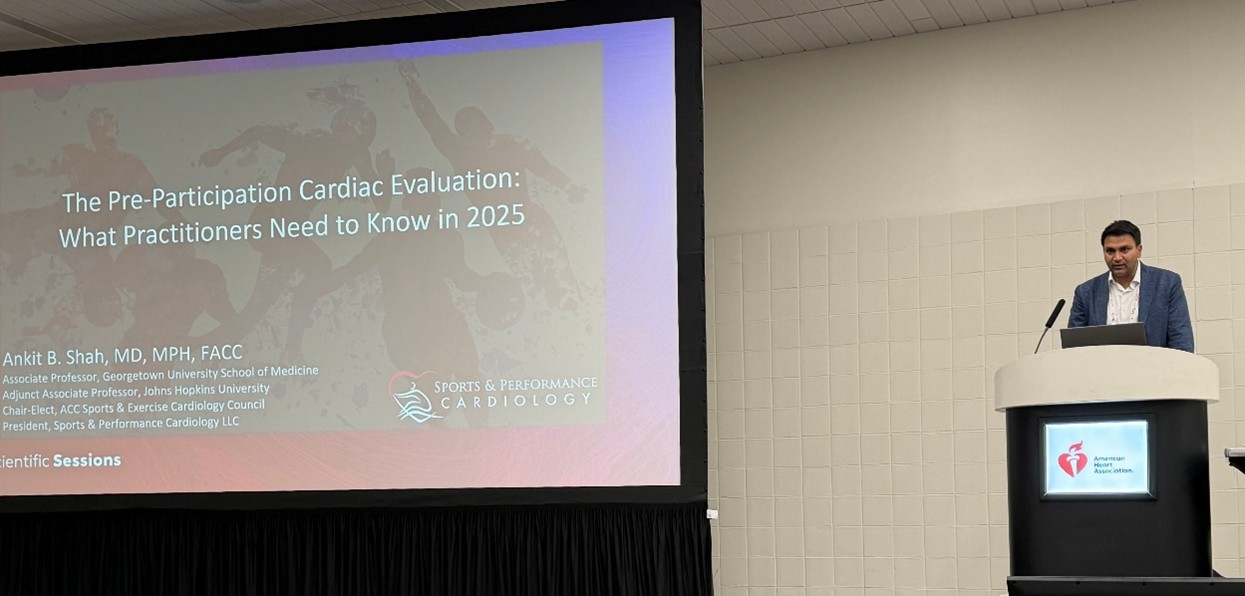
Dr. Ankit Shah presented updates to the preparticipation cardiac evaluation recommendations with an emphasis on evidence-based approaches to screening.
Outcomes Registry for Cardiac Conditions in Athletes: The Path Forward
Dr. Bradley Petek described the ORCCA (Outcomes Registry for Cardiac Conditions in Athletes), which monitors outcomes in athletes with potentially life-threatening cardiac conditions (Image 2).3 Dr. Petek highlighted the ease of enrolling patients, which can be completed in <2 min. Additionally, enrolling clinicians are included as contributors on PubMed manuscripts resulting from registry data.
Image 2
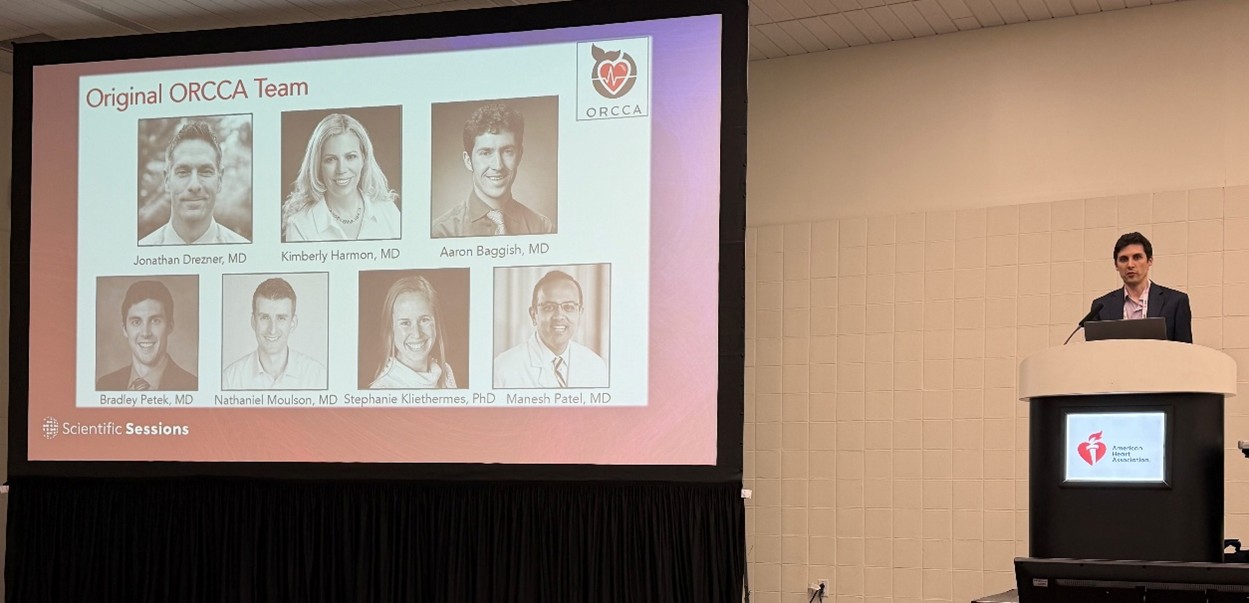
Dr. Bradley Petek presented information about the ORCCA and urged clinicians caring for athletes with CV conditions to participate.
CV = cardiovascular; ORCCA = Outcomes Registry for Cardiac Conditions in Athletes.
Athletes and providers interested in participating in the ORCCA can find additional information and registration materials on the study's website.4
For those interested in learning more about the updated guidelines and how to best put them into action, there will be an ACC Care of the Athletic Heart preconference at ACC.26 in New Orleans, Louisiana. The preconference will take place on Friday, March 27, 2026 at the conference center.
References
- Kim JH, Baggish AL, Levine BD, et al. Clinical considerations for competitive sports participation for athletes with cardiovascular abnormalities: a scientific statement from the American Heart Association and American College of Cardiology. J Am Coll Cardiol. 2025;85(10):1059-1108. doi:10.1016/j.jacc.2024.12.025
- Lampert R, Ackerman MJ, Marino BS, et al. Vigorous exercise in patients with hypertrophic cardiomyopathy. JAMA Cardiol. 2023;8(6):595-605. doi:10.1001/jamacardio.2023.1042
- Moulson N, Petek BJ, Ackerman MJ, et al. Rationale and design of the ORCCA (Outcomes Registry for Cardiac Conditions in Athletes) study. J Am Heart Assoc. 2023;12(11):e029052. doi:10.1161/JAHA.122.029052
- Outcomes Registry for Cardiac Conditions in Athletes (ORCCA). Register With ORCCA: Join the Study (ORCCA website). 2022. Available at: https://orccastudy.org/. Accessed 01/26/2026.
Clinical Topics: Heart Failure and Cardiomyopathies, Sports and Exercise Cardiology
Keywords: AHA25, AHA Annual Scientific Sessions, Decision Making, Shared, Sports and Exercise Cardiology, Cardiomyopathies
