STEP Analysis: BP Trajectories and CV Outcomes in Older Patients
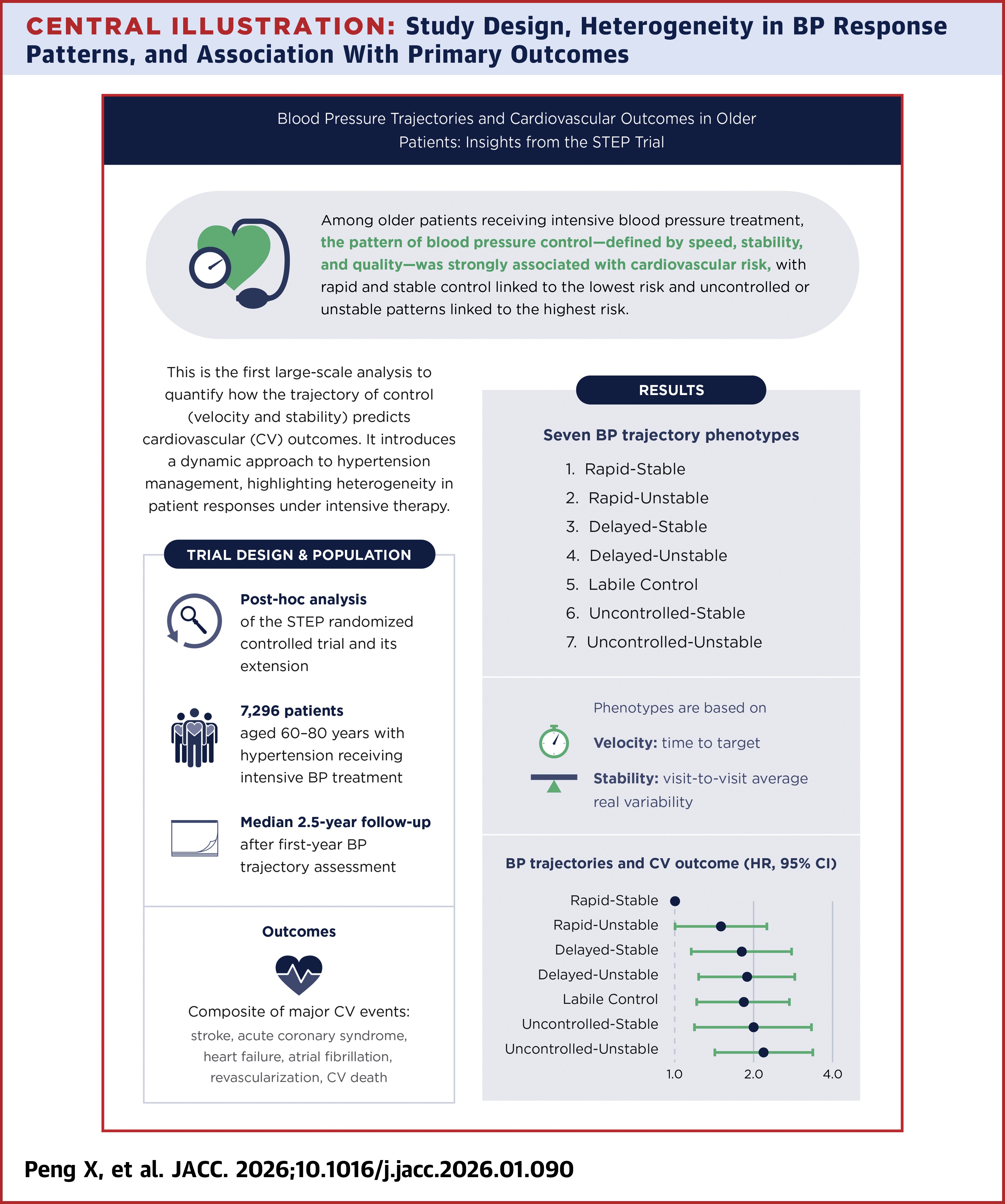
In older patients on intensive blood pressure (BP) treatment, the trajectory of BP control was an effective predictor of cardiovascular risk, with a rapid-stable pattern associated with the lowest risk and uncontrolled or unstable patterns associated with the highest risk, according to a post hoc analysis of data from the STEP trial published April 8 in JACC.
For the analysis, researchers examined longitudinal data from 7,296 patients with hypertension aged 60-80 years who were in either the original intensive-treatment arm in STEP (systolic BP [SBP] goal 110 to <130 mm Hg) or who were in the standard-treatment arm and moved to the intensive-treatment arm in an extension period after STEP was terminated for efficacy.
By classifying patients by control, velocity and stability, researchers identified seven distinct trajectories based on whether they reached their SBP goal within two months or one year of treatment (rapid, delayed or uncontrolled), and their level of visit-to-visit variability (stable or unstable), as well as a labile control group who did not meet the criteria for controlled, but had at least one SBP measurement <130 mm Hg.
The primary outcome was a composite of the first occurrence of ischemic stroke, hemorrhagic stroke, acute coronary syndrome (acute myocardial infarction or hospitalization for unstable angina), acute decompensated heart failure, coronary revascularization, atrial fibrillation and cardiovascular death.
Results showed that only 17.8% of patients achieved rapid-stable BP control and that they had the lowest incidence of the primary outcome (0.79 per 100 person-years). The other six trajectories were associated with a significant and progressive increase: uncontrolled-stable (1.64 per 100 person-years; hazard ratio [HR], 2.00); uncontrolled-unstable (1.96 per 100 person-years; HR, 2.19); labile control (1.54 per 100 person-years; HR, 1.83), delayed-stable (1.46 per 100 person-years; HR, 1.81), delayed-unstable (1.56 per 100 person-years; HR, 1.89); and rapid-unstable (1.21 per 100 person-years; HR, 1.50).
Each one-month delay in SBP target achievement increased cardiovascular risk by 3%. Additionally, an independent and significant association was found between worse outcomes and higher variability (HR, 1.13 per SD increase), higher SBP load (HR, 1.21 per SD increase) and lower time in target range (HR, 0.95 per 10% increase), were all significantly and independently associated with worse outcomes.
Noting this is the first study to examine the impact of time to target while on intensive antihypertensive therapy, study authors Xinyi Peng, MD, PhD, et al., write that it “shifts the focus from what target to achieve to how fast it should be reached.”
“Our findings quantify the temporal burden and establish that treatment delays contribute to a cumulative cardiovascular risk,” they add. “This correlation highlights the detrimental impact of therapeutic inertia, suggesting that therapeutic inertia is not a benign interval of waiting, but rather a measurable and modifiable risk factor for poor outcomes.”
“The findings from this analysis are novel and clinically important but not unexpected,” write Jessica Cheng, PhD; Jing Chen, MD; and Jiang He, MD, PhD; in an accompanying editorial comment. “This study answered the question of whether [BP] control trajectories are associated with cardiovascular outcomes. A more important question is whether these trajectories reflect pathophysiological variations among patients or implementation gaps in management of intensive [BP].”
Clinical Topics: Prevention, Hypertension
Keywords: Antihypertensive Agents, Blood Pressure, Hypertension, Cardiovascular Diseases
< Back to Listings


