A Rare Pattern of Harm: Statin-Associated Immune-Mediated Necrotizing Myopathy in Native American Populations
Quick Takes
- Statin-associated immune-mediated necrotizing myopathy, although rare, occurs disproportionately in American Indian and Alaska Native communities, warranting heightened clinical vigilance for muscle weakness and elevated creatine kinase levels after statin initiation.
- Prudent statin selection and future pharmacogenomic investigation may identify patients at increased risk of severe statin-related adverse events in populations at high risk.
Statin therapy remains a cornerstone in the prevention of cardiovascular (CV) morbidity and mortality. Although statin-associated muscle symptoms are relatively common and often self-limited, severe statin-associated immune-mediated necrotizing myopathy (IMNM) has emerged as a rare but important clinical entity. IMNM is characterized by progressive symmetric proximal muscle weakness, markedly elevated creatine kinase (CK) levels, myofiber necrosis, and persistent symptoms despite statin withdrawal.1 Importantly, symptom onset is highly variable, occurring weeks to years after statin initiation.2 IMNM is associated with autoantibodies against 3-hydoxy-3-methylglutaryl-coenzyme A reductase (HMGCR), the pharmacologic target of statins.2 Anti-HMGCR antibody testing is highly specific and, in many patients, may establish diagnosis without the need for muscle biopsy while distinguishing IMNM from other idiopathic inflammatory myopathies (IIMs).1,2 Muscle biopsy demonstrating myofiber necrosis remains valuable in uncertain cases, atypical presentations, seronegative disease, or when alternative inflammatory myopathies remain under consideration.2 Treatment requires prolonged immunosuppression with intravenous immunoglobulin (IVIG), and achieving remission is difficult.1 Once statin-associated IMNM is diagnosed, statin rechallenge is avoided and nonstatin lipid-lowering strategies are considered.3 The diagnostic and therapeutic approach is described in Figure 1.
Figure 1: Clinical Recognition and Management of Statin-Associated IMNM
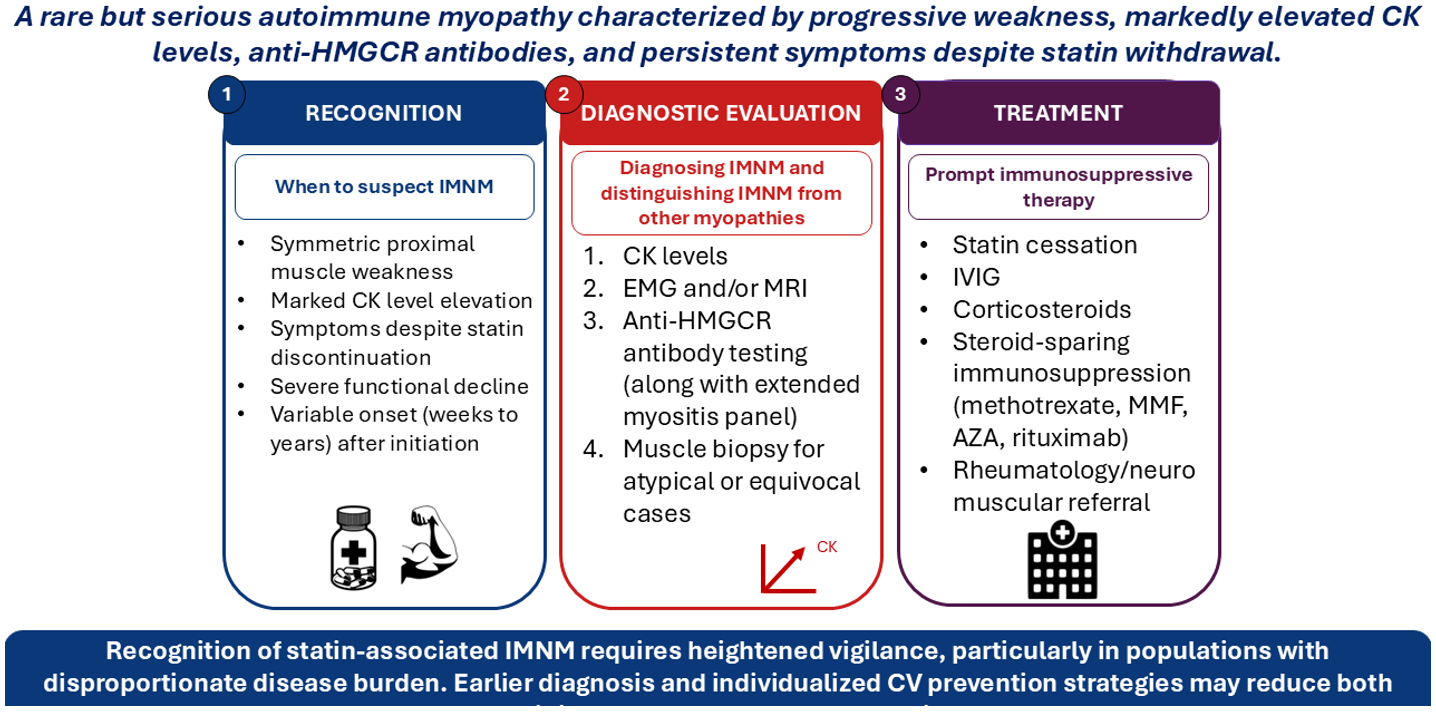
AZA = azathioprine; CK = creatine kinase; CV = cardiovascular; EMG = electromyography; HMGCR = 3-hydoxy-3-methylglutaryl-coenzyme A reductase; IMNM = immune-mediated necrotizing myopathy; IVIG = intravenous immunoglobulin; MMF = mycophenolate mofetil.
IMNM occurs in 2-3 per 100,000 individuals treated with statins.1 Despite this rarity, evidence suggests a disproportionately higher burden among American Indian and Alaska Native (AIAN) communities, which also have a high prevalence of autoimmune disease.1,2,4,5 In one study, the estimated prevalence in AIAN patients was 182 cases per 1 million people compared with 30.6 per million among non-AIAN populations, a sixfold higher disease burden.4 Another study from the American Southwest reported increased prevalence among Hispanic populations in the region due to their substantial Indigenous ancestry.2 At the Whiteriver Indian Hospital, which serves 18,000 AIAN patients including 1,800 who took statins, 6 cases of IMNM were identified, with cumulative statin exposure ranging from 1 to 14 years (mean 8.5 years).1 Another cohort from the Gallup Indian Medical Center identified 14 patients between 2017 and 2019 with a mean statin exposure of 39.6 months prior to symptom onset, representing a 150-fold higher prevalence than the general population.5
The pathophysiology of IMNM reflects an interaction between statin exposure, aberrant immune activation, and genetic susceptibility.1 HMGCR is expressed in skeletal tissue, and statin inhibition of this enzyme reduces cholesterol synthesis but increases expression of the enzyme, potentially exposing immunogenic epitopes that trigger autoantibody formation and sustained autoantibody and complement-mediated activation with T-cell involvement.1,6 Susceptibility is strongly associated with class II human leukocyte antigen (HLA) alleles, particularly HLA-DRB1*11:01.7,8
Heritable HLA types may be conserved in AIAN populations.1 Genomic data suggest autoimmune predisposition, although large genome mapping has not been extensively characterized in AIAN populations. In a Swedish study, individuals with IIMs were more likely to have relatives with autoimmune diseases.7 Non-HLA loci shared across IIMs and other autoimmune diseases such as celiac and type 1 diabetes mellitus have been identified, including variants near NGFI-A binding protein 1 (NAB1) andproline rich 12(PRR12).7,8 Lower C4 copy number within the major histocompatibility complex class III region has also been implicated.7 Moreover, AIAN populations carry a high frequency of decreased-function variants in solute carrier organic anion transporter family member 1B1 (SLCO1B1) encoding the hepatic transporter OATP1B1, a key determinant of statin-induced myopathy, particularly with simvastatin use.9 Whether this risk extends to IMNM is poorly understood. High rates of diabetes mellitus and metabolic syndrome may also contribute to immune dysregulation and increased vulnerability to statin-triggered IMNM.1 These findings suggest a complex polygenic and metabolically influenced immune architecture.
Notably, atorvastatin predominates in reported AIAN case series of IMNM, a finding also observed in larger cohorts.10 Although atorvastatin and simvastatin are among the most lipophilic statins and penetrate peripheral tissues readily, the apparent predisposition toward atorvastatin-associated IMNM remains incompletely understood and not explained by lipophilicity alone or by prescription patterns.10 In a cohort of 109 patients from the United Kingdom and Australia, 9.3% were exposed to rosuvastatin and 4.1% to simvastatin, suggesting that hydrophilic statins may be less frequently implicated but not exempt from risk.10
Despite growing evidence suggesting heightened susceptibility, statin-associated IMNM in AIAN communities remains under-recognized. Initial symptoms may easily be mistaken for other conditions or progression of age, and geographic isolation may limit advanced subspecialty care and testing, including biopsy and electromyography. Given the high burden of diabetes mellitus and dyslipidemia in AIAN communities, clinicians are appropriately motivated to reduce CV risk with lipid-lowering therapy. However, this imperative must be balanced with recognition of this rare but serious adverse event.
For affected individuals, the consequences can be profound, often requiring burdensome treatment for patients living far from infusion centers. In addition to the substantial health care demands, patients experience disability, diminished workforce participation, and reliance on assistive devices or caregiver support. For health care institutions, the cost associated with IVIG may pose resource constraints, particularly given the prolonged infusion courses required for many patients.
This still-uncommon clinical syndrome raises practical considerations for clinicians. Weakness after statin initiation should prompt early CK testing, and persistent weakness and elevated CK levels should raise earlier consideration of anti-HMGCR antibody testing. In populations at high risk, there should be detailed assessment of a three-generation family history with attention to autoimmune disease. Additionally, prudent statin selection may include alternatives to atorvastatin given its disproportionately high representation in observational IMNM cases, although this use is not currently guideline recommended. Adjunctive risk-stratification tools such as coronary artery calcium scoring may help individualize lipid-lowering decisions, but the assessment may be difficult to obtain in AIAN individuals who live in remote areas and do not have access to specialized imaging modalities. Future investigation into HLA-associated susceptibility and pharmacogenomic testing in select populations may identify individuals at increased risk.
The disproportionate burden of IMNM observed in AIAN communities highlights the need for increased representation in statin safety studies, multicenter collaboration with Tribal and Indian Health Service health systems, and strengthened pharmacovigilance efforts to address unanswered questions, including whether tribe-specific genetic and environmental factors contribute to risk. These rare adverse events should not be minimized solely because of their low overall incidence, particularly when they appear to cluster within historically marginalized populations. Ultimately, achieving equity in CV disease prevention requires comprehensive patient-clinician risk discussion to ensure that rare yet consequential harms are prevented, recognized, better studied, and mitigated in underserved populations.
References
- Close RM, Close LM, Galdun P, Gerstberger S, Rydberg M, Christopher-Stine L. Potential implications of six American Indian patients with myopathy, statin exposure and anti-HMGCR antibodies. Rheumatology (Oxford). 2021;60(2):692-698. doi:10.1093/rheumatology/keaa337
- Dinh TN, Nunez SE, Gonzales KM, et al. Statin-associated immune-mediated necrotizing myopathy in Hispanic Americans. Semin Arthritis Rheum. 2025;73:152759. doi:10.1016/j.semarthrit.2025.152759
- Shokravi A, Zawari A, Abdul Ghafoor AA, et al. LIPID-LOWERING STRATEGIES BEYOND STATINS TO REDUCE CARDIOVASCULAR BURDEN IN IDIOPATHIC INFLAMMATORY MYOPATHIES (Beyond Rhematology website). 2026. Available at: https://www.beyond-rheumatology.org/wp-content/uploads/sites/10/2026/04/e600.pdf. Accessed 08/03/2026.
- Dinh TN, Inga EE, Waters YM, et al. Increased prevalence and incidence of statin-associated immune-mediated necrotizing myopathy in Native Americans. Rheumatology (Oxford). 2026;65(2):keaf618. doi:10.1093/rheumatology/keaf618
- Wei J, Ketner E, Mammen AL. Increased risk of statin-associated autoimmune myopathy among American Indians. Arthritis Rheumatol. 2022;74(9):1602-1603. doi:10.1002/art.42126
- Gagliardo CM, Noto D, Giammanco A, et al. Statin-induced autoimmune myositis: a proposal of an "experience-based" diagnostic algorithm from the analysis of 69 patients. Intern Emerg Med. 2023;18(4):1095-1107. doi:10.1007/s11739-023-03278-9
- Lamb JA. The genetics of autoimmune myositis. Front Immunol. 2022;13:886290. Published 2022 May 26. doi:10.3389/fimmu.2022.886290
- Zhu C, Han Y, Byun J, et al. Genetic architecture of idiopathic inflammatory myopathies from meta-analyses. Arthritis Rheumatol. 2025;77(6):750-764. doi:10.1002/art.43088
- Arkansas BlueCross BlueShield. Genetic Test: Statin-Induced Myopathy (SLCO1B1) (Arkansas BlueCross BlueShield website). 2025. Available at: https://secure.arkansasbluecross.com/members/report.aspx?policyNumber=2013020. Accessed 08/03/2026.
- Khoo T, Tan E, Limaye V, et al. The incidence of anti-HMGCR immune-mediated necrotizing myopathy: an Australian and UK retrospective multi-site cohort study. Rheumatology (Oxford). 2025;64(9):4995-5003. doi:10.1093/rheumatology/keaf238
Clinical Topics: Dyslipidemia, Prevention, Nonstatins, Novel Agents, Statins
Keywords: American Native Continental Ancestry Group, Alaskan Natives, American Natives, Hydroxymethylglutaryl-CoA Reductase Inhibitors, Primary Prevention
