
 Log in to MyACC
Is Distal Radial Access a Safe, Effective Procedure For Patients With RAO?
Recanalization of radial artery occlusion (RAO) using distal radial access (DRA) is a safe, effective and reproducible procedure among centers with DRA expertise, according to a study published Sept. 8 in JACC: Cardiovascular Interventions.
Giuseppe Colletti, MD, et al., conducted an international, retrospective observational registry study at seven independent centers to evaluate the safety, efficacy and reproducibility of DRA and identify procedural strategies to optimize patency. The study included 110 adult patients with RAO scheduled for coronary procedures from January 2020 to April 2024. Retrograde radial recanalization was performed by experienced operators through DRA in the anatomical snuffbox using either ultrasound-guided or conventional puncture techniques.
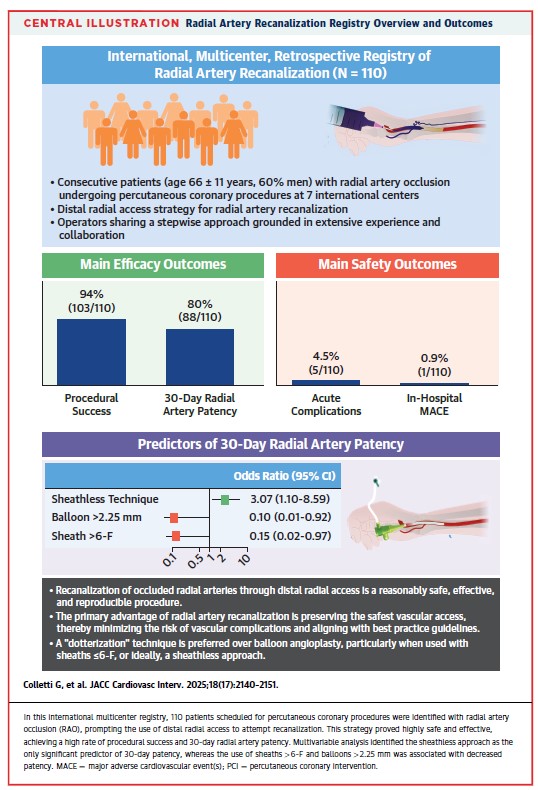
Looking at the two primary endpoints, results showed that procedural success was achieved in 94% of patients and radial artery patency at 30 days was 80%. Acute complications occurred in 4.5% of patients and were managed conservatively and there was only one case of in-hospital MACE.
The only significant predictor of patency was the use of a sheathless technique (odds ratio, [OR], 3.07), and the predictors of decreased patency were the use of balloon >2.25 mm (OR, 0.10) and use of sheaths >6-F (OR, 0.15).
The authors write that a dotterization technique is preferable to balloon angioplasty, especially with sheaths ≤6-F or no sheath, for significantly improving patency rates at one month. Furthermore, "The primary benefit of radial occlusion recanalization is to maintain the safest vascular access option by minimizing the risk of bilateral RAO."
Future studies should validate these findings in operators without prior coronary experience in chronic total occlusion treatment to ensure broader applicability.
"[Colletti, et al.] present a clear and convincing case for use of DRA for recanalization of RAO in patients needing repeat arterial access, clearly outlining technical details, high success rates and low incidence of complications," write Thomas M. Das, MD, and Khaled M. Ziada, MD, FACC, in an accompanying editorial comment. "… The study demonstrates that in the right patient and with the right operator, this procedure is of clinical value."
Clinical Topics: Invasive Cardiovascular Angiography and Intervention, Noninvasive Imaging, Vascular Medicine, Interventions and Imaging, Interventions and Vascular Medicine, Echocardiography/Ultrasound
Keywords: Radial Artery, Angioplasty, Balloon, Coronary, Arterial Occlusive Diseases, Ultrasonography, Interventional
< Back to Listings


