Is Occupational Physical Work Exposure a Risk Factor For ATTRwt-CM?
In a registry-based study, an association was found between transthyretin wild-type amyloid cardiomyopathy (ATTRwt-CM) and occupational upper-body mechanical stress, along with a greater burden of orthopedic and cardiovascular comorbidities including increased cardiovascular mortality among patients with ATTRwt-CM. The hypothesis-generating findings were published Feb. 24 in JACC: Advances.
Bertil T. Ladefoged, MD, et al., included consecutive patients diagnosed with ATTRwt-CM between January 2016 and December 2023 at a single center in Denmark who were matched 1:5 by age and sex with randomly selected controls from the Danish population. A total of 258 patients (median age of 82 years, 91% men) with ATTRwt-CM were matched with 1,290 controls.
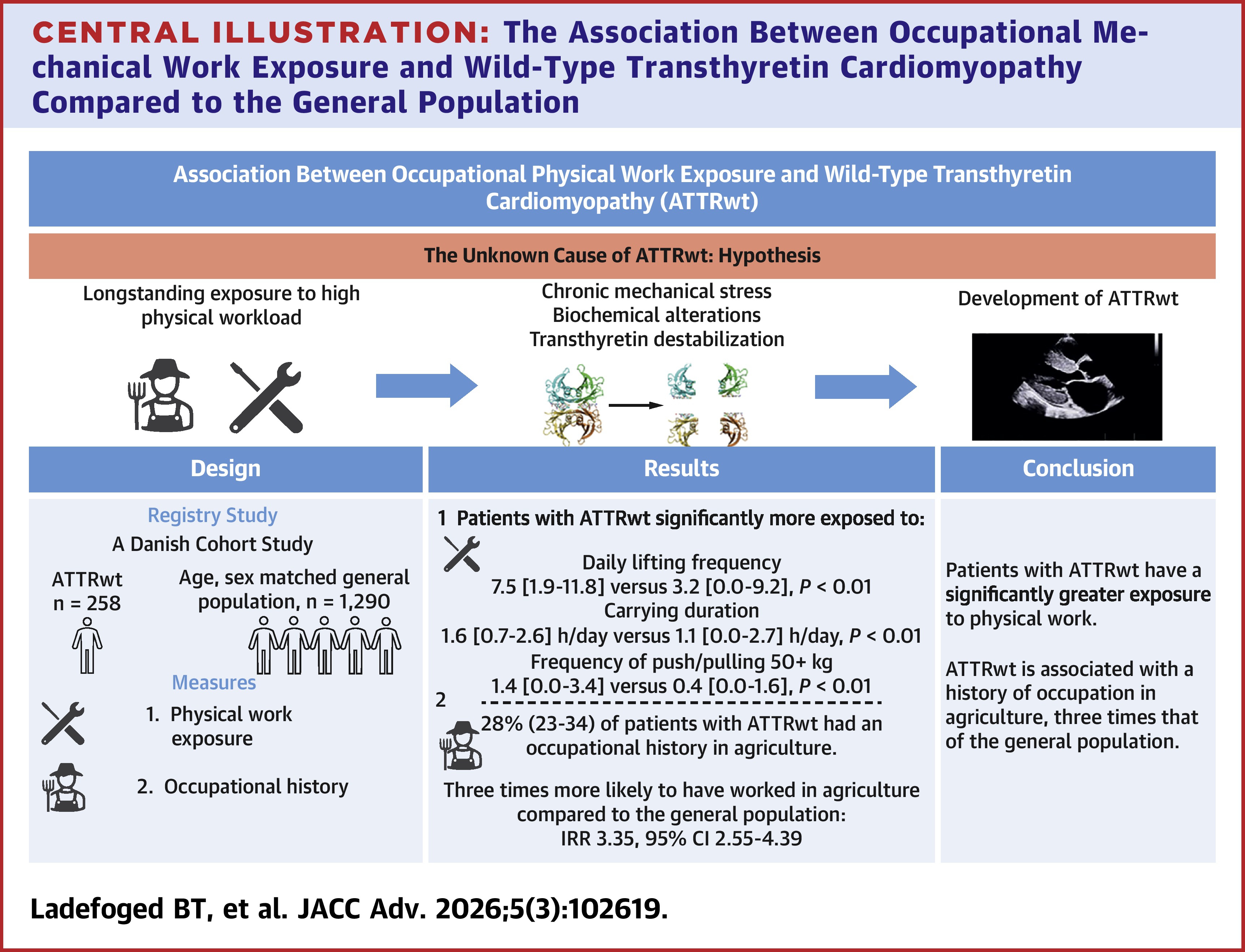
The main outcome was a work history of at least three years of agricultural or other physically demanding employment since 1991, as well as predicted median upper and lower body mechanical exposures, and three-year cardiovascular and all-cause mortality. Researchers used conditional Poisson regression to estimate incidence rate ratios (IRR) and median follow-up was 2.1 years.
Results showed that patients with ATTRwt-CM were more likely to have a history of agricultural employment compared with controls (28% vs. 8%; IRR 3.35) and significantly greater repetitive physical workload in particular upper body mechanical strain.
Furthermore, patients with ATTRwt-CM had a higher prevalence of cardiovascular comorbidities, including atrial fibrillation and aortic stenosis, as well as orthopedic conditions including carpal tunnel syndrome, lumbar spinal stenosis and lower limb arthrosis.
Additionally, the rates of three-year cardiovascular mortality (13% vs. 5%; IRR 3.38) and all-cause mortality (33% vs. 21%; IRR 1.93) were higher in patients with ATTRwt-CM than in controls, respectively.
“The present study proposes a potential association between repetitive upper-body mechanical stress and the development of ATTRwt-CM,” write the authors. They add that further investigation through prospective cohort studies is needed to clarify whether mechanical exposure itself, occupation-specific factors or unmeasured confounders explain the observed associations.
Clinical Topics: Arrhythmias and Clinical EP, Heart Failure and Cardiomyopathies, Valvular Heart Disease, Atrial Fibrillation/Supraventricular Arrhythmias
Keywords: Atrial Fibrillation, Stress, Mechanical, Workload, Cardiomyopathies, Risk Factors, Occupations, Employment, Denmark, Aortic Valve Stenosis
< Back to Listings


