Is High Cardiorespiratory Fitness Associated With Longer Lifespan, Lower Multimorbidity?
Higher cardiorespiratory fitness (CRF) was associated with longer lifespan, longer health span and lower multimorbidity in both women and men, according to a cohort study using participants from the Cooper Center Longitudinal Study (CCLS) and published April 22 in JACC.
Researchers included 24,576 participants (25% women) in the U.S. who were healthy through age 65 and tracked their health outcomes later in life using Medicare data (1999-2019). About a quarter of participants were women. CRF was measured earlier in adulthood using a treadmill test, and the development of 11 major chronic conditions were identified using the Medicare Chronic Conditions Data Warehouse. Conditions were defined as any of the 11 conditions (composite); any condition within a clinical group (cardiovascular, cardiovascular-kidney-metabolic, cancer); or an individual condition.
Multivariable illness-death models were used to estimate the likelihood of transitioning between health, disease and death by CRF level (low, moderate or high), and model parameters were used to calculate adjusted Aalen-Johansen probabilities and expected times in each state of health, disease and death. Results were then used to calculate expected health span, number of diseases, disease-years and lifespan by CRF.
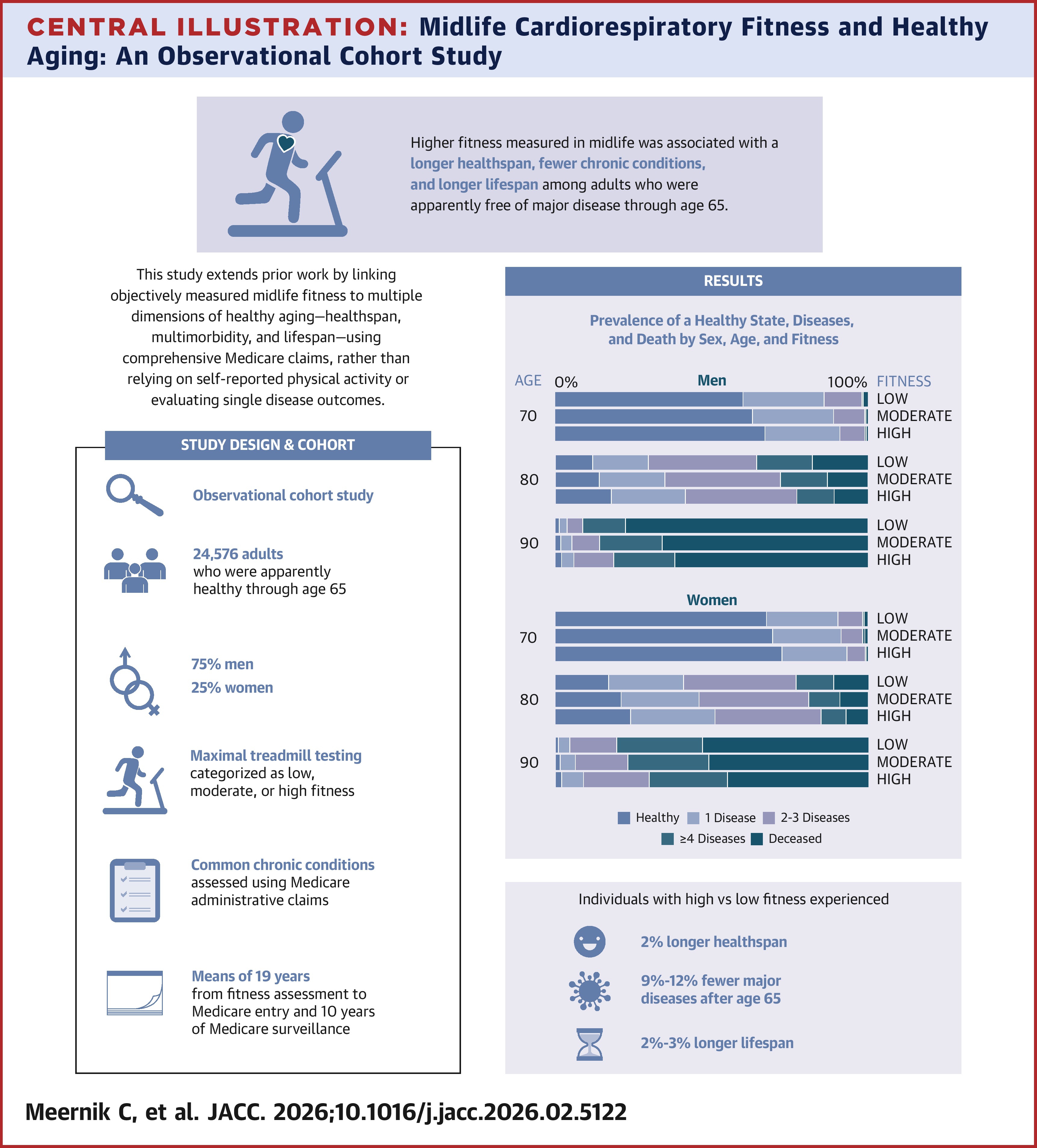
Results of the prospective study showed that high-fit men had a 2% longer health span, 9% fewer major diseases and a 3% longer lifespan compared with low-fit men, when disease was defined as any of 11 major chronic conditions. Similar patterns were observed among women. Additionally, higher-fit men and women developed fewer conditions within each group, and had a later onset of cardiovascular, cardiovascular-kidney-metabolic and cancer outcomes. Higher-fit men and women also experienced the onset of each of the 11 chronic conditions at an average of at least 1.5 years later than low-fit participants.
Notably, findings were consistent across clinical subgroups defined by clinic visit year (before or after 1990), age (younger or older than 45 years), smoking status (current smoking, nonsmoking, missing smoking), and BMI-based weight category (healthy weight and overweight or obese).
Limitations of the study include its observational design, which does not allow researchers to establish causality, and the fact that participants were generally health‑conscious, which may limit broader generalizability.
"Addressing aging-related disease broadly, rather than preventing or treating single conditions, will be increasingly important for enhancing quality of life in older age and reducing the burden to a health care system already strained by an aging U.S. population," write study authors Clare Meernik, PhD, Laura F. DeFina, MD, et al. "To gain a more comprehensive understanding of morbidity compression, future research should consider the number of diseases accumulated in addition to the time spent living with disease."
Clinical Topics: Sports and Exercise Cardiology
Keywords: United States, Cardiorespiratory Fitness, Morbidity, Longevity, Multiple Chronic Conditions
< Back to Listings


