Novel TEER System Safe, Effective For High-Risk Primary MR Patients
For high-risk patients with primary mitral valve regurgitation (MR), the novel Neonova transcatheter edge-to-edge repair (TEER) system was safe and effective, with a high rate of event-free survival and sustained clinical and echocardiographic improvements through two years, according to a prospective study published June 29 in JACC: Asia.
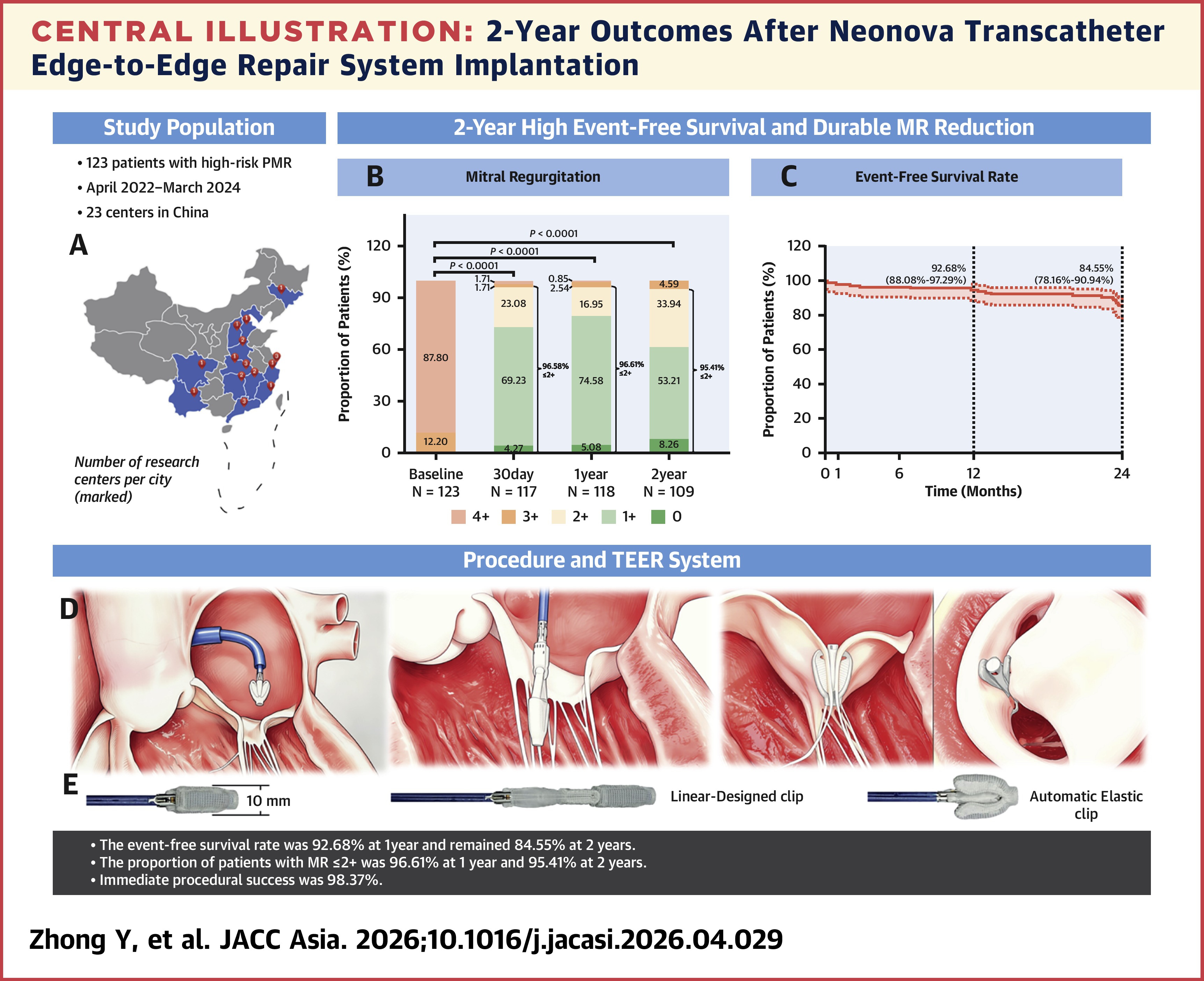
In this single arm, performance-goal pivotal trial, Yucheng Zhong, MD, PhD, et al., enrolled 123 patients from 23 centers in China; their mean age was 71 years and 46% were women. Eligible patients had symptomatic primary MR (≥3+) and high surgical risk, and data were collected from April 2022 to March 2024. A total of 118 patients completed the one-year follow-up.
The primary efficacy endpoint was TEER treatment success at one year (freedom from mortality, mitral valve surgery and MR >2+) compared with a 60% performance goal, and follow-up extended to two years.
Study results showed that event-free survival exceeded the target value with 93% of participants alive and event-free at one year, and 84% event-free at two years. Notably, the proportion of patients with MR ≤2+ was 97% at one year and 95% at two years, and immediate procedural success was 98%.
The proportion of patients with functional class I/II increased from 0% at baseline to 95% at one year and this was sustained at 93% at two years. Significant left ventricular reverse remodeling was also observed. The composite major adverse event rate was 8% at one year, with all-cause mortality at 2%. At two years, all-cause mortality remained low at 4%.
"The high success rates, low complication rates and significant improvements in quality of life indicate that [TEER treatment] is a promising alternative to traditional surgical methods, particularly for high-risk patients," write the authors. "Future investigations should include larger cohorts with extended follow-up to comprehensively evaluate long-term efficacy, complication risks, and quality-of-life impacts."
"The [two]-year Neonova trial demonstrates the feasibility and safety of this novel device in a carefully selected primary-MR cohort…" write Ching-Wei Lee, MD, MSc; Chun-Chin Chang, MD, PhD, FACC; and Shih-Hsien Sung, MD, PhD, in an accompanying editorial. "Ultimately, integration of a multidisciplinary heart-team approach in treating patients with severe MR remains the cornerstone of delivering high-quality transcatheter valvular intervention."
Clinical Topics: Valvular Heart Disease, Mitral Regurgitation
Keywords: Mitral Valve, Mitral Valve Insufficiency
