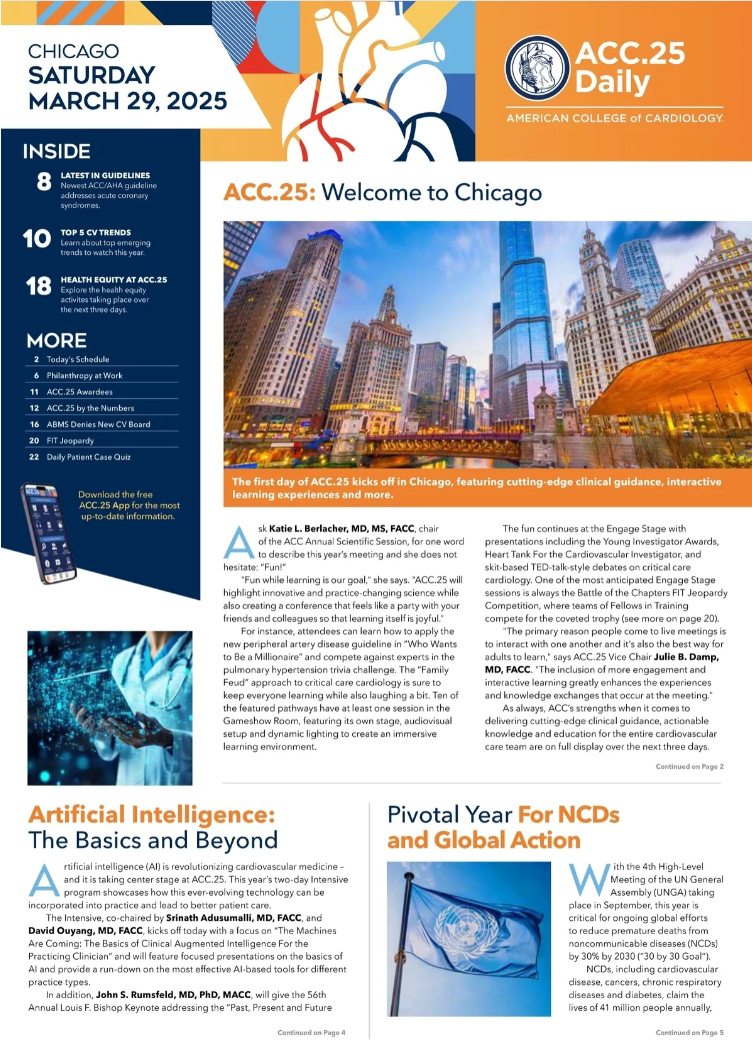
Artificial Intelligence: The Basics and Beyond
Artificial intelligence (AI) is revolutionizing cardiovascular medicine – and it is taking center stage at ACC.25. This year’s two-day Intensive program showcases how this ever-evolving technology can be incorporated into practice and lead to better patient care.
The Intensive, co-chaired by Srinath Adusumalli, MD, FACC, and David Ouyang, MD, FACC, kicks off today with a focus on “The Machines Are Coming: The Basics of Clinical Augmented Intelligence For the Practicing Clinician” and will feature focused presentations on the basics of AI and provide a run-down on the most effective AI-based tools for different practice types.
In addition, John S. Rumsfeld, MD, PhD, MACC, will give the 56th Annual Louis F. Bishop Keynote addressing the “Past, Present and Future of Clinical AI in Cardiovascular Medicine.” He will highlight more recent AI milestones like machine learning, generative AI and the use of large language models, while also shedding light on emerging AI technologies that hold promise for helping to further transform cardiovascular care.
According to ACC Board of Trustee Member Thomas M. Maddox, MD, MSc, FACC, who will be speaking on generative AI as part of the Intensive, AI is already being used for ambient scribing, automating prior authorization and claims processing, and assisting with echo image acquisition and interpretation. Diagnostic reasoning, treatment plan design, and medical education for both patients and care teams are among the uses on the horizon.
“It is essential that our community understand how AI works and where its limitations lie so that we can effectively and safely use it in delivering care,” he says. “It’s no different than our community needing to be knowledgeable about new medicines, medical devices or other technologies.”
Later today the Intensive will go “Diving Into the Weeds” to discuss the practical considerations for implementing AI in practice. Sessions will focus on ways AI is changing business models, provide opportunities for discussion around malpractice risks and shed light on government regulation.
“The vast amount of medical data available exceeds human capacity, necessitating AI to distill relevant information,” says ACC Chief Innovation Officer Ami Bhatt, MD, FACC. “Clinicians need to understand AI to decide the best steps for patient care.”
Both Maddox and Bhatt hope the Intensive will encourage clinicians to take an active role in understanding AI and ultimately testing and implementing it in practice. “We all have to decide where additional help from AI is going to make the biggest difference and then focus on those areas,” says Bhatt. “It’s not necessarily going to be the same for every practice, every part of the country or the world.”
ACC Past President B. Hadley Wilson, MD, MACC, who is also part of the Intensive faculty, agrees. “AI is being implemented on all fronts at a breakneck pace,” he says. “Clinicians need to use every opportunity to familiarize and work with AI.” His final words of wisdom: “Hold on for a wild ride."
Keywords: Cardiology Magazine, ACC Publications, Artificial Intelligence, ACC Annual Scientific Session, ACC25
