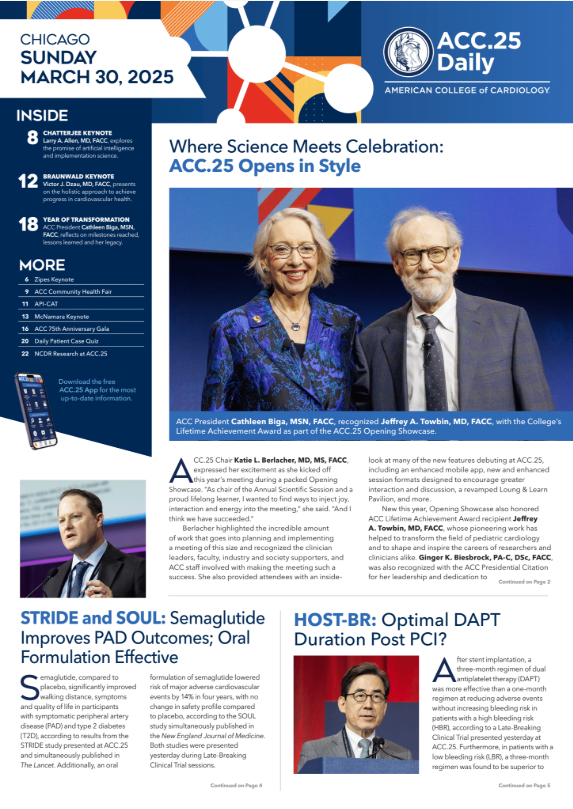
Jeffrey A. Towbin, MD, FACC, Receives ACC Lifetime Achievement Award
From a quiet beginning as an introvert in Brooklyn, NY, Jeffrey A. Towbin, MD, FACC, has evolved to be a renowned leader, researcher and clinician in pediatric cardiology. For his groundbreaking work in gene discovery and identification, growing three different programs as a pediatric cardiology chief and his development of three separate high-level cardiomyopathy, heart failure (HF) and transplant programs, Towbin received the ACC Lifetime Achievement Award during ACC.25 on Saturday during the Opening Showcase Session.
A Pioneer in the Field
Towbin was among the first pediatric cardiologists to develop a translational genetic research interest and laboratory, focusing initially on the genetic basis of cardiomyopathies and the mechanisms of disease before expanding into the arena of the genetic and mechanistic basis of arrythmia disorders. In the cardiomyopathy studies, he was first to identify the dystrophin gene on the X chromosome – the cause of Duchenne and Becker muscular dystrophy – as the gene responsible for X-linked dilated cardiomyopathy (XLCM). He went on to identify several other genes responsible for the different forms of cardiomyopathies.
He designed and published his “final common pathway hypothesis,” which suggested that multiple genetic mutations in multiple different but similar genes and the abnormal proteins encoded can disrupt a common protein pathway. Those changes lead to a specific disease, such as abnormal sarcomere-sarcolemma protein interactions in cardiomyopathies or abnormal ion channel genes and proteins in arrhythmia disorders, such as long QT syndrome and Brugada syndrome.
Finding Areas of Interest
After graduating from high school, where he became interested in cardio-physiology, Towbin earned his undergraduate degree and a master’s degree in cell biology at the University of Cincinnati (UC). While attending medical school at the UC College of Medicine and working different hospital rotations, he found another interest – pediatrics.
“It was pretty clear to me that I loved taking care of kids and interacting with their families. So, pediatrics made sense to start with, and I thought cardiac physiology would be interesting,” Towbin says, adding that he also learned he “enjoy caring for patients with cardiomyopathies and HF.”
While working as a fellow in pediatric cardiology at Baylor College of Medicine/Texas Children’s Hospital, he focused his clinical research on pediatric cardiomyopathies, HF and transplant patient diagnoses, therapies and outcomes. At the end of his first year of fellowship, he expanded his research to learn about the developing field of molecular genetics. After his fellowship, Towbin joined the faculty at Baylor/Texas Children’s and developed a “single-minded focus” on cardiomyopathies, cardio-skeletal myopathies and arrhythmias that has continued for his 35 years of research.
Towbin spent 24 years at Baylor/Texas Children’s, the last seven as chief of pediatric cardiology, where the program ranked among the top three U.S. pediatric cardiology programs. “It was fun, I worked with great people and I was productive,” he said, but his alma mater, the UC College of Medicine and Cincinnati Children’s Hospital Medical Center (CCHMC), recruited him to grow its cardiology program.
“I agreed to relocate back to Cincinnati to take on the position as chief of pediatric cardiology and executive co-director of the Heart Institute at CCHMC. Within three years of joining CCHMC, we turned into a top five ranked program.”
In 2015, he was recruited by Le Bonheur Children’s Hospital/University of Tennessee Health Science Center, whose pediatric cardiology program was not ranked in the top 50 programs.
“They reached out and wanted to create a larger and higher impact program. They agreed with my vision of what the program could look like under my leadership and their necessary support. I thought it would be a great challenge and that, with my vision and plan, we could perhaps become a top 20 program over the following five years,” Towbin says, adding that the Le Bonheur Heart Institute became a top 10 program in three years.
Making an Impact in Research
While he was effective as a leader, Towbin also was expanding his focus and interest in research. When he first arrived at Baylor/Texas Children’s, he started working with a renowned adult heart transplant program at the Texas Heart Institute, which was led by Denton A. Cooley, MD, who performed one of the first heart transplants in the U.S., and O. Howard Frazier, MD. Working with those surgeons, Towbin started a pediatric cardiomyopathy, HF, mechanical circulatory support and transplant program that used blood samples and fresh frozen heart samples from transplant patients to evaluate the genetic and viral causes of heart muscle disease. Using DNA from these samples, Towbin was able to identify genes causative of cardiomyopathies and HF, the first of which was dystrophin.
Towbin also used samples from patients potentially having XLCM and identified the dystrophin gene that was causative in several families with inherited dilated cardiomyopathy. On closer examination, the patients also had biochemical evidence of skeletal muscle involvement. With that known, he hypothesized that other heart and skeletal muscle disorders would result from mutations and dysfunction of similar genes and proteins. XLCM patients, therefore, had dysfunction of the skeletal and heart muscles, so Towbin looked for other cardiomyopathy genes involved in the same tasks as dystrophin, encompassing other cytoskeletal genes and proteins, and found many of these genes and their proteins were responsible for development of dilated cardiomyopathy in general. From those findings he developed the concept of the final common pathway hypothesis.
He found that other heart samples from children with dilated cardiomyopathy have viral nucleic acid in the heart, consistent with viral myocarditis being the cause of the dilated cardiomyopathy. The viruses he found included coxsackievirus, adenovirus and parvovirus B19 as the main culprits, with each becoming dominant over different years.
Towbin later started studying arrhythmia disorders and, using the same Final Common Pathway Hypothesis approach, began to study ion channel genes and proteins in children and adults with arrhythmia disorders and identified a variety of ion channel-encoding genes for sodium and potassium channel ions as disease-causing. He also studied patients with arrhythmogenic cardiomyopathy and identified mutations in genes encoding the desmosomes, cell-cell junction proteins that lead to impaired cell adhesion between cardiac myocytes, ultimately causing the characteristic structural abnormalities and arrhythmias seen in the disease. These include the genes encoding desmosomal proteins and others that interact with the desmosome, including desmosomal proteins plakophilin-2 (PKP2), desmocollin-2 (DSC2), desmoglein-2 (DSG2), plakoglobin (JUP) and desmoplakin (DSP).
“I just want to say thank you to the ACC for this honor,” Towbin said of receiving one of ACC’s most prestigious awards. While the spoken response is self-effacing, decades of work leading pediatric cardiology programs speak loudly. “I’m a person who is always first in and last out. I’ve had a lot of stamina over the years, so I usually worked seven days a week doing something clinically, administratively or in my laboratory.”
Clinical Topics: Heart Failure and Cardiomyopathies, Acute Heart Failure
Keywords: Cardiology Magazine, ACC Publications, ACC25, ACC Annual Scientific Session, Heart Failure, Pediatric Cardiology
