Sudden Cardiac Arrest Survival Varies by Race in Young Athletes; Incidence Stable in Race Runners
Among young athletes, while overall survival after a sudden cardiac arrest (SCA) is improving, the likelihood of survival varies by race, and SCA is more likely to occur during practice than games, according to a study presented at ACC.25 in Chicago and simultaneously published in JACC. Another study found the rate of SCA among long-distance runners has remained stable along with a marked reduction in cardiac arrest mortality; it was simultaneously published in JAMA. The studies were presented during Featured Clinical Research sessions.
In the observational study of young athletes, Bradley J. Petek, MD, FACC, et al., used data from the National Center for Catastrophic Sports Injury Research to examine outcomes following SCA among those between the ages of 11 and 29 years.
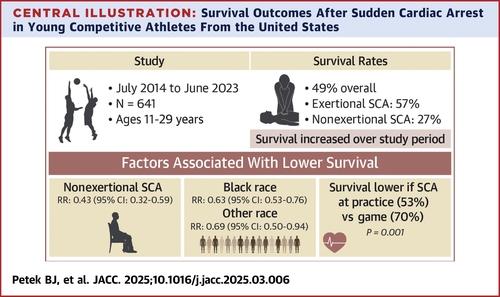
The study identified 641 athletes or former athletes (within one year of participation) who experienced SCA from 2014 to 2023 (mean age 17 years, 85% male). Of the SCAs, 75% occurred during exertion, 3% within one hour of exertion and 16% during rest or sleep. Exertion status was unknown in 5% of cases.
Results showed that 57% of Black athletes and 54% of non-White, non-Black athletes who suffered SCA during exertion died, compared with 32% of White athletes. Lower survival rates were also found among those who experienced non-exertional SCA during rest or sleep.
Of the total study population, 49% of athletes survived SCA, with the majority of cases being at the high school level (61%), followed by college (15%) and middle school (12%). The most common etiologies were hypertrophic cardiomyopathy (20%), congenital coronary artery abnormalities (13%) and idiopathic left ventricular hypertrophy/possibly cardiomyopathy (11%).
Overall survival and survival from exertional SCA both increased throughout the study period (from 30% to 66%, p=0.007; and 38% to 72%, p=0.03, respectively). More athletes survived who experienced SCA during a game or competition than during practice or training (70% vs. 53%, p=0.001).
"It's exciting that we've seen survival improve over the last decade, likely because of ongoing efforts to improve emergency preparedness including the recognition of sudden cardiac arrest and increases in AED distribution and CPR training," said Petek. "However, the disparities that we see in survival, especially in athletes of Black race or other non-White, non-Black race, are important and warrant further research. Black athletes' higher risk of having a sudden cardiac arrest coupled with a lower likelihood of survival is deeply troubling."
In an accompanying editorial comment, Marius Chukwurah, MD, FACC, et al., call this a "herculean effort" to capture data on SCA and call for a legislative focus on improving SCA survival. "Making cardiac arrest a reportable condition in the U.S. and creating a national database capturing Utstein variables, social determinants of health, post-arrest clinical data, postmortem/autopsy results, and long-term follow up would provide critical insights to truly understand the scope of this problem and identify modifiable factors to intervene upon," they write. They note that a lack of resources may make it hard for historically disadvantaged communities to respond to SCA, especially during training or practice compared to a game, which would have more on-site personnel to intervene.
In the RACER study, Jonathan H. Kim, MD, MSc, FACC, and colleagues, examined data collected from the Race Associated Cardiac Event Registry to examine SCA among 29 million marathon and half-marathon runners from 2010 to 2023.
Investigators found that during U.S. long-distance races there were 176 cases of SCA (127 men, 19 women, 30 sex unknown) and 59 deaths (34% of cases), for which the most common etiology was coronary artery disease (52%) when it could be determined. While incidence rates were comparable to those from 2000-2009, the risk of dying has decreased over time.
Most cardiac arrests occurred during the last quartile of races. They note a slight increase in cardiac arrests since 2020 and believe it is an area that warrants further study.
As to the higher survival rate, investigators write, "these results suggest that improvements in emergency action planning, particularly universal application of bystander CPR and near-immediate deployment and use of AEDs, have positively affected outcomes of cardiac arrest during long-distance racing."
From 2000 to 2009, 58% of SCA received bystander CPR and 48% on-scene AED. In 2010-2023, it was 100% CPR and near-universal AED use.
In an accompanying editorial comment, Nimesh S. Patel, MD, FACC, and Mark S. Link, MD, FACC, note that, "The decline in cardiac arrest mortality likely underscores the importance of effective emergency action planning during races, including immediate access to defibrillation. Rapid access to prehospital automated external defibrillators has been associated with a favorable survival and neurologic outcome in distance runners who experience a cardiac arrest."
"The findings of the study also may reinforce the importance of primary cardiac prevention in older runners, particularly men, who are at higher risk of coronary artery disease," they add.
Citations:
- Petek B, Churchill T, Moulson N. et al. Survival outcomes after sudden cardiac arrest in young competitive athletes from the United States. JACC. Published online March 30, 2025. Doi: 10.1016/j.jacc.2025.03.006
- Kim JH, Rim AJ, Miller JT, et al. Cardiac arrest during long-distance running races. JAMA. Published online March 30, 2025. Doi:10.1001/jama.2025.3026
Keywords: ACC Annual Scientific Session, ACC25, Sports and Exercise Cardiology, Myocardial Infarction
< Back to Listings


