Vutrisiran and All-Cause Mortality, Prognostic Implication of sTTR Levels in Patients With ATTR-CM | JACC Special Focus Issue
Studies exploring the association between vutrisiran and all-cause mortality and the prognostic information gleaned from serum transthyretin (sTTR) levels in patients with transthyretin amyloid cardiomyopathy (ATTR-CM), using data from the HELIOS-B and ATTRibute-CM trials respectively, were published May 19 in a JACC Special Focus Issue on cardiac amyloidosis.
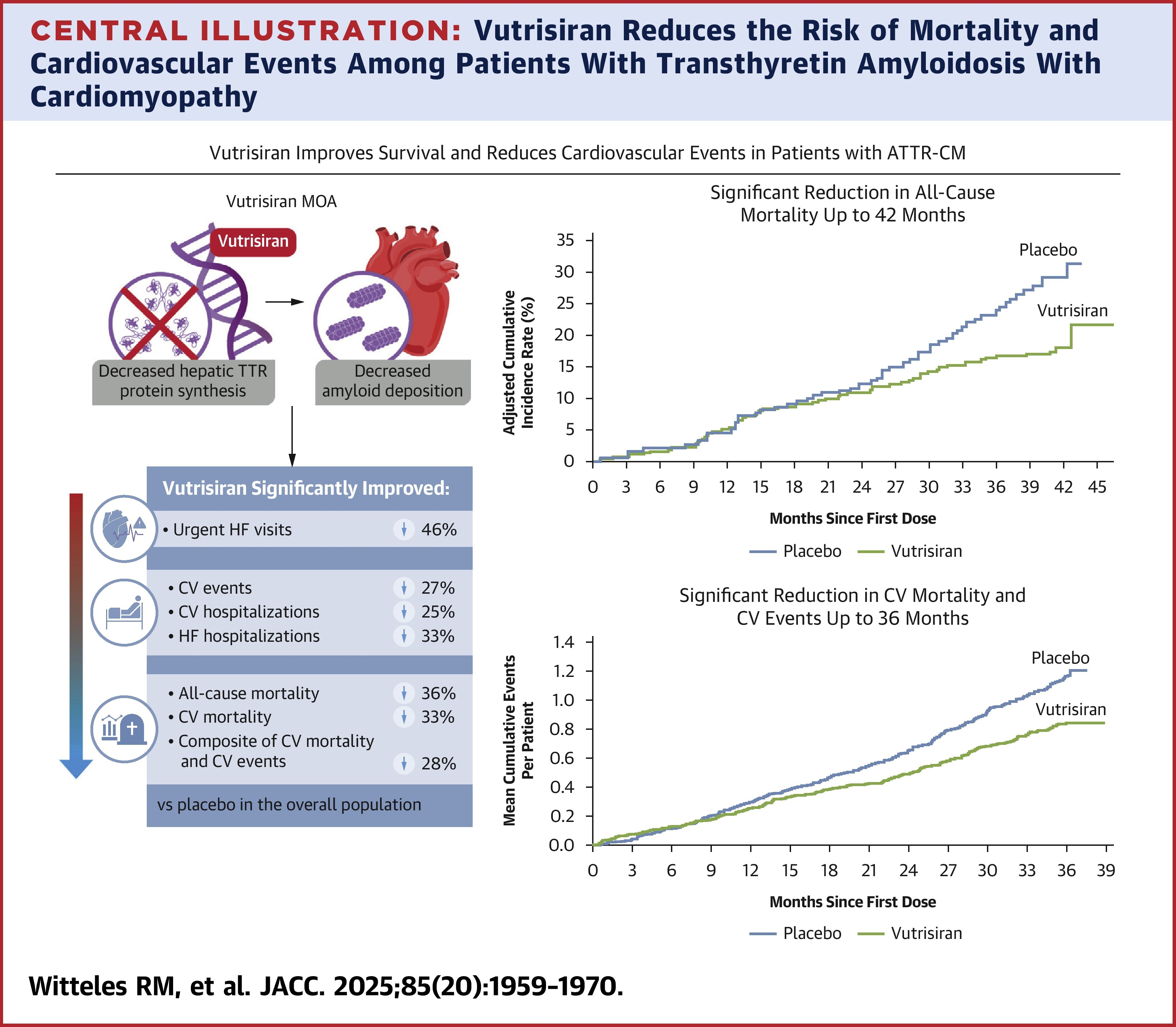
The first study, presented at ESC HF 2025, found that vutrisiran reduced the risk of all-cause mortality and cardiovascular events in patients with ATTR-CM.
Ronald M. Witteles, MD, FACC, et al., included 655 patients randomized to vutrisiran 25 mg or placebo, taken once every three months for a 33- to 36-month double-blind period followed by an open-label extension. Outcomes reviewed were all-cause mortality, cardiovascular mortality and other cardiovascular events such as cardiovascular hospitalizations, heart failure (HF) hospitalizations and urgent HF visits.
The vutrisiran group saw a reduced risk of all-cause mortality (hazard ratio [HR], 0.64; 95% CI, 0.46-0.88), cardiovascular mortality (HR, 0.67; 95% CI, 0.55-0.94) and a composite of cardiovascular mortality and cardiovascular events (HR, 0.72; 95% CI, 0.55-0.94) when compared to placebo.
Rates of cardiovascular hospitalizations, urgent HF visits and HF hospitalizations were all lower among the participants treated with vutrisiran. These results were consistent regardless of tafamidis use at baseline.
Commenting on findings from the tafamidis subgroup, Amrut V. Ambardekar, MD, FACC, and Sarah A.M. Cuddy, BCh, BM, MD, FACC, caution that "this analysis should not be interpreted as supporting combination therapy at this time. The data presented are hypothesis-generating but insufficient to direct practice change."
Witteles and colleagues acknowledge this limitation. They write: "Further assessment of combination regimens in large, prospectively designed studies are warranted to shed light on potential synergies."
In the second study, Mathew S. Maurer, MD, FACC, et al., investigated the prognostic implication of acoramidis-mediated early change in sTTR among patients with ATTR-CM.
Evaluating the sTTR levels of 557 participants, the authors examined factors associated with all-cause mortality. The acoramidis group exhibited a "sharp and significant" early increase in sTTR levels (mean 9.1 mg/dL) within 28 days of starting treatment, which remained over the course of the 30-month treatment period.
This early increase in sTTR levels (early ΔTTR) was associated with a reduced risk of all-cause mortality (HR, 0.96 per 1 mg/dL increase in early ΔTTR; 95% CI, 0.93-0.98; p=0.002). Even after accounting for variables such as TTR variant status, baseline NYHA functional class, baseline National Amyloidosis Centre stage and baseline sTTR level, early ΔTTR was still associated with reduced all-cause mortality (p<0.001).
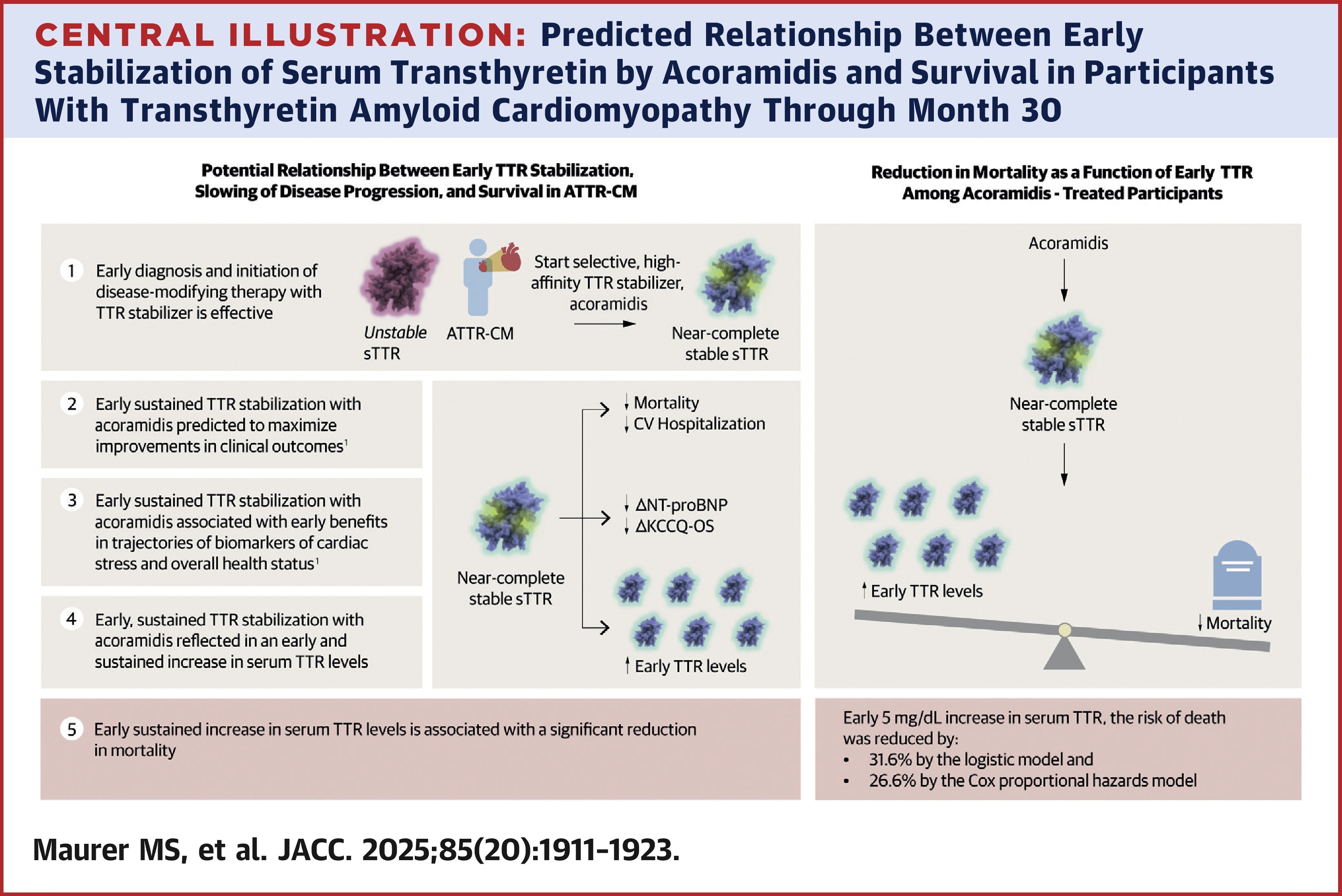
The authors developed a logistic model which predicted a 31.6% relative reduction in odds of all-cause mortality for every 5 mg/dL increase in sTTR levels. "This is the first study to demonstrate the exposure-response between acoramidis treatment and sTTR, with early ΔTTR after dosing being a strong independent predictor of survival in patients with ATTR-CM treated with acoramidis," write the authors.
"These findings naturally raise the question of monitoring sTTR response to personalize treatment in ATTR-CM," add Jessica A. Regan, MD, et al., in an accompanying editorial comment. "Similarly to strategies serially assessing and targeting low-density lipoprotein cholesterol levels for cardiovascular risk reduction, individualizing therapy in response to sTTR, with stabilizers and silencers driving sTTR changes in opposite directions, may someday be relevant."
Citations:
- Witteles, R, Garcia-Pavia, P, Damy, T. et al. Vutrisiran Improves Survival and Reduces Cardiovascular Events in ATTR Amyloid Cardiomyopathy: HELIOS-B. JACC. 2025 May, 85 (20) 1959–1970. doi:10.1016/j.jacc.2025.04.008
- Maurer, M, Judge, D, Gillmore, J. et al. Early Increase in Serum Transthyretin by Acoramidis Independently Predicts Improved Survival in TTR Amyloid Cardiomyopathy. JACC. 2025 May, 85 (20) 1911–1923. doi:10.1016/j.jacc.2025.03.542
Clinical Topics: Heart Failure and Cardiomyopathies, Acute Heart Failure
Keywords: Amyloidosis, Familial, Amyloid Neuropathies, Familial, Amyloidosis, Cardiomyopathies, RNA Interference, Prealbumin, Heart Failure
< Back to Listings


