AMI Could Carry Higher Risk of Hematologic Malignancies
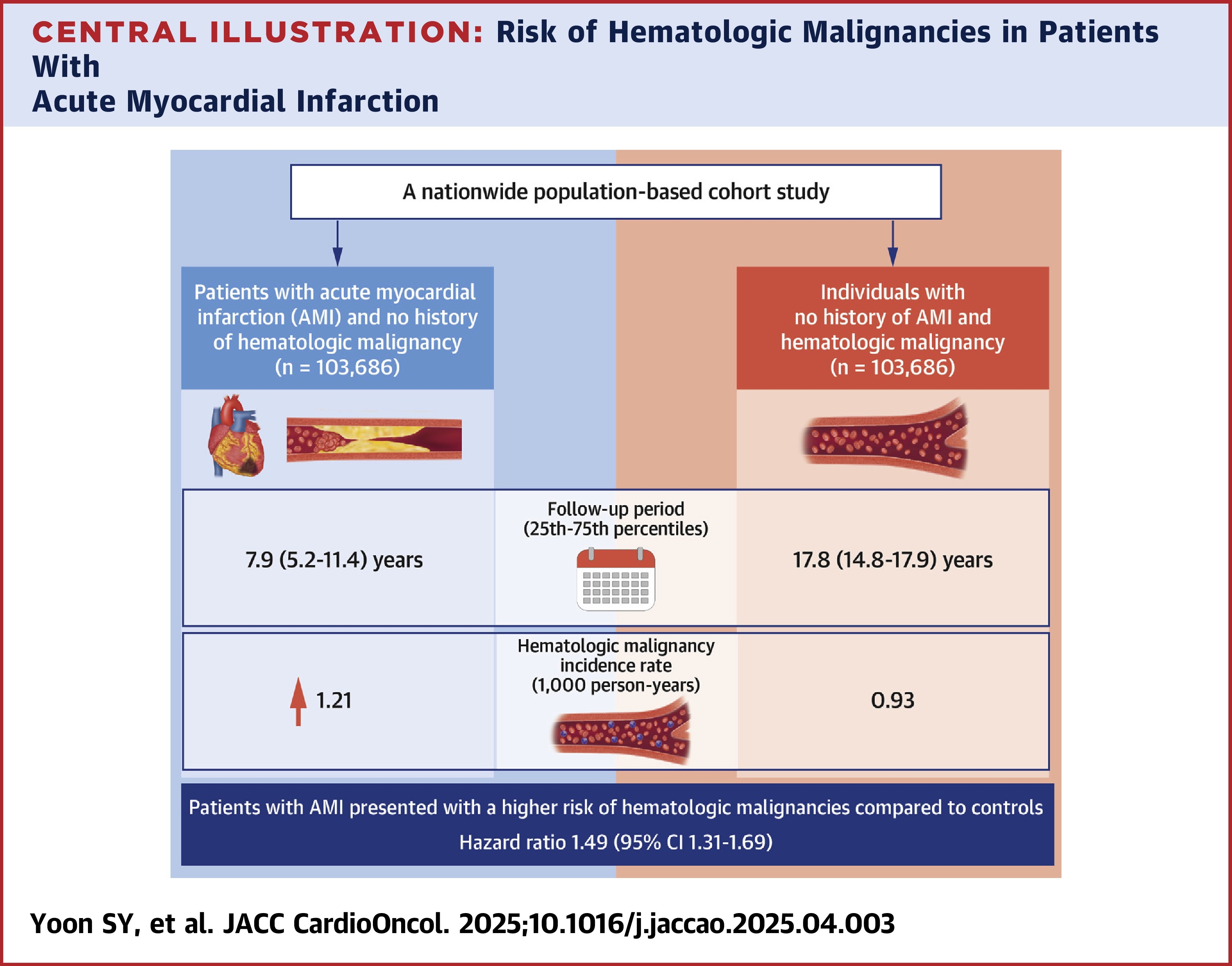
Patients with new acute myocardial infarction (AMI) had a 49% higher risk of hematologic malignancies, according to original research published May 27 in JACC: CardioOncology.
In a retrospective cohort study using the Korean National Health Insurance claims database, Seug Yun Yoon, MD, et al., paired by age and sex 103,686 patients with AMI but no history of hematologic malignancies with 103,686 participants with no history of either (median age 60 years, 78 % men). The primary outcome was the incidence of hematologic malignancies during follow-up.
Patients in the AMI group were more likely to have comorbidities, including diabetes (49% vs. 10% of control group), hypertension (78% vs. 21%) dyslipidemia (80% vs. 7%) and obesity (47% vs. 34%). Median follow-up was 7.9 years in the AMI group vs. 17.8 years in the control group.
Results showed that 1,043 patients in the AMI group and 1,479 in the control group were diagnosed with hematologic malignancies (incidence rate per 1,000 person-years: 1.21 vs. 0.93). The risk of hematologic malignancies was higher in the AMI than the control group, based on the competing risk analysis (hazard ratio, 1.49), and this remained consistent across sensitivity and standardized incidence ratio analyses.
AMI was associated with an increased risk specifically for multiple myeloma (MM), myeloproliferative neoplasms (MPNs), myelodysplastic syndrome and malignant immunoproliferative diseases, but not for non-Hodgkin lymphoma, myeloid leukemia, lymphoid leukemia, Hodgkin lymphoma or unspecified leukemia. MM and MPNs carried the strongest association.
"Although routine screening is not indicated, increased clinical awareness of this association [between AMI and hematologic malignancies] may be warranted in the care of patients with AMI," write the authors.
In an accompanying editorial comment, Caitlin Bell, MD, FACC, notes that "the totality of evidence underscores the enhanced risk of hematologic malignancy in those with [cardiovascular disease] and vice versa, but a wide translational gap remains." She suggests that "making these epidemiologic associations actionable will require both basic research to define biological mechanisms and longer-term prospective studies assessing outcomes with differing treatment or surveillance strategies."
Clinical Topics: Acute Coronary Syndromes
Keywords: Acute Coronary Syndrome, Hematologic Neoplasms, Cardio-oncology, Myocardial Infarction
< Back to Listings


