SWEDEHEART Registry Tracks Rise in Complete Revascularization, Physiology-Guided Procedures
Use of complete revascularization (CR) and physiology-guided procedures has increased over time in patients with STEMI and multivessel disease (MVD), with half of patients in 2021 undergoing CR vs. incomplete revascularization (IR), and physiology-based guidance was used in 14%, according to an analysis of the SWEDEHEART registry published in JACC: Cardiovascular Interventions. Additionally, CR, whether angiographic or physiology-guided, was independently associated with favorable outcomes.
Study investigators Felix Lindberg, MD, PhD, et al., compared year-by-year adoption of CR in 20,131 patients (median age 70 years; 28% women) from the SWEDEHEART registry who had undergone primary PCI (PPCI) for STEMI with MVD from 2009-2021.
Results showed that in 2009, 33% of procedures were CR, which rose to 46% in 2015 and 51% in 2021. Likewise, there was an increase in physiology-guided CR procedures, from none recorded in 2009, to 7% of procedures in 2015 and 14% of procedures in 2021.
Patients treated with CR compared to IR were more likely to be young, male, with better renal function, lower Killip class and overall fewer comorbidities.
Over a median follow-up of 4.2 years, adjusted risk for the primary outcome, a composite of all-cause mortality, myocardial infarction or unplanned repeat revascularization, was lower with angiographic CR and physiology-guided CR compared to IR, (adjusted hazard rate [aHR], 0.84 and aHR, 0.80, respectively). Notably, the combined endpoint was not lower with physiology-guided CR vs. angiographic CR (aHR, 0.94), although it was for all-cause mortality (aHR, 0.75).
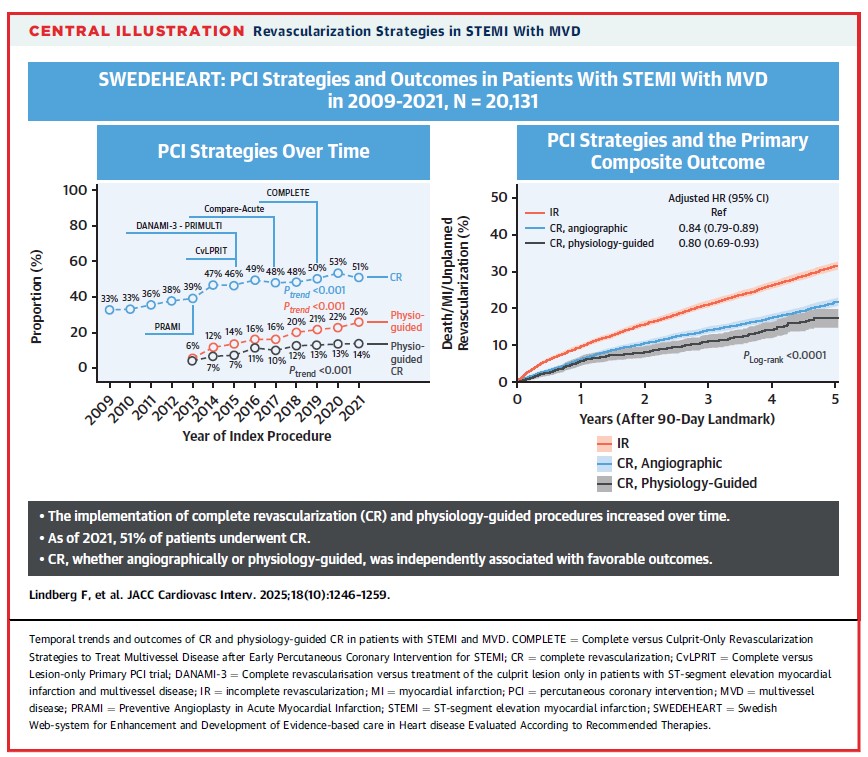
"As of 2021, CR was performed in only 51% of patients, despite additional support from trials, guideline recommendations and the interventional community," Lindberg, et al., write, noting the plateau from 2015 to 2021. "The discrepancy between trial populations and real-world patients, the latter being older, might contribute to this lag in implementation."
In an accompanying editorial comment, Francis R. Joshi, MBBS, adds that, "Completely revascularized patients were more likely to have had PPCI performed via radial access and had better secondary preventative care, indicating an association with, overall, higher quality care," which begs the important question: "So why are one-half of patients with [MVD] still left incompletely revascularized?" He notes a current paucity of data on decision-making for complete revascularization and relevant cognitive biases.
Clinical Topics: Invasive Cardiovascular Angiography and Intervention, Stable Ischemic Heart Disease, Vascular Medicine, Interventions and Vascular Medicine, Chronic Angina
Keywords: Percutaneous Coronary Intervention, Fractional Flow Reserve, Myocardial, ST Elevation Myocardial Infarction
< Back to Listings


