Nonatherothrombotic MI Events, SCAD in Younger Patients More Common Among Women
Nonatherothrombotic causes of myocardial infarction (MI) events, especially spontaneous coronary artery dissection (SCAD), were more common in younger women than younger men, according to a community-based study published Sept. 15 in JACC.
Study investigators Claire E. Raphael, MBBS, PhD, FACC, et al., identified 4,116 MI events associated with a cardiac troponin T >99th percentile of the upper reference range (≥0.01 ng/mL) in 2,780 patients ≤65 years (36% women) between 2003 and 2018 and living in Olmsted County, MN. Events were separated into eight categories based on cause: atherothrombosis, SCAD, embolism, vasospasm, MI with nonobstructed coronary arteries not meeting another category (MINOCA-U), and supply/demand mismatch secondary MI (SSDM), as well as myopericarditis and takotsubo syndrome.
Of 1,474 index events, 32% were attributed to nonatherothrombotic causes among the entire patient population. However, when divided by sex, results showed that 53% of events among women had nonatherothrombotic causes, compared to 25% in men.
All nonatherothrombotic causes comprised a significant proportion of MI events in women than men: SSDM, 34% vs. 19%; SCAD, 11% vs. 0.7%; embolism, 2% vs. 2%; vasospasm, 3% vs. 1%; and MINOCA-U, 3% vs. 2%.
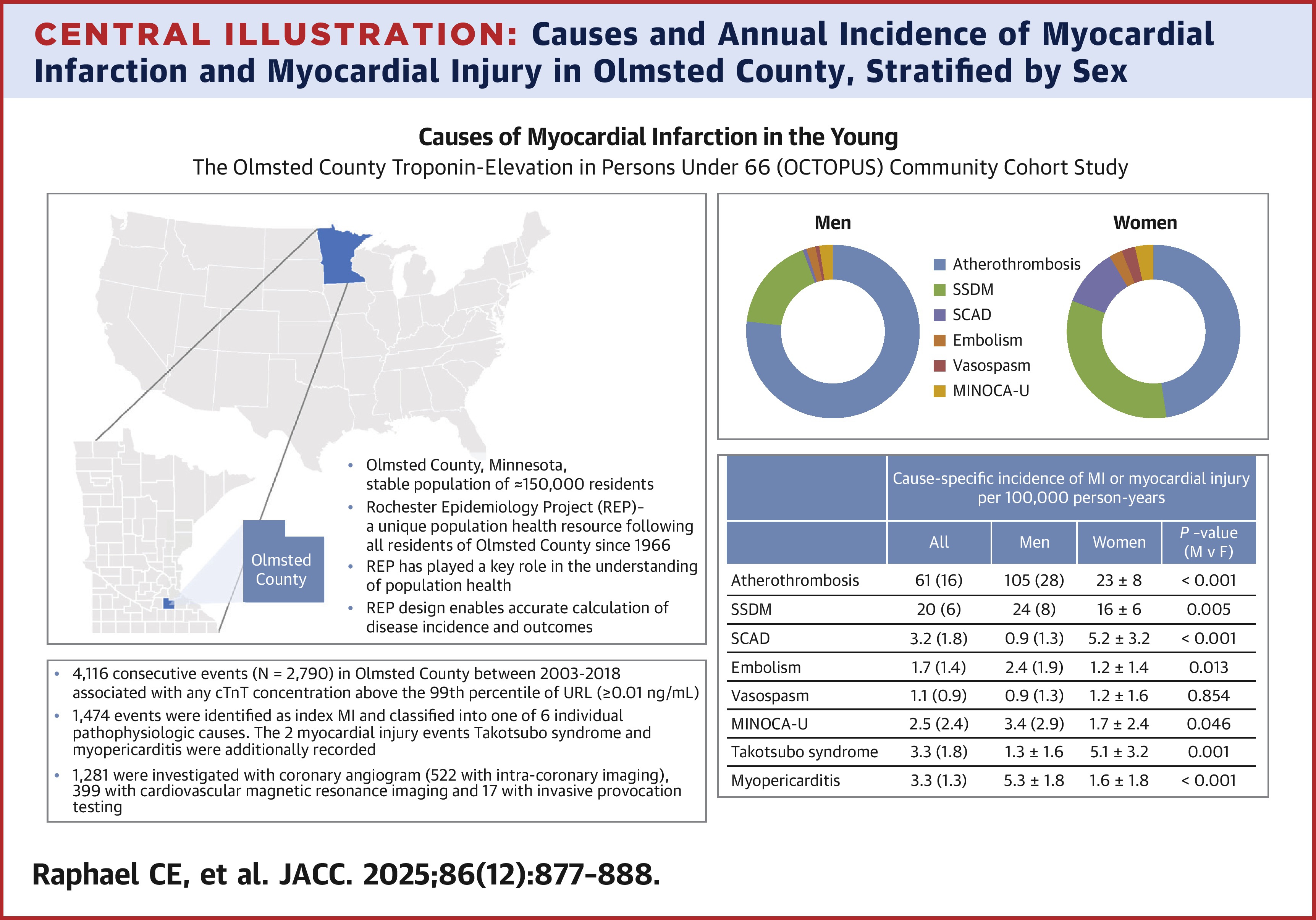
Women had lower incidence of MI in total compared to men (48 vs. 137 per 100,000 person-years), as well as MI specifically caused by atherothrombosis (23 vs. 105 per 100,000 person-years). Women who had atherothrombosis-caused MI were similar in age and disease severity to men but had a greater number of risk factors.
Women also had a higher incidence of all nonatherothrombotic causes, especially of SCAD (3.2 vs. 0.9 per 100,000 person-years). However, upon review, investigators found that 55% of SCAD cases were misclassified at index presentation as MINOCA-U or atherothrombosis.
Across the whole population, five-year all-cause and cardiovascular mortality were both highest after events that were classified as SSDM MI (33% and 8%) or takotsubo syndrome (26% and 7%).
In an accompanying editorial comment, Harmony R. Reynolds, MD, FACC, calls the study “a foundation for future research and focused clinical care” and “a major advance in our understanding of MI epidemiology in the young.” She writes that the results also prove the critical importance of angiographic review in the diagnosis of SCAD, pointing out the high incidence of misdiagnosis. “SCAD is treated differently from other types of MI, with conservative management preferred in most cases based on frequent early healing,” Reynolds adds. “Thus, initiatives are needed to improve accuracy of SCAD diagnosis by cardiologists.”
Clinical Topics: Heart Failure and Cardiomyopathies
Keywords: Troponin T, Takotsubo Cardiomyopathy, Embolism, Thrombosis
< Back to Listings


