Inaugural JACC Stats Report Reveals State of US CV Health
In an effort to clearly understand the state of cardiovascular health in the U.S., the inaugural JACC Cardiovascular Statistics 2026 report offers a comprehensive picture of the major cardiovascular risk factors and conditions that collectively account for the most deaths and disability across the country.
Drawing on nationally representative surveys, clinical registries, administrative claims and vital statistics, the report examines the top five risk factors of hypertension, diabetes, obesity, LDL cholesterol and smoking, along with the top five cardiovascular conditions, including coronary heart disease (CHD), acute myocardial infarction (AMI), heart failure (HF), peripheral artery disease (PAD) and stroke.
"JACC Cardiovascular Statistics 2026 reflects one of JACC's most important responsibilities: to help our community see clearly where we stand," said Rishi Wadhera, MD, MPP, a lead author of the report. "Progress in cardiovascular health has always depended on data – on our willingness to reflect the evidence clearly, to face uncomfortable truths, and to use evidence to guide action."
Key findings from the report include:
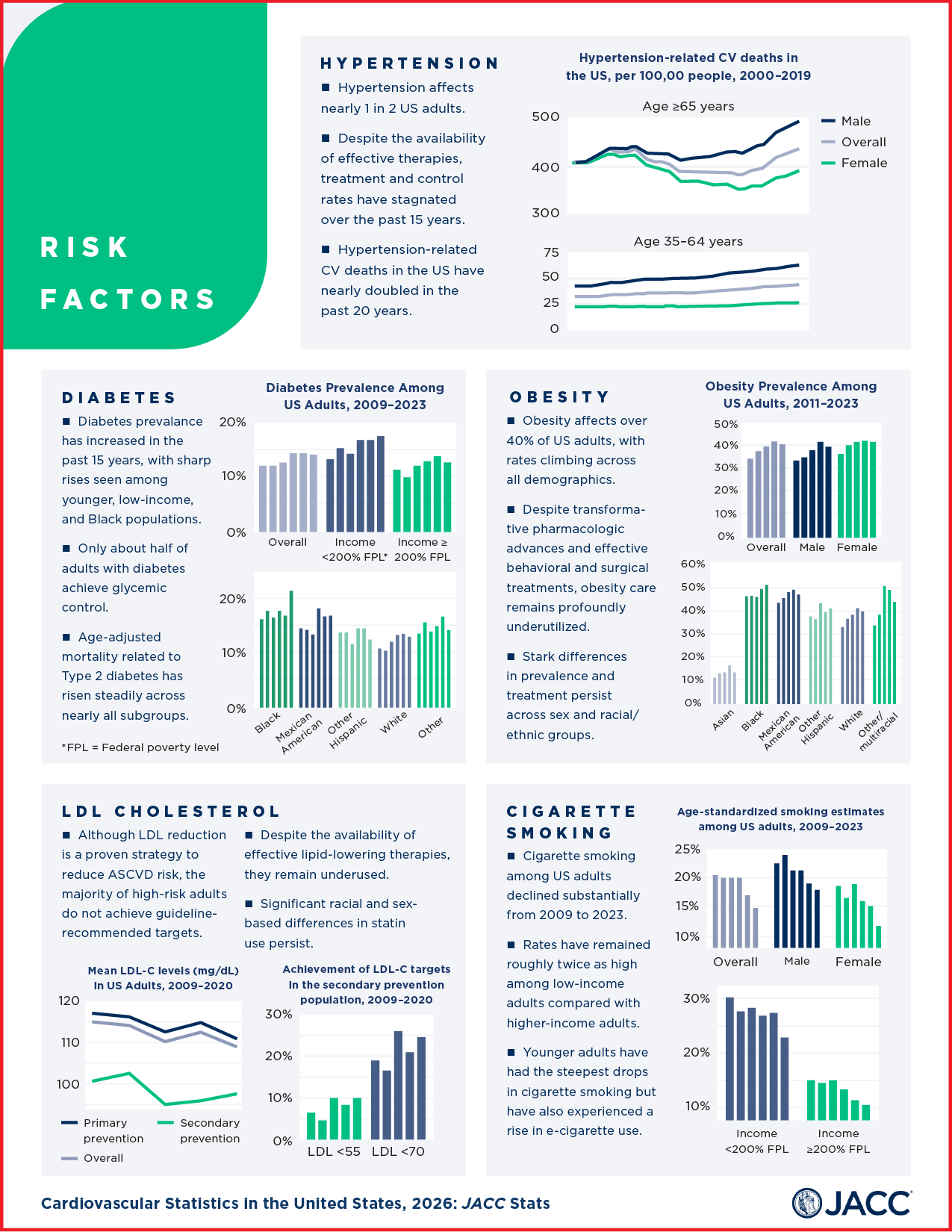
- Hypertension: Nearly 1 in 2 adults meet criteria for hypertension under current guidelines, yet treatment and control rates have stagnated for 15 years. Hypertension-related deaths have nearly doubled over two decades.
- Diabetes: Prevalence has risen sharply, especially among younger adults and low-income populations. Only half of adults achieve glycemic control, and mortality continues to climb.
- Obesity: Now affects 40% of adults, with profound disparities by race and ethnicity. Despite effective therapies, treatment remains underutilized.
- LDL Cholesterol: Fewer than 1 in 4 high-risk adults achieve guideline-recommended LDL targets. Statin use remains uneven, with striking racial and sex-based disparities.
- Smoking: Cigarette use has declined overall, but rates remain twice as high among low-income adults, and e-cigarette use is on the rise.
- Heart Disease & Stroke: Mortality from coronary artery disease fell by 50% since 2000, but recent reversals and widening inequities threaten these gains. Stroke mortality shows similar troubling trends.
According to the authors, persistent disparities by race, geography and socioeconomic status emerged as a central finding across all risk factors and conditions, underscoring urgent gaps in prevention and care. The report also highlights critical gaps where data are incomplete, pointing to opportunities for innovation, policy and discovery.
"If we want a healthier future, we must understand how far we have come, how far we have yet to go and what stands in our way," said Harlan M. Krumholz, MD, SM, FACC, Editor-in-Chief of JACC. "By putting data at the center of JACC's collective awareness, we aim to help the cardiovascular community, including clinicians, researchers, policymakers and the public, see the landscape clearly and chart a more effective path forward."
JACC plans to release a new report each year, providing a benchmark to assess advancement towards better cardiovascular outcomes, greater equity and stronger systems of care. The assessments will identify areas to expand the report's scope to include additional conditions and international populations. The report was led by Wadhera and Lesley H. Curtis, PhD, and will be part of a JACC print issue in March 2026 that will include a series of complementary JACC Data Reports examining key dimensions of cardiovascular health and health care, including access to care, diet, sleep, physical activity and related behavioral and social factors.
Clinical Topics: Dyslipidemia, Heart Failure and Cardiomyopathies, Prevention, Vascular Medicine, Atherosclerotic Disease (CAD/PAD), Lipid Metabolism, Nonstatins, Acute Heart Failure, Hypertension
Keywords: Cholesterol, LDL, Coronary Artery Disease, Myocardial Infarction, Peripheral Arterial Disease, Heart Failure, Hypertension, Diabetes Mellitus, Obesity, Stroke
< Back to Listings


