From the Member Sections | How Do the 2025-2030 Dietary Guidelines Measure Up For CV Health?
The Dietary Guidelines for Americans (DGA), released every five years by the U.S. Department of Health and Human Services and U.S. Department of Agriculture, are a major driver of U.S. food policy, diet quality and cardiovascular health. As in prior years, the 2025-2030 DGA1 were preceded by an evidentiary review compiled by a 2025 Dietary Guideline Advisory Committee (DGAC) of independent nutrition scientists.2 The final 2025-2030 DGA will be used by federal nutrition programs (including the National School Lunch Program; Special Supplemental Nutrition Program for Women, Infants, and Children [WIC]; and Supplemental Nutrition Assistance Program [SNAP]), as well as health care professionals, educators, policymakers, the food industry, media and the public. Given their reach, the DGA significantly influences dietary practices nationwide.
The Nutrition and Lifestyle Work Group of ACC's Prevention of Cardiovascular Disease Member Section reviewed the 2025-2030 DGA (available at dietaryguidelines.gov) and the 2025 DGAC report and summarized key points.
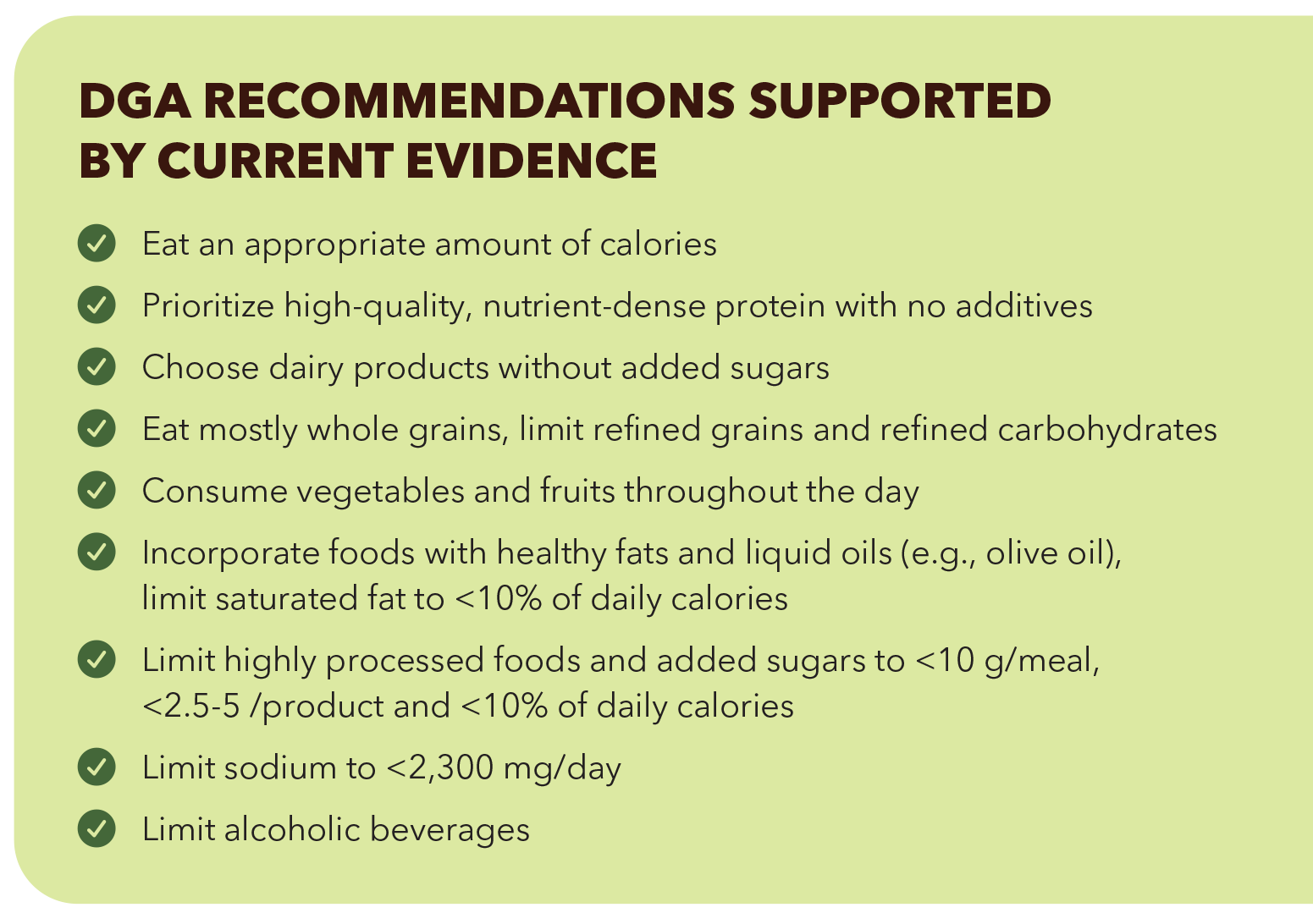
DGA Recommendations Supported By Current Evidence
- Eat an appropriate amount of calories
- Prioritize high-quality, nutrient-dense protein with no additives
- Choose dairy products without added sugars
- Eat mostly whole grains, limit refined grains and refined carbohydrates
- Consume vegetables and fruits throughout the day
- Incorporate foods with healthy fats and liquid oils (e.g., olive oil), limit saturated fat to <10% of daily calories
- Limit highly processed foods and added sugars to <10 g/meal, <2.5-5 /product and <10% of daily calories
- Limit sodium to <2,300 mg/day
- Limit alcoholic beverages
A Focus on the Diet-Driven Health Crisis
The 2025-2030 DGA emphasizes that most U.S. health care spending is devoted to chronic diseases, much of it diet related. Of U.S. adults, 70% have overweight or obesity, one in three has prediabetes and 45% of cardiometabolic deaths – from heart disease, stroke and diabetes – are linked to poor diet.3 Overconsumption of calorie-dense, nutrient-poor, ultra-processed foods high in added sugars and sodium plays a major role.3
The DGA confronts this crisis by identifying what should be removed (most added sugars, refined grains and highly processed foods) and what should be emphasized ("real foods"). The guidelines reinforce recommendations to prioritize fruits, vegetables and whole grains, while introducing new guidance on protein and fat intake.
New Protein Recommendations
The DGA recommend increasing protein intake to 1.2-1.6 g/kg/day, beyond the National Academy of Sciences Recommended Daily Allowance of 0.8 g/kg/day for adults under age 75, and a change not included in the 2025 DGAC recommendations.
They also encourage consuming a variety of protein foods, listing first and graphically displaying animal sources (red meat, eggs, poultry, whole milk, seafood) before plant-based sources (beans, lentils, peas, nuts, seeds, soy). However, evidence consistently shows that plant proteins are associated with better cardiovascular outcomes than red and processed meats,2 which are also linked to gut dysbiosis and inflammation, as well as diabetes and some cancers.4,5 These findings support emphasizing to patients the health benefits of plant proteins, as well as seafood and unsweetened dairy foods, over red and processed meats.
Saturated Fat and Fat Source Recommendations
The new DGA continue with recommendations to limit saturated fatty acids (SFA) to <10% of daily calories. They advise consuming "healthy fats" from red meat, whole-fat dairy, eggs, omega-3-rich seafood, nuts, seeds, olives, avocados and olive oil, with butter and beef tallow as options.
Some of these recommendations are not evidence-based and supported by science. Feeding trials and cohort studies show that butter and, to a lesser extent, beef tallow, raise LDL-C compared with olive oil, and that replacing healthier fats with butter increases total and cardiovascular mortality.6,7 Thus, evidence does not support promotion of butter or beef tallow. Regarding milk, cheese and yogurt, while cheese raises LDL-C compared to unsaturated fat sources these dairy foods have not been associated with higher cardiovascular risks,8 and may have potential benefits. However, increasing dairy fat and other animal fats will push SFA intake above the recommended limit of 10% of daily calories.
A New Food Graphic
The new DGA food graphic, intended as a symmetric triangle, may be misinterpreted as an inverted food pyramid. Animal protein foods appear prominently at the top alongside fruits and vegetables, potentially shifting perceptions toward an animal-protein–dominant diet. Legumes and nuts are visually de-emphasized and soy foods are absent. Without clear explanatory materials, this graphic may confuse the public.
Extensive evidence supports promoting dietary patterns high in unprocessed, fiber- and nutrient-dense plant foods, including vegetarian, whole-food plant-based, Mediterranean and DASH diets, for cardiovascular health, cancer prevention and longevity.9,10
Counseling Patients and Peers
The ACC Nutrition and Lifestyle Work Group encourages open discussions with patients and colleagues about both the strengths of the DGA and areas of uncertainty.
Rotating the food pyramid counterclockwise graphically emphasizes more whole, minimally processed plant foods. The "Healthy Eating Plate," available in 21 languages from the Harvard T.H. Chan School of Public Health,11 can also convey evidence-based foods and dietary patterns. Together, these approaches can help translate the DGA into meaningful improvements in cardiovascular health for patients and the population.
This article was authored by Monica Aggarwal, MD, FACC; Karen Aspry, MD, MS, FACC; Penny Kris-Etherton, PhD, RDN; Andrew Freeman, MD, FACC; Kim Allan Williams Sr., MD, MACC; and Eugenia Gianos, MD, FACC, all members of ACC's Nutrition and Lifestyle Work Group. Learn more and join.
References
- 2025-2030 Dietary Guidelines for Americans. Accessed Jan. 26, 2026. Available here.
- Scientific Report of the 2025 Dietary Guidelines Advisory Committee. Accessed Jan. 26, 2026. Available here.
- Micha R, Peñalvo JL, Cudhea F, Imamura F, Rehm CD, Mozaffarian D. Association between dietary factors and mortality from heart disease, stroke and diabetes in the U.S. JAMA Network. 2017;317(9):912-24
- Li C, Bishop TRP, Imamura F, et al. Meat consumption and incident type 2 diabetes: an individual-participant federated meta-analysis of 1·97 million adults with 100 000 incident cases from 31 cohorts in 20 countries. Lancet Diabetes Endocrinol. 2024;12(9):619-30.
- Farvid MS, Sidahmed E, Spence ND, et al. Consumption of red meat and processed meat and cancer incidence: a systematic review and meta-analysis of prospective studies. Eur J Epidemiol. 2021;36(9):937-51
- Kim Y, Je Y, Giovannucci EL. Association between dietary fat intake and mortality from all-causes, cardiovascular disease, and cancer: A systematic review and meta-analysis of prospective cohort studies. Clin Nutr. 2021;40(3):1060-70.
- Zhang Y, Chadaideh KS, Li Y, et al. Butter and plant-based oils intake and mortality. JAMA Intern Med. 2025;185(5):549-60.
- Kiesswetter E, Neuenschwander M, Stadelmaier J, et al., Substitution of dairy products and risk of death and cardiometabolic diseases: a systematic review and meta-analysis of prospective studies. Curr Dev Nutr. 2024;8(5):102159.
- Lichtenstein AH, Appel LJ, Vadiveloo M, et al. 2021 Dietary guidance to improve cardiovascular health: a scientific statement from the American Heart Association. Circulation. 2021;144(23):e472-e487.
- Shan Z, Wang F, Li Y, et al. Healthy eating patterns and risk of total mortality and cause-specific mortality. JAMA Intern Med. 2023;183:142-53.
- Healthy Eating Plate. Harvard T.H. Chan School of Public Health. Accessed Jan. 26, 2026. Available here.
Clinical Topics: Dyslipidemia, Prevention, Lipid Metabolism, Nonstatins, Diet
Keywords: Cardiology Magazine, ACC Publications, CM-Mar-2026, Cholesterol, LDL, Diet, Food, and Nutrition, Diet, Food, Guidelines as Topic, Health
