Feature | Moving Upstream: Why the Next Frontier of CV Prevention Begins in Childhood

For years, efforts to address cardiovascular disease have focused primarily on pharmaceuticals and medical procedures – statins, antihypertensives, catheterizations, stents and other devices. But what if we could reduce the need for many of those interventions by helping people build heart‑healthy habits early in life, long before disease takes hold?
That's the strategy behind the ACC's Fuster Prevention Forum, named after Valentin Fuster, MD, PhD, MACC, one of the world's leading cardiovascular prevention researchers and a longtime advocate of early-childhood interventions. During this three-year program, which kicks off in June 2026, the first cohort of 50 "Fuster Fellows" will participate in structured training and receive evidence-based educational materials with demonstrated success in primordial prevention. Once completed, these trained experts will return to their communities equipped with curriculum materials, digital content and practical toolkits to implement change.
"The Mission statement of the ACC is to transform cardiovascular care and improve heart health for all," says Pamela B. Morris, MD, FACC, Forum co-chair and professor of medicine at the Medical University of South Carolina. "But in reality, we spend a lot of our time focused on training clinicians to treat manifest cardiovascular disease. We spend very little time with the absolute basics of preventing risk factors from an early age."
Even preventive cardiology has historically focused on managing existing risk factors, such as elevated cholesterol or blood pressure (BP), rather than preventing their emergence, she notes.
"We are typically taking care of the tip of the pyramid," says Forum co-chair and former ACC President Edward T.A. Fry, MD, MACC. "The base of the pyramid is where we really need to be intervening."
Addressing cardiovascular disease earlier could dramatically reduce both disease burden and health care costs, according to several studies published over the last 10 to 15 years.
Primordial Prevention
Pathology, cohort and intervention studies confirm that atherosclerosis starts in childhood and is influenced by both genetic susceptibility and modifiable lifetime exposures.7-9 In addition, adverse conditions during pregnancy and early childhood such as poor maternal nutrition, gestational diabetes or physical inactivity may also program higher cardiometabolic risk in children, supporting a focus on antenatal and perinatal prevention.10
It's also important to note that childhood behaviors and risk factors track into adult life. Elevated BP, dyslipidemia, obesity and smoking in youth are associated with greater carotid intima-media thickness and coronary calcification in adulthood, markers of early atherosclerosis.7,9
Policy statements and reviews from major cardiovascular organizations, including the ACC, conclude that cardiovascular disease is largely preventable or mitigated through a combination of primordial and primary prevention, and that investments in early-life lifestyle and policy measures yield large societal returns by reducing future health care costs and improving productivity.9,11-13 Ultimately, this improves heart health for everyone, everywhere, as well as quality of life.
Access the ACC Clinical Guidance Hub for ACC guidelines along with clinician and patient resources.
For instance, in one study, infancy‑onset dietary counseling from seven months to 20 years, with follow‑up at 26 years, led to sustained benefits in all markers of cardiovascular risk compared to a control group.1
Another study found that individuals exposed to lower sugar intake during fetal development and early childhood had significantly lower rates of cardiovascular disease decades later, including reduced risk of heart failure, stroke and cardiovascular death.2
Recognizing the contribution of systolic BP and non–HDL-C to coronary heart disease (CHD) at a population level, other findings suggest a substantial effect with primordial prevention by lowering systolic BP to <130 mm Hg or lowering LDL-C by 30%, leading to an expected lowering of baseline 10-year CHD risk of 10.7% to 7.0% and 8.0% respectively (with absolute risk reductions of 3.7% and 2.7% respectively).3
Primordial prevention makes economic sense, as well.
Statements from the ACC and American Heart Association note that primordial prevention is a sound investment for the U.S. health care system.4 One study found that employees younger than 30 years old with good cardiovascular health had annual health care costs about $4,000 less than those with a poor cardiovascular health profile.5
However, less than 5% of total U.S. health care spending is allocated for preventive programs.6
"We spend twice as much as other industrialized countries and achieve worse outcomes because we focus on fixing the car after it's broken down rather than providing preventive maintenance," says Fry.
The need for primordial prevention is also driven by demographic and resource factors.
"We are in a health care workforce crisis," Fry says. "We simply will not have enough clinicians to treat the growing population with cardiovascular disease." Even advances in technology, including artificial intelligence (AI), will not fully close this gap. "Irrespective of what AI does, you're still going to need hands-on people," says Fry.
The Fuster Forum would mitigate some of the workforce issues by adopting a distributed, community-based approach rather than relying solely on centralized health care, with the goal of creating a cascading effect. "You teach the children, you teach the parents, and it becomes part of communities," says Morris. This is about creating sustainable programs that keep the process going."
Morris adds that early interest in the program is a sign the College is on the right track. "The program had far more enrollees than we had space. That is the first metric of success," she says. "It is even more important, given this is a passion-based activity and these are volunteers."
Going forward, future cohorts of 100 clinicians are planned. "As cardiologists and physicians, we have a responsibility to prevent the disease we are trained and incentivized to treat," says Fry. "At its core, primordial prevention means preventing cardiovascular risk factors before they ever develop. Heart disease starts in childhood and it's time to intervene at its earliest beginnings."
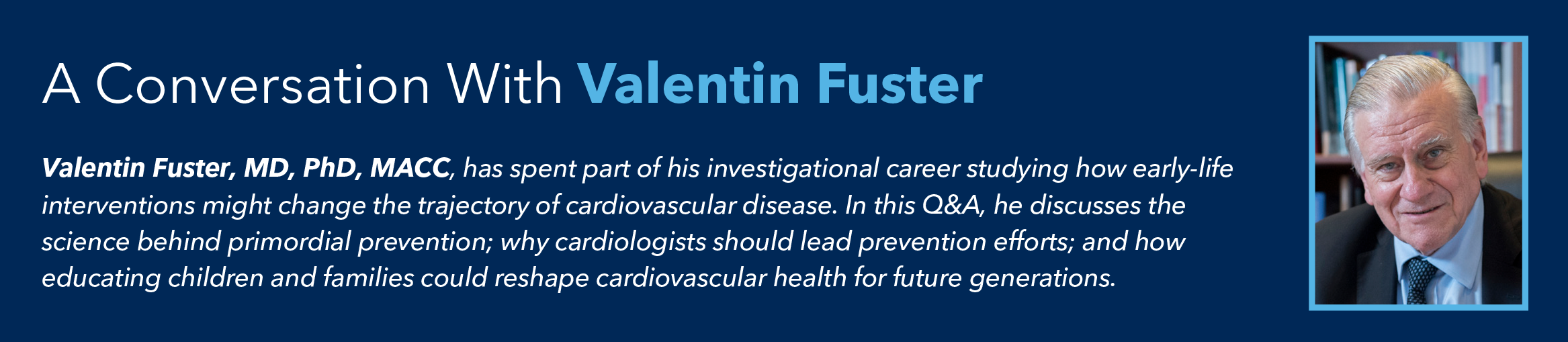
Why is primordial prevention so critical to reducing cardiovascular disease?
The reason is biological. In childhood, the brain has receptors that capture what you tell a child. As people grow older, those receptors increase in number and become interconnected, which makes concepts much more complex. In children, the connections are few, so whatever you tell a child is stored much more simply and stays for life.
The question we asked was whether this biological concept could be used to promote health – by conveying to children that health should be a priority in their lives. We have now worked with about 50,000 children around the world in randomized studies of early intervention programs; hopefully what we capture will stay for life.
Some might argue that prevention in childhood should fall to pediatricians or primary care physicians. Why do you think this is the job of cardiologists?
I'm not saying pediatricians or other health professionals shouldn't be involved. In the future, they certainly will. But cardiologists deal with cardiovascular disease, the number one cause of death in the U.S., every day, so we should set the example for prevention. If cardiologists take the lead, the health system can eventually capture the model and expand it through pediatricians, nurses and other professionals.
The Fuster Forum takes a broader approach than many traditional prevention programs. How and why is it different?
It's different in two important ways. First, we are dealing with children. Second, we involve the family – sometimes even grandparents.
When the whole family participates, the impact is much stronger.
Another innovation is engaging communities. We encourage cardiologists to participate in schools their children or grandchildren attend; to speak in community settings such as churches and others, and to engage families in clinic waiting areas with educational content and opportunities to participate in prevention programs. This approach allows us to connect with entire families rather than just individual patients.
Why do you believe society is ready now for this kind of prevention movement?
There is a growing trend toward prevention that did not exist before. In the past, the main concern was mortality – how long people lived. Now life expectancy has increased, and people are asking not just 'How long can I live?' but 'How well can I live?' That shift toward quality of life naturally leads to greater interest in prevention.
Prevention has been a theme throughout your career. How did this become your life's work?
I began by trying to understand heart attacks. My early work focused on platelets circulating in the blood and we found that platelets stick to vessel walls that contain cholesterol.
Over time, I realized that human behavior plays a key role in that process. My research moved from basic science to understanding behavior and risk factors.
I first worked on prevention in adults. Later I realized that if we really want to make a difference, we must start earlier – with children.
If these initiatives succeed, how might cardiovascular disease look different in 20 or 30 years?
I don't think the world will completely change; in terms of personal responsibility vs. the world of consumption. But I believe the balance will move more toward responsibility and prevention. If we educate children and families about health, even moving the pendulum a little can make a difference. We may not change everything, but contributing even an inch toward prevention can have a meaningful impact for future generations.
References
- Pahkala K, Laitinen T, Niinikoski H, et al. Effects of 20-year infancy-onset dietary counselling on cardiometabolic risk factors in the Special Turku Coronary Risk Factor Intervention Project (STRIP): 6-year post-intervention follow-up. The Lancet Child & Adolescent Health. 2020-05-01 2020;4 5:359-369. doi:10.1016/s2352-4642(20)30059-6
- Zheng J, Zhou Z, Huang J, et al. Exposure to sugar rationing in first 1000 days after conception and long term cardiovascular outcomes: natural experiment study. BMJ. 2025;391:e083890. doi:10.1136/bmj-2024-083890
- Pencina M, Navar A, Wojdyla D, et al. Quantifying importance of major risk factors for coronary heart disease. Circulation. 2018-12-07 2018;139:1603-1611. doi:10.1161/circulationaha.117.031855
- Nasir K, Keeley B, Krumholz HM. Living longer in good cardiovascular health. Circulation. 2017/05/02 2017;135(18):1702-1704. doi:10.1161/CIRCULATIONAHA.117.027960
- Osondu CU, Aneni EC, Valero-Elizondo J, et al. Favorable cardiovascular health is associated with lower health care expenditures and resource utilization in a large US employee population: The Baptist Health South Florida Employee Study. Mayo Clin Proc. Mar 13 2017;doi:10.1016/j.mayocp.2016.12.026
- Dieleman JL, Baral R, Birger M, et al. US spending on personal health care and public health, 1996-2013. JAMA. 2016;316(24):2627-2646. doi:10.1001/jama.2016.16885
- Morton K, Heindl B, Clarkson S, Bittner V. Primordial prevention of atherosclerotic cardiovascular disease. J Cardiopulm Rehabil Prev. 2022-11-01 2022;42:389-396. doi:10.1097/hcr.0000000000000748
- Gillman M. Primordial prevention of cardiovascular disease. Circulation. 2015;131 7:599-601. doi:10.1161/circulationaha.115.014849
- Hayman L. Prevention of atherosclerotic cardiovascular disease in childhood. Curr Cardiol Rep. 2020;22:1-7. doi:10.1007/s11886-020-01332-y
- D'Ascenzi F, Sciaccaluga C, Cameli M, et al. When should cardiovascular prevention begin? The importance of antenatal, perinatal and primordial prevention. European Journal of Preventive Cardiology. 2019-12-13 2019:2047487319893832. doi:10.1177/2047487319893832
- Ebrahimpour F, Esmaeili M, Nayeri N. Primordial prevention in cardiovascular diseases. J Qazvin University of Medical Sciences. 2018;doi:10.29252/qums.22.2.4
- Weintraub W, Daniels S, Burke L, et al. Value of primordial and primary prevention for cardiovascular disease: a policy statement from the American Heart Association. Circulation. 2011;124 8:967-990. doi:10.1161/cir.0b013e3182285a81
- Arnett DK, Blumenthal RS, Albert MA, et al. 2019 ACC/AHA guideline on the primary prevention of cardiovascular disease. JACC 2019;74:e177-e232.
Clinical Topics: Prevention
Keywords: Cardiology Magazine, ACC Publications, CM-Apr-2026, Heart Disease Risk Factors, Primary Prevention, Blood Pressure, Risk Factors, Cardiovascular Diseases, ACC Annual Scientific Session, ACC26
