Editors' Corner | The Ongoing Challenge of Tricuspid Regurgitation
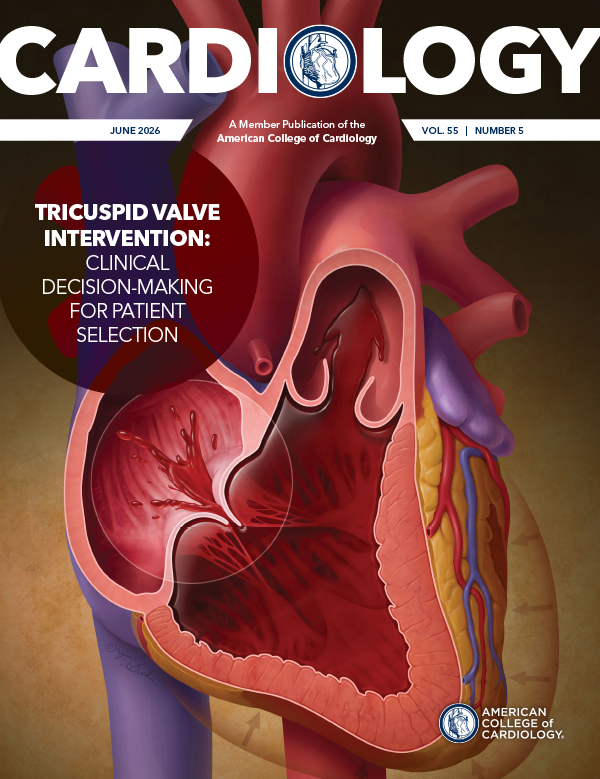
This month's cover story offers a practical, concise review of contemporary care for patients with tricuspid regurgitation (TR). It synthesizes key lessons from clinical trials that now guide decision-making for direct tricuspid valve interventions. Randomized transcatheter data show that tricuspid edge-to-edge repair can substantially reduce TR and improve symptoms and quality of life, while transcatheter tricuspid valve replacement can achieve more complete TR elimination in selected anatomies. It also underscores two clinical pearls. First, much of secondary TR is driven by left-sided disease, particularly mitral pathology. Second, TR is increasingly recognized as "atrial functional TR" in the setting of atrial fibrillation. As a bonus, the article includes a practical checklist suitable for posting in clinic, as well as educational resources and support for shared decision-making conversations with patients.
Our cover story emphasizes that careful longitudinal follow-up and early referral are essential to recognizing the often-subtle manifestations of TR, including fatigue, edema, ascites, and hepatic or renal congestion and cardiac cirrhosis, before advanced right-sided failure develops.
When TR is driven primarily by left-sided disease, treating significant mitral regurgitation (MR) is an important first step. After correction of MR, TR improves in slightly more than half of patients. Unfortunately, it persists in nearly the other half.1 When residual TR reflects structural changes of the tricuspid apparatus or the presence of a trans-tricuspid pacemaker or ICD lead, tricuspid intervention can be beneficial.
Yet TR is not always straightforward. Patients who undergo correction of MR but continue to have secondary TR are a challenge. Despite improved left atrial pressure, some have persistent pulmonary hypertension, progressive right ventricular (RV) dysfunction, tricuspid annular dilation as the RV enlarges, and worsening TR.
In this phenotype, the problem is not purely the tricuspid valve. Surgical or transcatheter annuloplasty, and even tricuspid replacement, cannot reverse advanced RV failure or fixed pulmonary vascular disease. In selected patients, tricuspid intervention may reduce congestion and improve quality of life, but abrupt reduction of severe TR as the RV loses its "blow-off" into the right atrium can unmask limited RV reserve. In such patients, mortality is driven by RV function, pulmonary vascular load, and the consequences of end-organ congestion. For structural heart disease, effective treatment of the pulmonary vasculature remains one of the last major therapeutic frontiers.

Don't miss our feature on device surveillance post approval, along with pieces reviewing current data on atherectomy devices, finerenone and more. As always, we welcome your thoughts at CardiologyEditor@acc.org.
Reference
- Saeed S, Smith J, Grigoryan K, et al. Impact of pulmonary hypertension on outcome in patients with moderate or severe tricuspid regurgitation. Open Heart. 2019;3;6(2): e001104.
Clinical Topics: Valvular Heart Disease, Mitral Regurgitation
Keywords: Cardiology Magazine, ACC Publications, CM-Jun-2026, Mitral Valve, Regurgitation, Mitral Valve Insufficiency, Tricuspid Valve Insufficiency, Tricuspid Valve
