Perspective | Beyond the Academic Medical Center: New Frontiers For Cardiologists

Historically, academic medical centers (AMCs) provided cardiologists with the greatest opportunities for extracurricular impact, including research opportunities with the National Institutes of Health (NIH), medical education with university professorship, and a myriad of exclusive career advancement engagements. The scholarly activities afforded by AMCs were perceived as more significant than similar academic activities conducted in community hospitals and private practices.
Nowadays, a cardiologist may not need to be affiliated with AMCs to meaningfully advance the field. Here we share our perspectives from working in an AMC and non-AMC.
Blurring Boundaries in Cardiology
The distinction between AMCs and non-AMCs in cardiology is rapidly fading. Many landmark clinical trials now receive substantial physician support and patient enrollment from non-AMCs. Community hospitals are increasingly establishing residency and fellowship programs, further dissolving the line between "academic" and "non-academic" institutions.
Looking forward, career choices in cardiology will hinge less on the practice label and more on factors such as workplace culture, institutional resources, opportunities for research, teaching and innovation, as well as personal considerations like family and lifestyle needs. Ultimately, the most important determinant of a fulfilling and sustainable career is organizational culture. Environments that foster collective inspiration over territorial aspirations – with trust, flexibility and support for diverse needs such as maternity/paternity leave, protected research time and professional development – tend to provide greater long-term employment satisfaction.
A particularly striking trend is the growing role of non-AMCs in advancing science. Many clinical trials are now designed and conducted outside AMCs, expanding patient access and generating rich datasets that fuel discovery. This evolution has opened the door for private-practice physicians to meaningfully contribute to scientific advancement – an opportunity once thought to be the exclusive domain of AMCs
This realization underscores an urgent need: professional societies must create more supportive environments for extracurricular impact across all practice settings. Smaller organizations should have access to shared infrastructure, digital platforms and AI-based tools that can lower barriers to participation. Incentives such as CME credit and MOC points for research activity can also encourage greater engagement, aligning professional development with practice requirements.
Systemic challenges also persist. Medicare reimbursement cuts threaten financial sustainability, contribute to physician burnout via increased workload, and reduce available time and resources available for innovation. This is why the advocacy, well-being and workforce efforts of the ACC and other professional societies are vital and deserve strong support.
Personal Reflections
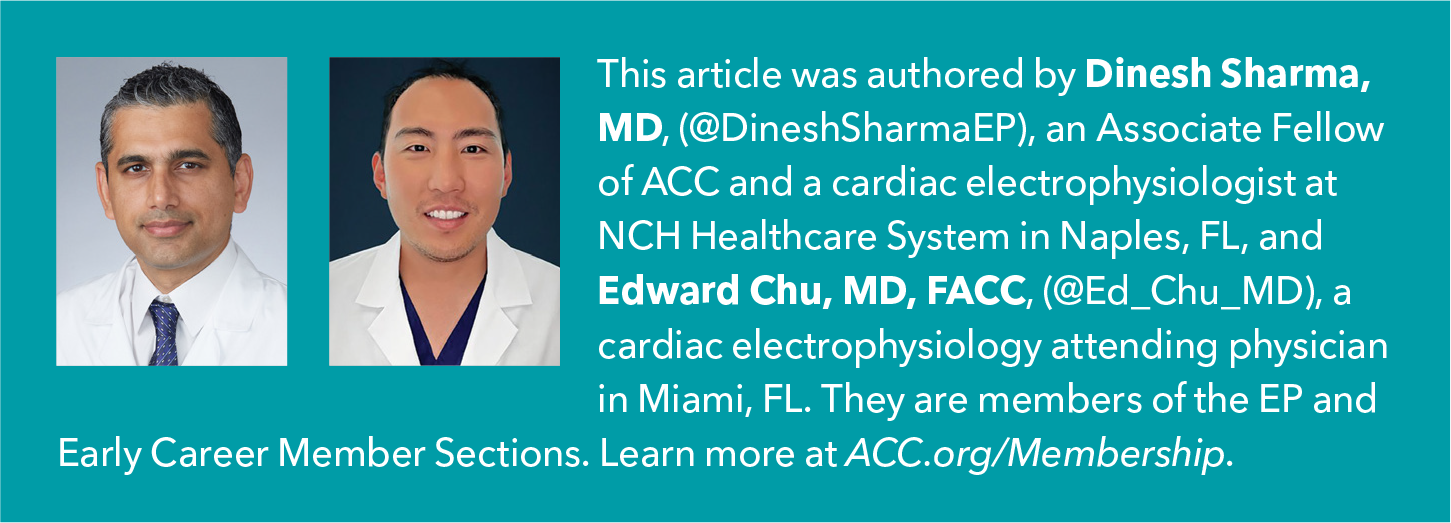
"I spent my entire medical training at AMCs and never envisioned myself working outside of one," says Chu. However, with employment opportunities scare for graduating fellows during the COVID-19 pandemic, he joined a private practice that has subsequently evolved into a private equity-owned practice.
"For many years I yearned for the academic opportunities that were no longer available to me, until I eventually discovered similar meaningful engagements through collaboration with community health care organizations, industry partners and professional societies such as the ACC," he says.
"Although I took the path less traveled as an early career cardiologist, I have slowly realized that it is possible to create academic impact where it is least expected."
Creating Impact Where Its Least Expected
Over time the differences between academic opportunities in different practice settings have diminished, driven by changes in financial, educational and political climate. AMCs may have an advantage in facilitating academic endeavors, but the cost of employment to participate in these activities is becoming increasingly prohibitive. Established cardiologists, the majority of whom are hospital employed, are experiencing high levels of burnout and early career cardiologists, who are part of the newer Millennial and Generation Z era, may value extracurricular impact differently than their predecessors.
Additionally, federally funded health care initiatives that are not aligned with current federal priorities, such as transgender care and health equity projects, have come under scrutiny. Similarly, funding for NIH-sponsored research has decreased. Health care institutions have begun to restrict protected time and shift physician compensation towards productivity-based models. At the same time, hospital-employed cardiologists are increasingly tasked with administrative assignments that are often time-consuming and noncontributory to productivity metrics.
Concurrently, industry-sponsored clinical trials remain robust and physician participation has become more dependent on patient enrollment potential than hospital affiliation. Medical residency and fellowship programs have expanded to community hospitals, offering private practice cardiologists' opportunities to participate in medical education. Professional societies such as the ACC have created curricula for leadership advancement, particularly at the early career and mid-career levels, available to all who are interested. Graduating cardiology fellows have become more aware of nontraditional employment models, such as in private equity, as they explore other avenues of achieving professional impact.
Final Thoughts
Cardiology stands at a crossroads. Physicians today have more options than ever to pursue meaningful work in diverse employment structures. The boundary between AMCs and non-AMCs continues to blur. Perhaps it is time to stop seeing these worlds as separate and instead embrace a shared mission: to advance science, deliver exceptional patient care, and sustain our profession through curiosity, innovation and collective dedication.
As the landscape of cardiovascular medicine evolves, we may come to realize that the pursuit of academic impact is not dependent on the institution, but on the individual.
Keywords: Cardiology Magazine, ACC Publications, CM-Jun-2026, Academic Medical Centers, Learning, Training Support, Education
